Estate planning is the process of arranging how your assets are managed and distributed if you die or become incapacitated. It reaches nearly every adult who owns a home, a car, savings, or has people who depend on them, not just the wealthy or elderly. This guide walks through the four core documents you need, the seven-step planning process, what it costs in 2026, why it matters even with modest assets, and the life events that should trigger an update.
Key Takeaways
- Estate planning arranges how your assets and affairs are managed if you die or become incapacitated, and applies to nearly every adult 18 and older.
- A complete plan rests on four documents: a will, a revocable trust, an advance healthcare directive, and a power of attorney.
- Beneficiary designations on IRAs, 401(k)s, and life insurance override your will and pass directly to the named person.
- Roughly half of Americans have no will, yet a will alone does not avoid probate.
- Probate can consume 3% to 7% of an estate’s value, take over a year, and become public record.
- A DIY online plan runs $50 to $300, while an attorney-drafted plan typically costs $1,000 to $3,000 or more.
- The 2026 federal estate and gift tax exemption is $15 million per individual, with a $19,000 annual gift exclusion per recipient.
What Is Estate Planning in Simple Terms?
Estate planning is arranging how your assets and affairs are managed and distributed if you die or become incapacitated. That second word matters. Incapacity, not only death, sits at the center of a real plan, because a stroke or accident can leave you unable to sign a check or approve a medical procedure while you are very much alive.
Your estate is simply everything you own minus what you owe. It includes your home, vehicles, bank and retirement accounts, investments, life insurance, and personal belongings, offset by debts like a mortgage or loans.
Estate planning vs. just writing a will
Writing a will is one task. Estate planning is the full picture that also covers medical directives, financial authority, and beneficiary designations. A will speaks only after death; a plan speaks the moment you cannot.
What counts as your ‘estate’
Estate planning applies to essentially every adult 18 and older who owns any assets or supports loved ones. Experts suggest starting early, often in your 20s or 30s, and adapting the plan at each life stage. You already have an estate, whether or not you have ever written a single legal document.
The 4 Core Estate Planning Documents You Need
Every complete estate plan is built on four documents: a will, a revocable trust, an advance health care directive (living will), and a power of attorney. Each controls a different slice of your money, your care, or your family.
The four documents at the foundation of a complete estate plan.
Will: distributing assets and naming guardians
A last will and testament directs how your property is distributed and lets you name a guardian for minor children. Guardianship is often the single most important reason young parents plan at all. A guardian handles care and custody, while a separate conservator (guardian of the estate) may be needed to manage assets a child inherits; the age at which children receive property is state-set, generally 18 or 21.
Trust: avoiding probate
A revocable living trust holds assets you transfer into it during life so they pass to beneficiaries faster, privately, and outside the public, costly probate process. Because the trust is a separate legal entity, those assets are excluded from the probate estate. With an irrevocable trust, by contrast, the grantor gives up control and legal title of the transferred assets.
Power of Attorney (financial and healthcare)
A financial power of attorney can take effect immediately or be springing, meaning it activates only on incapacity. A healthcare proxy grants authority over medical decisions only and should be durable so it survives your incapacity.
Advance healthcare directive / living will
An advance healthcare directive, often called a living will, records your wishes for end-of-life care and life support so loved ones and doctors are not left guessing.
Will vs. Estate Planning: What’s the Difference?
A will is one document inside estate planning; the plan is the broader process covering incapacity, taxes, trusts, and beneficiary forms. A will typically only distributes property and names guardians, while a full plan can help heirs pay substantially less in taxes, fees, and court costs.
Why a will is not enough
A will alone does not avoid probate. Most wills still pass through the court process; a will can organize and simplify it, but bypassing probate requires tools like trusts or joint-title and beneficiary arrangements. Relying on a will only leaves your estate exposed to delay and public record.
Beneficiary designations that override your will
Beneficiary designations override a will. Retirement accounts like IRAs, life insurance, transfer-on-death brokerage accounts, and payable-on-death bank accounts pass directly to the named person on the filed form, bypassing both probate and your will entirely. If your ex-spouse is still listed on an old 401(k), that form wins, no matter what your will says. Reviewing these forms is the fastest, cheapest planning move most people overlook.
The 7 Steps in the Estate Planning Process
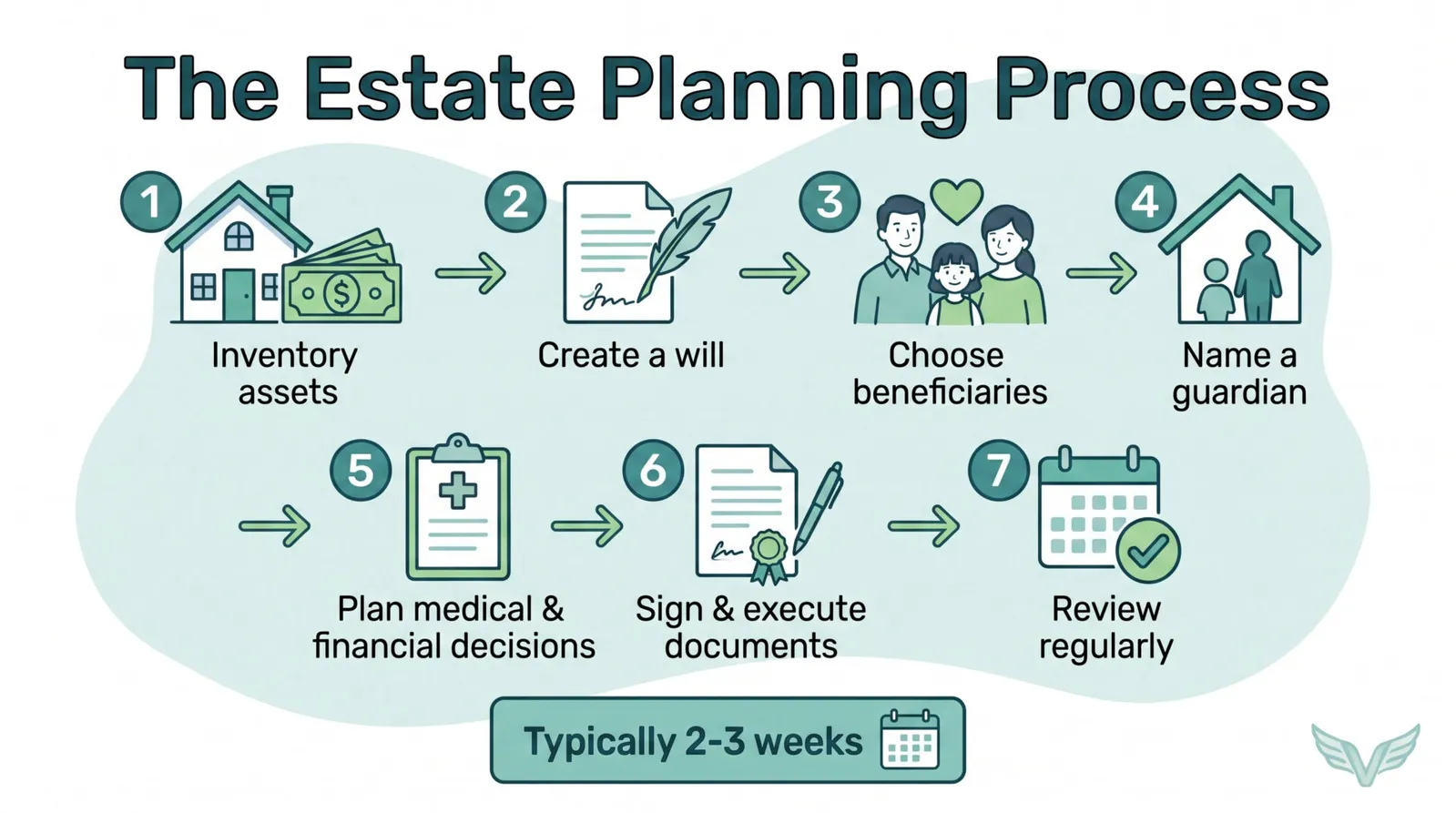
The estate planning process follows seven steps: draft a list of your assets, create a will, choose beneficiaries, name a guardian for young children, plan for medical and financial decisions, sign and execute the documents, then review regularly. Most people finish in a few weeks.
Steps 1-3: inventory, goals, beneficiaries
Start by gathering statements, deeds, titles, and existing beneficiary forms, then define who inherits what. Talk with family about who manages money, who raises the children, and who acts as executor. These conversations often surface decisions people had never named out loud.
Steps 4-7: documents, fiduciaries, execution, review
Next you select documents, name fiduciaries like an executor and trustee, then sign and store everything properly. Most states require two disinterested adult witnesses to sign a will, and notarization generally does not replace those witnesses. A revocable trust in many states need not be witnessed or notarized to take effect.
How long does estate planning take
A tailored estate plan generally takes about 2 to 3 weeks once you provide the needed information. Simple documents can be same-day to one week, while complex, trust-based planning runs 3 to 6 weeks or more.
Why Estate Planning Matters (Even If You Think You Don’t Need It)
Estate planning is not just for the wealthy or elderly. Without a plan, state intestacy laws decide who inherits and who raises your children, often causing delay, cost, and family conflict. Roughly half of Americans have no will, and even fewer have a full plan, making it one of the most neglected parts of financial planning.
What happens if you die without a plan (intestate)
Dying intestate hands the decision to state default rules. A common pattern: with no surviving spouse or children, the estate passes to parents, then siblings, then nieces, nephews, and extended relatives, and a spouse’s share varies by state and by separate versus community property rules. Strangers to your wishes, following a rigid formula, distribute what you built.
Estate planning for young adults, single people, and no-asset situations
Even with estate planning with no assets, a healthcare proxy and power of attorney still protect you if you are hospitalized. Single adults and young professionals need someone legally empowered to act, which is why estate planning for young adults is less about wealth and more about authority and medical wishes.
Disadvantages and costs of estate planning
The main drawbacks are cost, time, and the effort of upkeep. Probate itself, though, is the stronger argument for planning: attorney fees and court costs can consume 3% to 7% of an estate’s value, an average uncontested probate can take longer than a year, and probate records are public. Planning trades a modest upfront effort for privacy and speed.
Cost, DIY Options, and When to Hire an Estate Planning Attorney
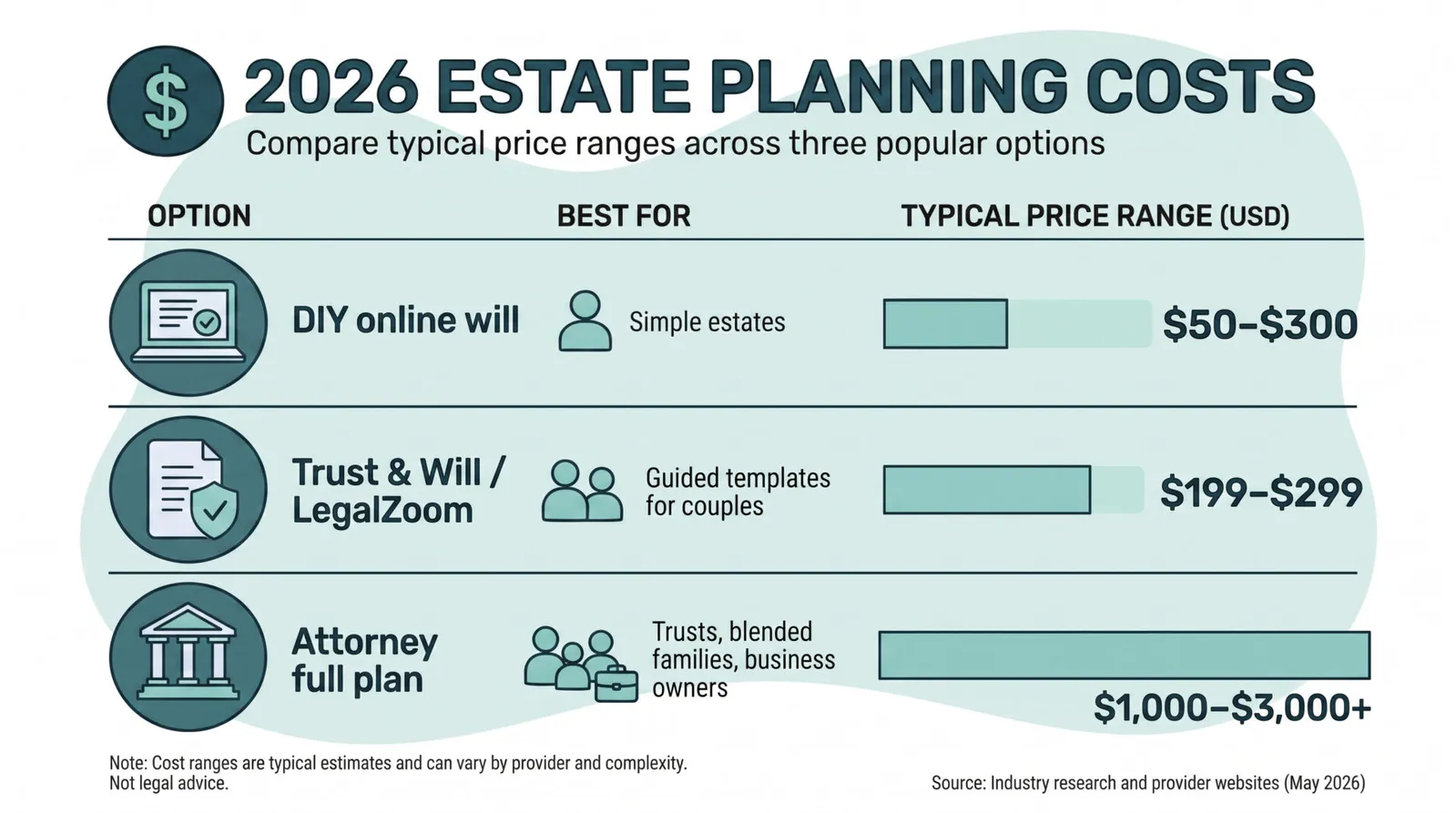
A basic DIY estate plan can cost under $200 online, while an attorney-drafted plan typically runs $1,000 to $3,000 or more. Complex situations, such as business owners, blended families, and taxable estates, warrant a professional.
Sources: NCOA, Northwestern Mutual, provider pricing 2026.
How much does estate planning cost
Online will makers generally start at $50 to $150. Named providers include Trust & Will at about $199 for an individual will and $299 for a couple, and LegalZoom premium tiers near $249. Attorney pricing scales with complexity: a simple will often runs $250 to $1,500, a living trust package $1,000 to $4,000, and a full attorney-drafted plan commonly $1,500 to $2,500.
| Option | Typical 2026 cost | Best for |
|---|---|---|
| DIY online will | $50-$300 | Simple estates, single filers |
| Trust & Will / LegalZoom | $199-$299 | Guided templates, couples |
| Attorney full plan | $1,000-$3,000+ | Trusts, blended families, business owners |
Estate planning without a lawyer
DIY tools cover basic documents only and may not comply with every state requirement. They fit uncomplicated situations but leave gaps for anyone with unusual assets or family structures.
What an estate planning attorney does
An estate planning attorney prepares wills, sets up powers of attorney and trusts, identifies ways to avoid probate, and coordinates with tax pros and financial advisors to reduce estate-tax burdens.
Special Situations and When to Update Your Estate Plan
Estate plans are not one-time documents. Life events like marriage, divorce, a new child, a new business, or a move should trigger updates. Blended families, digital assets, and taxes each need tailored strategies.
When to update (marriage, divorce, birth, death)
After a divorce, removing an ex-spouse as beneficiary is urgent, because that filed form still controls the account. Each major life event is a prompt to re-check documents and designations.
Blended families, business owners, and digital assets
Blended families may want to protect a biological family’s inheritance, and a special-needs beneficiary can be provided for through a trust structured so they still qualify for public assistance like SSDI. Digital assets in estate planning, including crypto and online accounts, should be named explicitly so heirs can find and access them.
Basic tax considerations (estate tax, step-up in basis)
The 2026 federal estate and gift tax exemption is $15 million per individual, confirmed by the IRS. The annual gift tax exclusion is $19,000 per recipient, or $38,000 for spouses splitting gifts, with a $194,000 limit for gifts to a non-citizen spouse. State estate and inheritance taxes carry much lower thresholds that real estate, retirement assets, and life insurance easily cross, so estates well under the federal exemption can still owe state tax.
Estate Planning Made Practical: 3 Things Most People Get Wrong Before They Start
After mapping the documents, steps, and costs, three mistakes stand out. First, people treat a will as the whole plan, forgetting that beneficiary designations override it. Second, they never update those forms after a divorce or birth. Third, they assume they have too little to plan, when a healthcare proxy and power of attorney protect anyone, regardless of net worth. Start small: inventory your assets, name your beneficiaries, and draft the four core documents. Escalate to an attorney once a trust, a business, or a blended family enters the picture.
Quick Answers to 6 Questions Readers Ask Most
What is estate planning in simple terms?
Estate planning is arranging how your assets and affairs are managed and distributed if you die or become incapacitated. It covers your property, your medical wishes, and who has authority to act for you. It applies to nearly every adult with assets or dependents, not only the wealthy.
What’s the difference between a will and estate planning?
A will is one document that distributes property and names guardians. Estate planning is the broader process that also handles incapacity, taxes, trusts, and beneficiary designations. A will alone still goes through probate, while a full plan can reduce court costs and pass some assets directly to beneficiaries.
What are the 7 steps in the estate planning process?
The seven steps are: list your assets, create a will, choose beneficiaries, name a guardian for young children, plan for medical and financial decisions, sign and execute the documents, and review regularly. Most people complete a tailored plan in about two to three weeks.
What are the disadvantages of estate planning?
The main disadvantages are upfront cost, the time to prepare documents, and the need to keep the plan updated after life events. These are modest next to the alternative: probate can consume 3% to 7% of an estate’s value, take over a year, and become public record.
How much does an estate plan cost in 2026?
A DIY online plan generally costs $50 to $300, with providers like Trust & Will around $199 to $299. An attorney-drafted plan typically runs $1,000 to $3,000 or more, depending on trusts and complexity. Business owners and blended families usually justify the higher professional cost.
Do I need an estate planning attorney or can I do it myself?
DIY tools work for simple estates but cover basic documents only and may not meet every state rule. Hire an attorney if you own a business, have a blended family, hold a taxable estate, or need a trust. An attorney also coordinates tax and probate-avoidance strategies.
Sources
- metlife.com/stories/legal/steps-to-prepare-for-meeting-estate-planning-attorney – MetLife: definition of estate planning, prep steps, and what an estate planning attorney does
- findlaw.com/estate/planning-an-estate/intestate-succession-laws-by-state.html – FindLaw: intestate succession laws and default distribution by state
- irs.gov/faqs/interest-dividends-other-types-of-income/gifts-inheritances/gifts-inheritances-1 – IRS FAQ: annual gift tax exclusion per recipient
This article is for informational purposes only and does not constitute legal advice. U.S. law is complex and varies by state and circumstance. For your specific situation, consult a licensed attorney.