Your Will, done this afternoon.
And legally real.
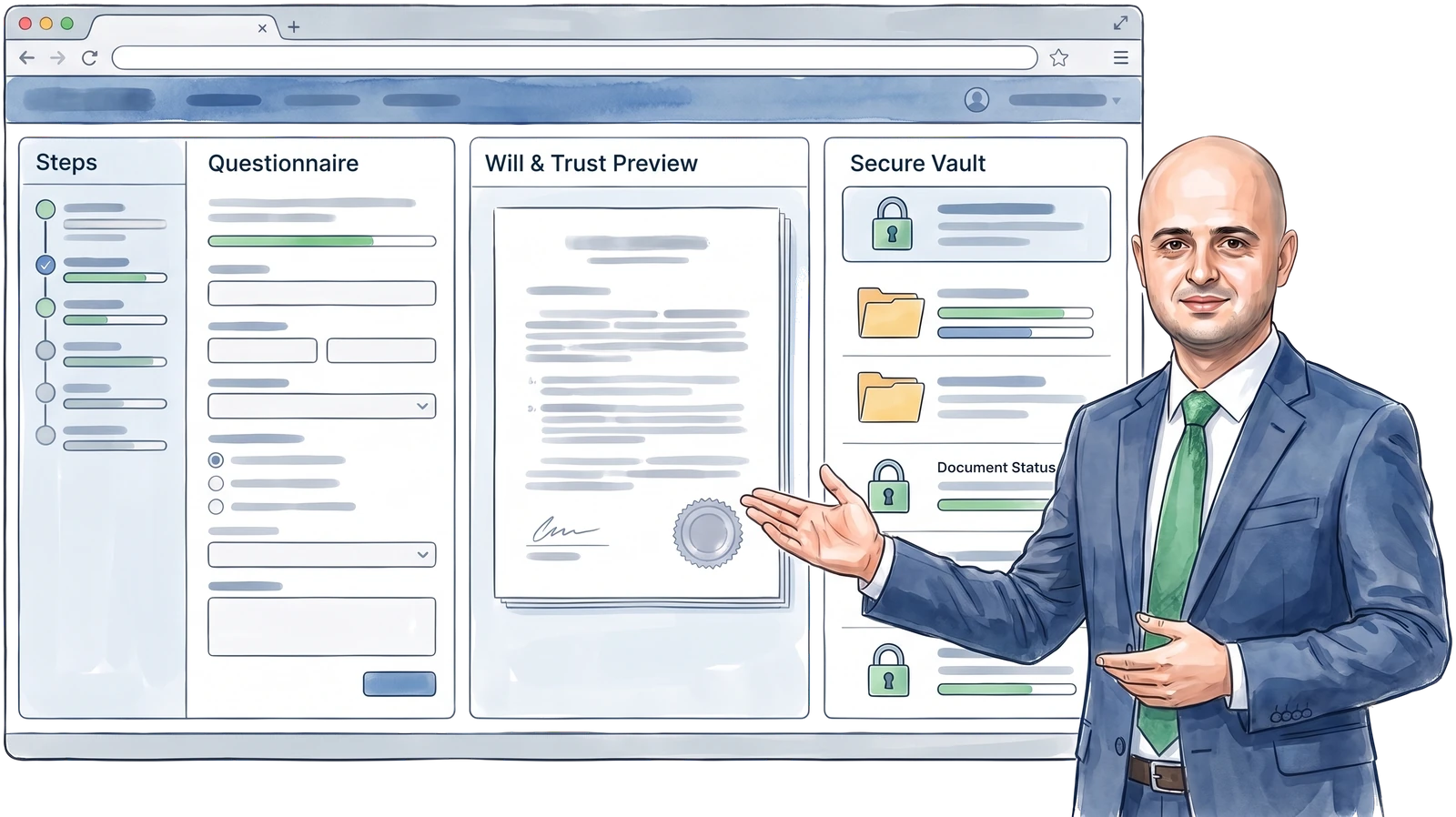
Skip the law office. You answer questions about your family and what you own. We draft the documents, then a licensed notary signs and seals them with you over video.
A licensed notary partner runs the signing. Nothing is final until you read every document and approve it.
Pick the plan that fits your estate.
A Will directs who gets what. A Trust does that and keeps your family out of probate court. Every document below comes with the plan, so here is exactly what each one does.
Will plan
For families who want their wishes on record without the cost of a Trust.
Priced separately: online notarization, $75 for one person or $100 for a couple. Document updates are free for 30 days; unlimited edits after that are a one-time $39.
- Last Will & TestamentNames who inherits what, and who carries out your wishes.
- Advance Care Directive (Living Will)Spells out the medical care you want if you can’t speak for yourself.
- Power of AttorneyLets someone you name handle money and property if you can’t.
- HIPAA AuthorizationLets your doctors share your records with the people you choose.
Talk to a real person before you start. Ask what a Trust would actually change for your family, or what the whole thing costs end to end.
Or email [email protected]
Trust plan
For homeowners and anyone who wants assets to pass without a court process.
Priced separately: online notarization, $80 for one person or $115 for a couple. Moving a property into the Trust is optional and costs $399 plus your county’s recording fee. Document updates are free for 30 days; unlimited edits after that are a one-time $39.
- Revocable Living TrustHolds your assets so they pass to your heirs without going through probate.
- Advance Care DirectiveSpells out the medical care you want if you can’t speak for yourself.
- Power of AttorneyLets someone you name handle money and property if you can’t.
- HIPAA AuthorizationLets your doctors share your records with the people you choose.
- Schedule of AssetsLists what the Trust owns, from bank accounts to the house.
- Funding InstructionsWalk you through moving each asset into the Trust, one at a time.
- Certification of TrustProves the Trust exists to banks without handing over the full document.
- Pour-Over WillCatches anything you left out and moves it into the Trust.
Not sure which one fits? The first few questions sort it out, and you can switch plans any time before you pay.
Four steps, and one honest handoff.
You answer, you review, you sign, you receive. The signing runs with a licensed notary partner, then drops you straight back into your account. Nothing happens off to the side without you.
Answer the questions
Plain-English questions about your family, your property, and who you trust. No legal terms to decode.
Review your documents
Read every document we draft, in full, and change anything before you move on.
Sign with an online notary
You confirm your identity and meet a commissioned notary on video. This step runs with our licensed notary partner. Once you sign, you come right back here.
Get your sealed PDFs
Signed, notarized, and sealed documents land in your account. Download them, print them, share them.
Signing and property, in plain terms.
Two things people worry about most: is an online signature real, and what happens to the house. Here is exactly how each one works.
Remote online notarization
- Confirm who you are. Your photo ID is scanned and checked online, plus a few knowledge-based questions to prove it is really you.
- Meet the notary on video. A live session with a commissioned notary who watches you sign. It usually takes 10 to 15 minutes.
- Witnesses come with the session. Every signing includes witnesses, so you are not calling round asking neighbours to show up.
- Receive a sealed PDF. Digitally signed and sealed, with the notary’s certificate attached.
Moving a property into your Trust
For Trust customers, the deed that moves your home into the Trust is drawn up by a legal team, reviewed by a licensed real estate attorney, and filed with your county recorder.
Preparation usually takes 4 to 12 hours. Most transfers finish within 2 to 4 weeks, depending on how fast your county records. The filing is confirmed back to your account, so the house actually sits inside the Trust and not just on paper.
This is a separate service: $399 plus your county’s recording fee.
One step happens in person. Your estate documents, the will, the trust, the power of attorney, are all notarized online over video. The property deed is the one exception: recording rules require a physical signature, so that page you sign with a local notary before it is filed.

Life changes. Your documents keep up.
Edit whenever something shifts
A marriage, a new child, a house, a move to another state. Open your plan, change what changed, and re-sign only what needs it.
Share with the people who need it
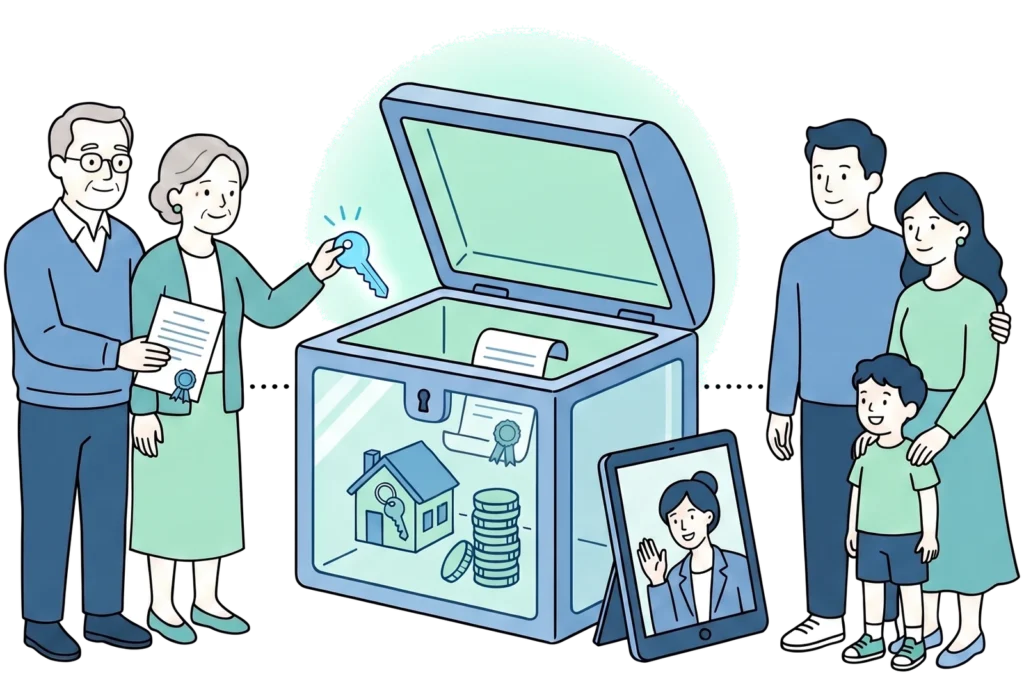
Give family members and trusted contacts access to what they should see. You decide who, and how much.
Updates are free for the first 30 days. After that, unlimited edits for life are a one-time $39, so a change of mind never turns into a new bill each time.
Offer estate planning under your own name.
Give clients a co-branded subdomain or a referral link, then watch each plan move through your dashboard. You send invitations and free quotes; we handle the documents and the notary.
Financial advisors · Insurance agents · CPAs · Estate planners
Straight answers, before you start.
Will or Trust: which one do I need?
A Will directs who gets what and names a guardian for minor children. A Trust does that too, and it keeps your estate out of probate, which can save your family months of court. If you own a home or want privacy, most people lean toward the Trust. The first few questions help you decide.
Will this hold up in my state?
Your documents are generated to meet the requirements of the state you live in, and the notarization is performed by a notary commissioned in a state that allows online sessions. You sign the version built for where you are.
How long does it actually take?
Most people finish the questions and review in a single afternoon. The notary session is booked separately and usually runs 10 to 15 minutes.
If you are moving a property into a Trust, the deed itself is drawn up within 4 to 12 hours, and most filings are complete within 2 to 4 weeks, depending on how fast your county records.
Is a lawyer involved?
Not for the drafting itself. You answer the questions and the documents are generated from templates that were written and reviewed by attorneys to meet the rules in your state.
Where a lawyer does step in: the deed that moves a property into your Trust is reviewed by a licensed real estate attorney before it is filed. And if your situation is complicated enough that a template is the wrong tool, we say so and point you to an attorney in your state.

Can I change my documents later?
Yes. Open your plan whenever life changes, edit what changed, and re-sign only the documents that need it. Your account always holds the current versions.
How does moving my house into a Trust work?
For Trust customers, the deed is prepared and filed with your county recorder, then confirmed back to your account. That filing is what actually places the home inside the Trust, not just naming it in a document.
What does it cost?
The Will plan is $199 for one person and $249 for a couple. The Trust plan is $499 for one person and $599 for a couple. That is a one-time price for the documents themselves.
Two things are priced separately, and you see them before you pay. Online notarization is $75 or $100 on the Will plan, and $80 or $115 on the Trust plan, depending on whether it is one person or a couple. Moving a property into your Trust is $399 plus whatever your county charges to record the deed.
Document updates are free for the first 30 days. Unlimited edits after that are a one-time $39.
Start your plan this afternoon.
Answer the first questions for free. You only pay when you’re ready to generate your documents and sign them.