
Estate Planning Checklist: Twelve Questions and What You Are Missing
Every estate planning checklist you can find is a list you read and then put down. This one answers back.
Twelve questions, each a yes or a no. At the end you get a score out of 100 and, more usefully, a list of the specific things you are missing, heaviest first. It takes about two minutes and it does not ask for your email.
Nothing is saved and nothing is sent anywhere. Your answers stay in your browser.
How ready is your estate plan?
Answer honestly rather than optimistically. A no is more useful to you than a hopeful yes.
Readiness score
Nothing answered yet.
What is missing
- Answer the questions above and anything missing turns up here.
Written in your browser. Nothing is uploaded and no copy is kept here.
This hypothetical example is used for illustrative purposes only. Actual results will vary.
This information is not intended as tax, legal, investment, or retirement advice or recommendations, and it may not be relied on for the purpose of avoiding any federal tax penalties. You are encouraged to seek guidance from an independent tax or legal professional. The content is derived from sources believed to be accurate.
The score is a summary of the twelve questions above and nothing more. It does not know your state, your family or your paperwork, and a high score is not a substitute for reading what you actually signed.
How the score is worked out
Each question is worth one, two or three points, and the weighting is the only judgement in the whole thing, so it is written here rather than hidden.
- Three points go to the questions that leave a family genuinely stuck: no will or trust, no guardian, nobody able to act on your money or your medical care, a plan that has not been read since the family changed, stale beneficiary forms, a trust nobody funded.
- Two points go to the ones that turn a bad week into a long one: no HIPAA authorization, nobody told they were named, nobody able to find the documents, no list of what exists.
- One point goes to the online accounts question, because it is the newest and the least understood, not because it matters least.
Two questions can be answered not applicable, and when they are they drop out of the total entirely. Marking somebody down for having no children, or no trust, would be arithmetic pretending to be rigour.
The five documents a checklist keeps asking about
- A will or a living trust. Who inherits what. A trust adds the ability to hand it over without a court in the middle.
- A durable power of attorney for finances. Who pays your bills and manages your money if you are alive and cannot act. This is the one people are most surprised to need.
- A health care directive. Who decides your medical care, and what you want when nobody can ask you.
- A HIPAA authorization. The permission that lets the people you named actually see your records. Without it, a directive can be met with a polite refusal.
- Your beneficiary designations. Not a document you sign at a desk, but a form at every bank and insurer, and the one that quietly overrules your will.
The first four are documents. The fifth is a habit, and it is the one that goes wrong most often, because a beneficiary form takes ninety seconds to fix and nobody schedules ninety seconds.
A plan goes out of date without anything happening to it
The documents do not expire. The facts around them move.
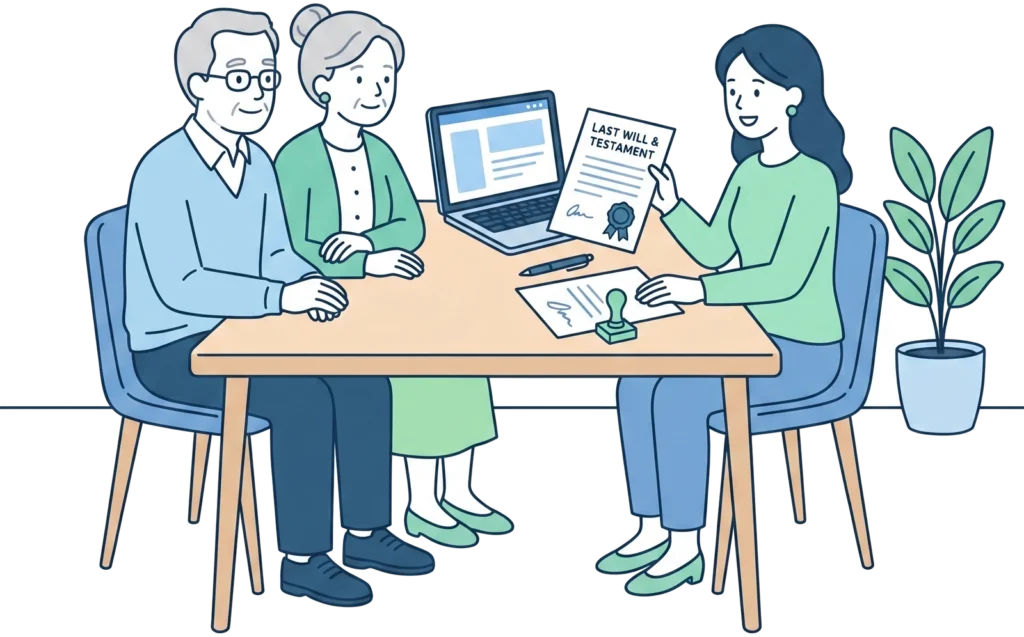
An estate plan review is not a rewrite. It is an hour spent checking that the names still make sense: the executor who has since moved three states away, the guardian who is now the age you were when you named them, the beneficiary form filled in before a divorce, the trust that was signed and then never funded.
The trigger is not the calendar. It is any of these, and the review belongs in the same month as the event rather than the same decade:
- a marriage or a divorce, yours or your children
- a birth, an adoption, or a death in the family
- a move to another state, because the rules that finish the job are the ones where the estate is settled
- buying or selling a house, or opening an account large enough to matter
- a serious diagnosis, yours or the person you named to act
If any of those happened and the plan has not been opened since, the questions above will find it.
Questions people ask about the checklist
What is a good score?
There is no threshold that makes you safe. The score is a summary of twelve answers, and the useful part is the list underneath it. One missing item at three points does more damage than four missing at one.
Why do some questions count for more?
Because the consequences are not equal. A missing guardian and a missing account list are both gaps, but only one of them ends up in front of a judge.
I have a trust. Why is there a question about funding it?
Because signing a trust and filling it are two separate jobs, and the second one is skipped constantly. An unfunded trust holds nothing, so the estate it was built to keep out of court goes to court anyway.
Do I need all five documents?
Most adults benefit from the four that get signed, and everybody with an account or a policy has beneficiary forms whether they think about them or not. Whether a trust earns its keep depends on what you own and where.
Is anything I type here saved?
No. The questions run in your browser, there is no account to make and no email field. Reload the page and it is gone.