
Estate planning for blended families comes down to reconciling protection for a current spouse with the inheritance rights of children from prior relationships, and default intestacy rules almost always diverge from real intentions. This is general legal information based on principles in force in the U.S., not advice, and the rules differ significantly between states. Below we cover who inherits without a plan, which tools genuinely protect both sides, and how to avoid common mistakes and family conflicts.
In short
-
Without a valid will, state law (intestacy) divides the estate between the spouse and biological descendants, often leaving out your own children.
-
Stepchildren usually do not inherit unless they were legally adopted or expressly named in the documents.
-
Leaving the entire estate outright to your spouse does not guarantee that it will ultimately reach children from a prior relationship.
-
Five tools carry the weight of planning: a will, a revocable living trust, a QTIP trust, beneficiary designations, and a prenuptial or postnuptial agreement.
-
Life insurance policies, IRAs, and retirement accounts are paid to the named beneficiaries regardless of the will, and a forgotten designation of a former spouse is a costly mistake.
-
A QTIP trust pays income to the spouse for life and later directs the principal to the named children, with no ability to change the recipient.
-
In community property states, roughly half of marital property bypasses the will, and the spousal elective share gives the spouse a statutory minimum contrary to the will’s terms.
Who Inherits in a Blended Family When There Is No Plan
Without a valid will, state intestacy law decides who inherits, usually splitting the estate between the surviving spouse and biological descendants by a fixed formula. For blended families, that default rarely matches real intentions. Stepchildren typically inherit nothing unless they were legally adopted or named outright. Without a valid will, state law (intestacy) decides how the estate is divided, usually between the surviving spouse and direct descendants, which increases the risk of disinheriting your own children.
A quick note on jurisdiction: estate planning for blended families in this guide follows U.S. principles, and inheritance rules vary significantly by state. This is legal information, not individualized advice. A qualified attorney in your state should confirm how the rules apply to your facts.
How intestacy splits assets between spouse and children
Intestacy statutes give the surviving spouse one share and the decedent’s children another, but the exact fractions differ by state. A common pattern leaves the spouse a set first portion plus a fraction of the remainder, with children dividing the rest. In a first marriage that feels fair. In a blended family it can quietly sideline children from a prior relationship.
Why stepchildren usually do not inherit automatically
Stepchildren do not have the same intestate rights as biological or legally adopted children. Statutory protections for omitted children generally cover only biological and adopted kids. To inherit without adoption, a stepchild must be expressly named in your planning documents, otherwise they may receive nothing.
Why state law changes the outcome
Rules depend heavily on where you live. In some states, such as South Carolina, stepchildren do not inherit unless legally adopted. Because outcomes shift with state law, treat any single rule as a starting point, not a universal answer.
The Core Conflict: Balancing a Current Spouse and Children From a Prior Marriage
In a blended family, estate planning turns on one painful trade-off: you want your surviving spouse to be cared for, yet you also want your biological children to eventually inherit. Those two goals quietly compete, and the plan you choose decides who wins.
The ‘I love you’ will trap
Many couples sign mirror wills that leave everything outright to the survivor, trusting them to pass assets to all the children later. The problem is simple. An outright gift becomes the survivor’s property to spend, sell, or redirect however they choose.
How remarriage can redirect assets
Suppose your spouse later remarries or writes a new will. Those assets can flow to a new partner, a new family, or stepchildren you never intended to benefit. Your own children may receive nothing. Leaving everything outright does not guarantee that the kids from your prior marriage ultimately inherit.
Leaving the entire estate outright to the surviving spouse does not guarantee that children from a prior relationship will ultimately benefit from it – trusts protect the spouse while ultimately directing assets to the children.
Separating emotional goals from legal mechanics
Many blended families use a trust to support the surviving spouse while ensuring the remaining assets eventually reach their children. The goal is not splitting everything perfectly down the middle. It is building a structure that matches your actual intentions. Because outcomes depend on state law and individual facts, treat this as general information and confirm the mechanics with a qualified attorney.
Key Estate Planning Tools for Blended Families
Five tools do most of the heavy lifting in estate planning for blended families: a last will, a revocable living trust, a QTIP trust, beneficiary designations, and a prenuptial or postnuptial agreement. Each solves a different piece of the spouse-versus-children balance. None works in isolation.
|
Tool |
What it does |
Why blended families use it |
|---|---|---|
|
Last will |
Names who inherits; must clear probate |
Foundation; explicitly includes stepchildren so they are not left out |
|
Revocable living trust |
Holds assets, avoids public probate, controls timing of distributions |
Privacy, faster distribution, and tighter control over how and when heirs receive assets |
|
QTIP trust |
Pays income to the surviving spouse for life, then principal to your children |
Locks in children’s inheritance while supporting the spouse |
|
Beneficiary designations |
Pass life insurance and retirement accounts directly to named people |
Route specific assets outside the will |
|
Prenup / postnup |
Defines separate vs. marital property by agreement |
Clarifies rights before conflict arises |
Last Will and Testament as the foundation
A will states who gets what and names an executor. It is the baseline document. One catch: a will must pass through probate, a public and often slow court process. In a blended family, the will is also where you explicitly name stepchildren, who otherwise inherit nothing.
Revocable living trust for lifetime support
A revocable living trust can avoid probate entirely, giving privacy, quicker distribution, and more control over how and when beneficiaries receive assets. A trust also lets you create tailored arrangements: it can protect assets for children from a prior marriage while still providing for a new spouse. Such a trust protects assets for children from a prior marriage while also providing for a new spouse, bypasses public and time-consuming probate, and offers privacy and control over payout conditions, for example deferring distributions until a certain age is reached.
QTIP trust to lock in children’s inheritance
A QTIP (qualified terminable interest property) trust pays all income to the surviving spouse for life. When that spouse dies, the remaining principal passes to the beneficiaries you chose, typically your own children. The spouse enjoys the income but cannot redirect where the assets ultimately go.
Prenuptial and postnuptial agreements
A prenup or postnup defines what counts as separate property and what the surviving spouse may claim. Separate or bypass trusts can further manage marital and separate assets, and you may set payout conditions, such as deferring access until the youngest child reaches a certain age.
Trust rules and tax treatment vary by state and change over time, so any QTIP or trust mechanics here reflect general U.S. principles as of 2025, not individualized advice. Confirm the details with a qualified attorney in your state.
Beneficiary Designations: The Assets Your Will Cannot Control
Life insurance, IRAs, and 401(k) accounts pass directly to the person named on the form, no matter what your will says. For blended families, this is where estate planning for blended families quietly succeeds or fails. A forgotten designation naming an ex-spouse is one of the most common and costly mistakes. Life insurance policies, IRAs, and retirement accounts are paid to the named beneficiaries regardless of the will.
Why beneficiary forms override the will
Several assets bypass probate and your will entirely. Beneficiary designations take priority over both a will and a trust.
Jointly owned property with rights of survivorship passes to the surviving co-owner automatically. In some states, half of community property also skips the will. Jointly owned property with right of survivorship (JTWROS) and half of community property bypass the will. In other words, the document you signed years ago, not your carefully drafted plan, controls these assets.
Removing a former spouse after divorce
People routinely forget to update forms after divorce, remarriage, or a new child. Failing to do so can send 100% of the proceeds to an ex-spouse, while a child from your current marriage receives nothing. Review every policy and account periodically.
Keeping designations synced with your plan
You can use designations as deliberate gifts: a life insurance policy to your spouse, a retirement account to your children or stepchildren. Stepchildren, remember, inherit only when named outright.
Because survivorship and community property rules vary by state, treat this as general U.S. information and confirm your specific setup with a qualified attorney.
Strategies to Prevent Conflict and Family Disputes
Documents alone rarely keep the peace. Beyond a will or trust, structure and honest conversation do the real work of preventing litigation in estate planning for blended families. Four moves matter most: name a neutral fiduciary, equalize inheritances with life insurance, make specific bequests of heirlooms, and talk openly before you pass.
Appointing a neutral trustee or executor
A professional executor or corporate trustee administers the estate impartially, which sharply reduces the potential for conflict between family members. If both sides can genuinely cooperate, co-executors drawn from each branch of the family are an alternative. The goal is an administrator no beneficiary can accuse of favoritism.
Using life insurance to balance inheritances
Life insurance lets you equalize gifts without carving up a single asset. You might leave the family home to one set of children and name the other set as beneficiaries on a policy of comparable value. The cash payout balances the ledger and avoids forcing a sale.
Specific bequests for heirlooms and property
Vague instructions about sentimental items breed resentment, even when the object has little financial worth. The fix is specific bequests: name the recipient of each meaningful heirloom directly in your will or trust. Precision here prevents the quiet arguments that tear blended families apart.
Communicating expectations early
Open communication is your strongest shield. Family meetings where you explain your intentions to adult children and stepchildren build trust and lower the odds that someone contests the estate after your death. Discussing your estate intentions with adult children and stepchildren builds trust and reduces the risk of the estate being contested after your death. Because these tools operate within state-specific rules, treat this as general U.S. information and confirm your plan with a qualified attorney.
Common Mistakes and When State Law Changes Everything
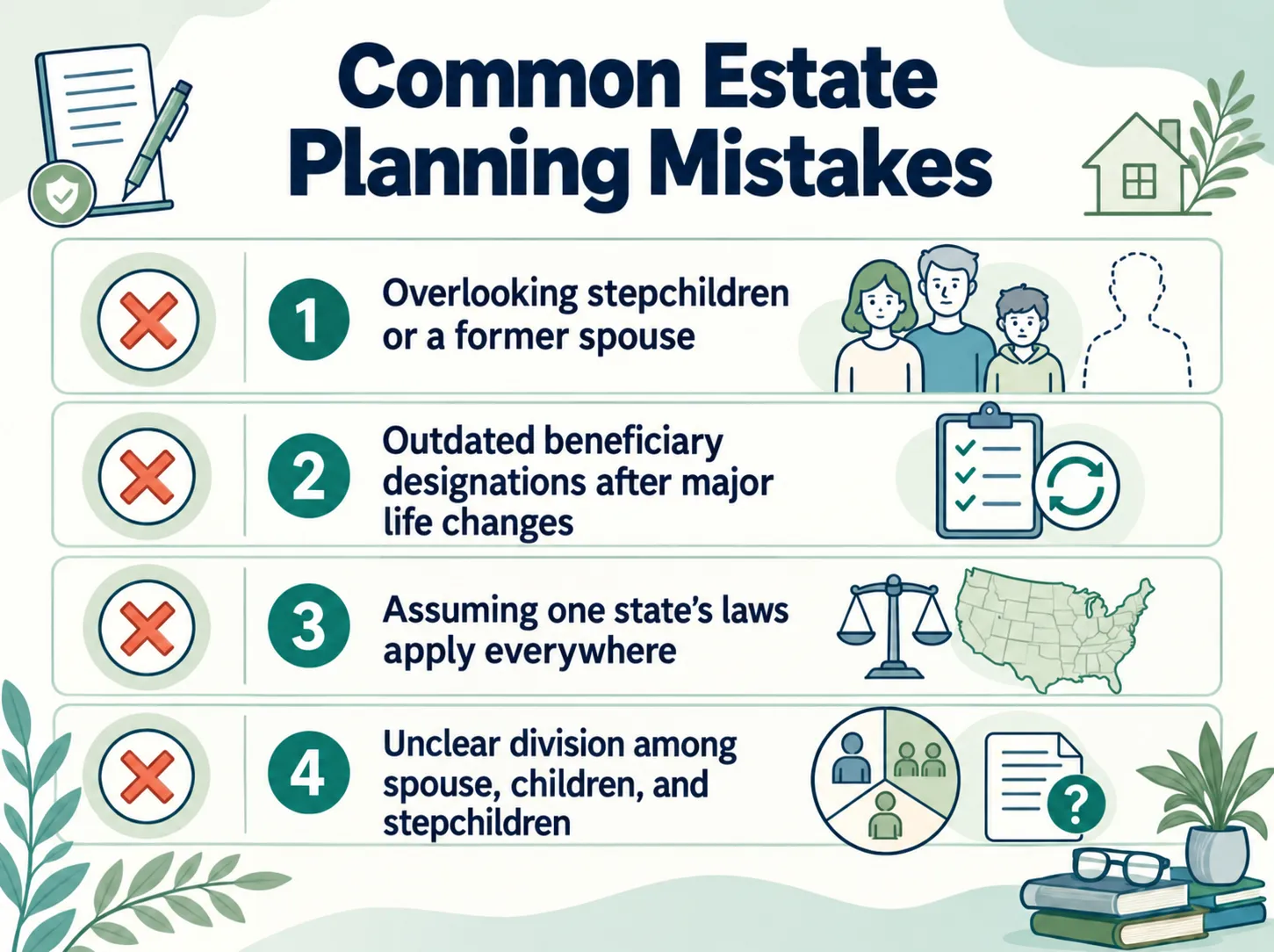
The costliest errors in estate planning for blended families follow a pattern. People lean on a joint “everything to each other” will, skip beneficiary updates after life changes, and assume one state’s rule applies everywhere. Each mistake quietly undoes carefully built intentions.
Top mistakes that disinherit biological children
Four traps appear again and again. Omitting stepchildren or an ex-spouse, ignoring rights locked in by an existing agreement, failing to update the plan after major life changes, and leaving an unclear split between a current spouse, biological children, and stepchildren. Any one of these can push your estate toward an outcome you never wanted.
The damage often hides in plain sight. A plan drafted at a first marriage, never revisited, can route assets away from the children it was meant to protect.
Elective share and community property differences
Two state-law doctrines can override a will outright. In the handful of community property states, roughly half of marital property passes outside the will to the surviving spouse, which can wreck an intended division. Separately, a spousal elective share lets a surviving spouse claim a statutory minimum of the estate, even against the will’s terms. Both rules vary by state and change over time.
When you genuinely need a local attorney
This is legal information, not individualized legal advice. These sources reflect U.S. state law, and the doctrines above do not map onto other countries’ succession rules. When elective share, community property, or beneficiary conflicts could materially change your outcome, consult a qualified attorney licensed in your state.
Questions Blended-Family Clients Ask Us Most
How do I protect my estate from stepchildren?
In most states, stepchildren do not inherit unless you legally adopt them or name them in your documents, so “protection” usually means the opposite problem: including the people you choose. If your goal is to direct assets to your biological children, use a revocable living trust or a QTIP trust to control who ultimately inherits. Because intestacy and elective-share rules vary, confirm the setup with a qualified attorney in your state.
What is the best way to divide assets in a blended family?
There is no single formula. The best approach matches your intentions rather than splitting everything perfectly in half. Many couples pair a trust for the surviving spouse with beneficiary designations that route specific accounts to specific children, and use life insurance to equalize uneven gifts like a house. A local estate attorney can model the division against your state’s rules.
What is the best type of will for a blended family?
There is no universal “best” document. A simple joint will is often the riskiest choice, because it can lock in terms the survivor later changes. Most blended-family plans combine a last will with a revocable living trust, and sometimes a QTIP trust, to balance spouse and children. Have a qualified attorney draft it for your jurisdiction.
How do I handle blended family inheritance conflicts?
Reduce conflict before it starts. Name a neutral or corporate trustee for impartial administration, write specific bequests for sentimental items, and hold an honest family conversation about your intentions. These steps build trust and make challenges less likely. Still, confirm the structure with a licensed attorney.
Do stepchildren inherit if I do not name them in my will?
Generally no. Without legal adoption, stepchildren are typically not treated as heirs, and omitted-child protections usually cover only biological and adopted children. To leave them anything, name them explicitly in your will, trust, or beneficiary forms. Because this depends on state law, verify your plan with a qualified attorney.
Sources / Bibliography
-
giftplanning.emory.edu/estate-planning-for-blended-families-guide – Emory University – Estate Planning for Blended Families Guide
-
nolo.com/legal-encyclopedia/estate-planning-blended-family-29665.html – Nolo – Estate Planning for a Blended Family
-
rhettburney.com/blog/estate-planning-for-blended-families-special-considerations-and-tips – Rhett Burney – Estate Planning for Blended Families