
A power of attorney lets one person act for you when you cannot act for yourself, whether that means paying your mortgage or telling a hospital what care you want. Most guides stop at the definition. This one shows where a power of attorney breaks down: the springing document that waits on a doctor’s signature, the bank that rejects a form dated four years ago, and the missing durable clause that hands your family to a courtroom instead. You will learn which type to choose, why institutions refuse valid documents, and how a power of attorney fits the four-document estate package.
Key takeaways
- A durable power of attorney survives incapacity, while a general POA ends the instant you lose capacity.
- A springing POA fails in a crisis because it needs a doctor to certify incapacity first, sometimes two physicians.
- The four core POA types are limited, general, durable, and springing, plus a separate medical/healthcare POA.
- No POA agent can make or change your will, vote, or marry on your behalf.
- Banks often reject old POAs; roughly 26 to 28 US states use a statutory form that is harder to refuse.
- A power of attorney ends at your death, when authority passes to your estate’s executor.
- A POA is one of four core estate documents alongside a will, an advance directive, and a HIPAA authorization.
What a Power of Attorney Actually Does When You Cannot Act for Yourself
A power of attorney is a legal document that authorizes another person, your agent or attorney-in-fact, to act on your behalf on money, property, or medical matters. The Consumer Financial Protection Bureau describes it as designating a substitute decision-maker. Its real value appears the moment you cannot speak for yourself.
Principal, agent, and attorney-in-fact defined
A power of attorney is an agreement between two parties: a principal (you) and an attorney-in-fact (the person you appoint). The attorney-in-fact need not be an attorney at law, so you can name a spouse, an adult child, or a trusted friend rather than a lawyer. That agent owes a fiduciary duty, a legal obligation to act in your best interest. Choosing someone trustworthy matters as much as any clause in the document. Watch for the classic abuses: pressure to expand the agent’s authority, self-dealing on personal expenses, unauthorized gifts, and changing the beneficiaries on your policies.
What authority a POA grants
A power of attorney can reach almost any financial task you could handle yourself. A financial POA names a specific person empowered to manage your property and financial affairs. Typical scope covers your mortgage, your bank accounts, an insurer, and tax filings. For tax matters, the IRS uses a separate form: Form 2848, Power of Attorney and Declaration of Representative, authorizes someone to represent you before the IRS, and you need a separate form for each taxpayer. To reduce disputes over which authority you granted, more than half of US states (roughly 26 to 28) have adopted the Uniform Power of Attorney Act (UPOAA), first approved in 2006, which standardizes statutory language.
Durable vs Springing Power of Attorney: The Difference That Fails Families
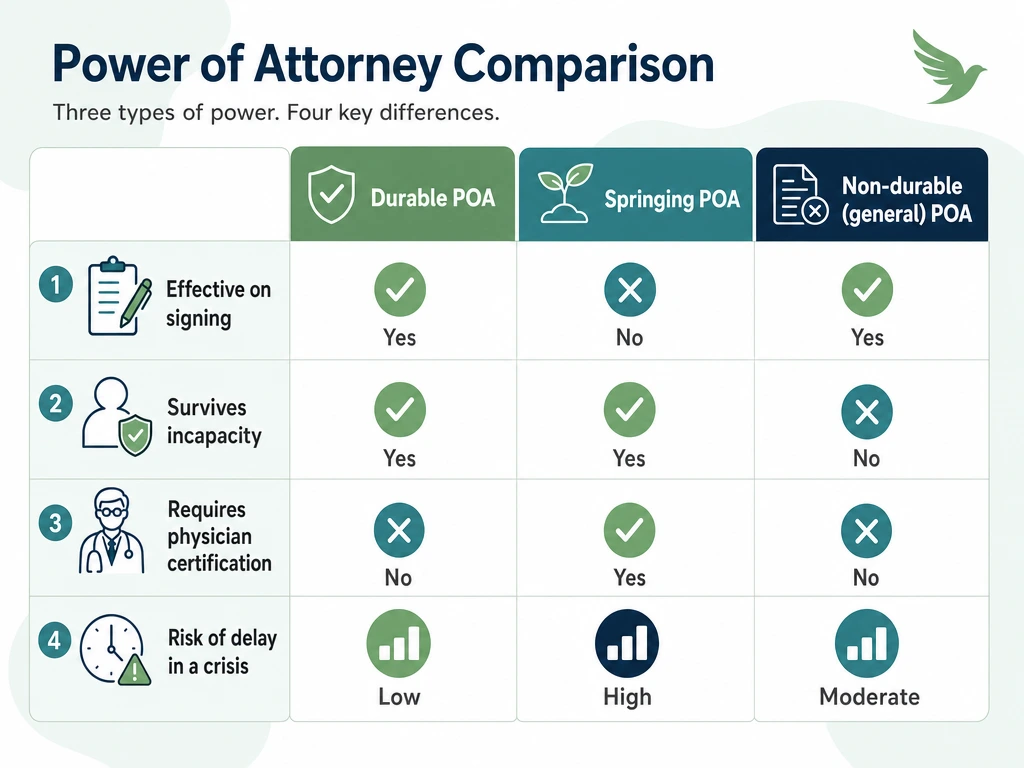
A durable POA stays valid after you lose capacity; a springing POA activates only on a triggering event, usually a doctor’s certification of incapacity. That certification requirement is the reason springing POAs fail in the week your family needs them most.
Why a springing POA is useless when time matters
A springing POA sits dormant until its stated trigger fires, and that trigger is almost always physician certification of incapacity; some states demand two physicians. The document itself defines the exact event. The gap between crisis and sign-off is where families stall. Your agent cannot pay the rent, cannot talk to the bank, cannot do anything until a doctor certifies incapacity. If a doctor hesitates or refuses to certify, help freezes entirely, because without that certification the agent is blocked from acting. That is why elder law attorneys generally steer clients toward durable rather than springing documents.
Durable POA for finances vs healthcare
A durable POA works the opposite way. It lets your agent act immediately on signing and keeps working after you lose capacity through dementia, a traumatic brain injury, or cognitive decline. The power is durable precisely because it survives incapacity of the principal. If a document is not durable, its authority ends the instant you become incapacitated. You can hold two: a durable power of attorney for finances to manage money and property, and a separate healthcare document to direct medical care.
| Feature | Durable POA | Springing POA | Non-durable (general) POA |
|---|---|---|---|
| Effective on signing | Yes | No | Yes |
| Survives incapacity | Yes | Yes (once triggered) | No |
| Requires physician certification | No | Yes | No |
| Risk of delay in a crisis | Low | High | N/A (ends at incapacity) |
The Four Types of Power of Attorney and Which One You Need
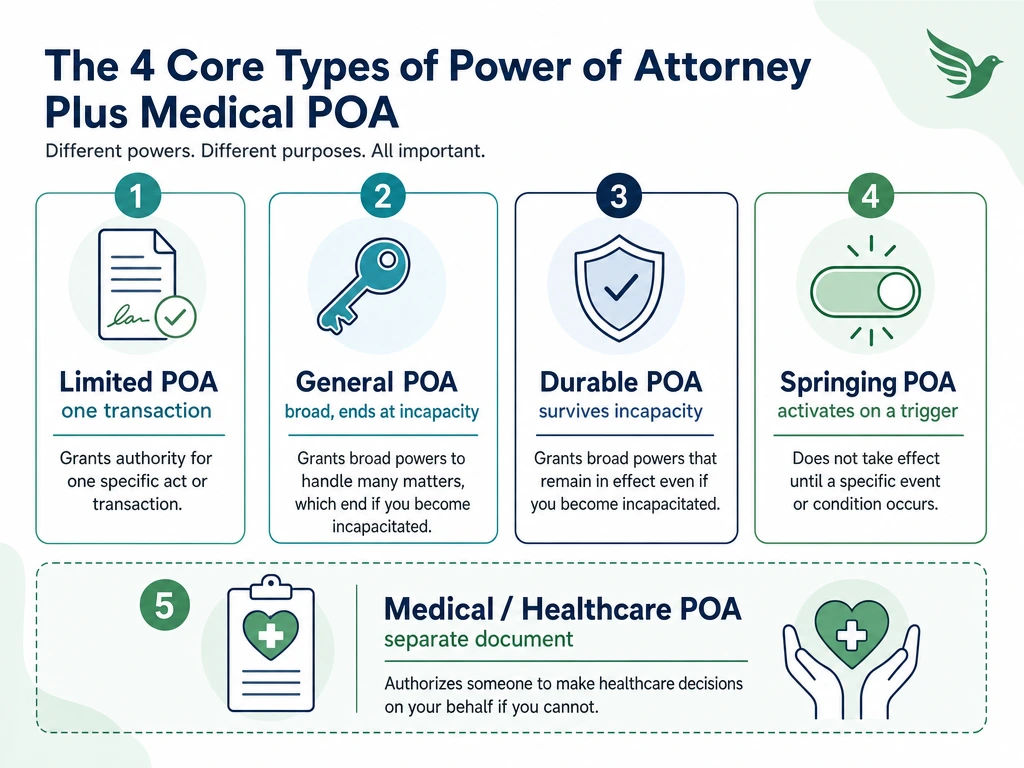
The four core types are limited, general, durable, and springing, with a medical/healthcare POA as a critical fifth instrument. Each behaves differently: a general POA expires when you lose capacity, a durable POA remains valid after you lose capacity, a springing POA activates only when a stated condition is met, and a limited POA covers a single transaction or narrow scope. Choosing the wrong type is the most common planning mistake, because a general POA expires exactly when you need help.
Limited POA for a single transaction
A limited power of attorney (also called a special POA) covers one transaction or a narrow scope, such as authorizing an agent for a single real estate closing. The authority ends when that task is done. Use it when you want help with one defined job and nothing more, for example a limited power of attorney for a real estate transaction while you are out of the country.
General POA vs durable POA
A general POA grants broad authority over your finances but expires at the moment of incapacity, which makes it unsuitable for end-of-life planning or long-term care. A general durable POA usually covers finances and, on its own, does not grant medical decision authority. The single-word difference (durable) is what separates a document that protects you through a decline from one that quits at the worst possible moment.
Medical power of attorney and healthcare proxy
A medical or healthcare POA is a separate document from a financial POA. Without it, doctors and facilities may refuse to speak to anyone but the patient. The terms healthcare proxy and medical power of attorney describe largely the same tool; the naming varies by state, but the function, giving your agent the same medical decision-making scope you have, stays similar. A medical POA is also one type of advance directive: it names a person to make healthcare decisions, while a living will states your specific end-of-life wishes, and families often complete both together.
Why Banks and Institutions Refuse a Power of Attorney and How to Prevent It
Institutions routinely reject a power of attorney that is several years old or that does not match their internal forms. The fix is a recently dated, properly notarized document and, where available, your state’s statutory form. Users describe banks citing outdated dates, missing current copies, or expired notary commissions as the reason for refusal, which points straight at document age and format.
Why the age and format of the document matter
A bank sees a stale POA as a liability. The older the document, the more room a compliance officer has to question whether you have since revoked it or lost capacity. Institutions also vary on format: some accept a digital copy, others demand paper or the original. Show the document, but never surrender the original; keep it with your key papers. Bank of America acknowledges that POA laws vary by state and advises using a legal advisor for statutory requirements.
States with a statutory form a bank cannot easily argue with
More than half of US states (roughly 26 to 28) have adopted a statutory POA form, which institutions have a harder time rejecting. Getting the document both witnessed and notarized makes banks and companies less likely to question it, since notarization and witness rules vary by state and most require a notary, two witnesses, or both. New York’s updated law, effective in 2021, now requires two witnesses (one may be the notary) for all POAs, an example of state reform aimed at acceptance. Under Virginia’s UPOAA, a signature is presumed genuine if acknowledged before a notary.
Power of Attorney vs Guardianship: When the Court Steps In Instead
A power of attorney is voluntary delegation you set up in advance; guardianship is court-ordered control imposed after you lose capacity without a valid POA. A durable POA is how you avoid the guardianship process entirely.
Voluntary POA vs court-ordered guardianship
Without a prior POA, a loved one may have to petition a court for a guardian once you lose capacity, and that process runs long, costs money, and is fully public. A durable POA avoids that entirely. A durable POA is almost always preferable to guardianship or conservatorship: it is less expensive, faster to set up, and keeps courts out of your affairs. For anyone managing a power of attorney for an elderly parent, a durable document signed while the parent still has capacity is the single best safeguard against a guardianship petition.
Three decisions no POA agent can make
Even a broad power of attorney has hard limits. Three decisions no agent can make for you: make or change your will, vote in an election, or marry on your behalf. Most jurisdictions explicitly ban using a POA to vote, a rule aimed squarely at preventing fraud, and an agent cannot sign your mail ballot; only you can. Only a court can strip someone’s right to vote, and only with a specific finding. Under guardianship, a ward may also lose the right to vote, to marry or divorce, or to hold a driver’s license.
Signing, Revoking, and When a Power of Attorney Ends
A power of attorney requires the principal to be of sound mind and at least 18 at signing, usually with notarization. It ends on revocation, on a set expiration, or at your death, and a POA does not survive death.
Mental capacity at signing
Both agent and principal must be at least 18 and of sound mind, and the principal must have mental capacity when signing. That is why the standard advice is to establish a POA early, before health declines. Once cognition slips, the window to sign a valid document may close, and guardianship becomes the only remaining path.
How to revoke a power of attorney
Revocation follows two accepted methods per elder law sources:
- Sign a written revocation document, have it notarized, and give your agent written notice.
- Physically destroy the original by burning, tearing, or crossing it out.
Either way, you must then notify every bank or institution that knew of the POA before it was revoked. This closes the gap users worry about when a later POA might not reach an institution still holding the old one.
Why a POA ends at death
A general POA ends in five situations under the Restatement of the Law – Agency 3d, sections 3.07 to 3.10: a set expiration date, completion of the task, your death (section 3.07), a declaration of incapacity for a non-durable POA (section 3.08), and revocation. A power of attorney does not survive your death, a frequent misconception; at death, authority passes to the executor of your estate.
Where a Power of Attorney Fits in Your Wider Estate Plan
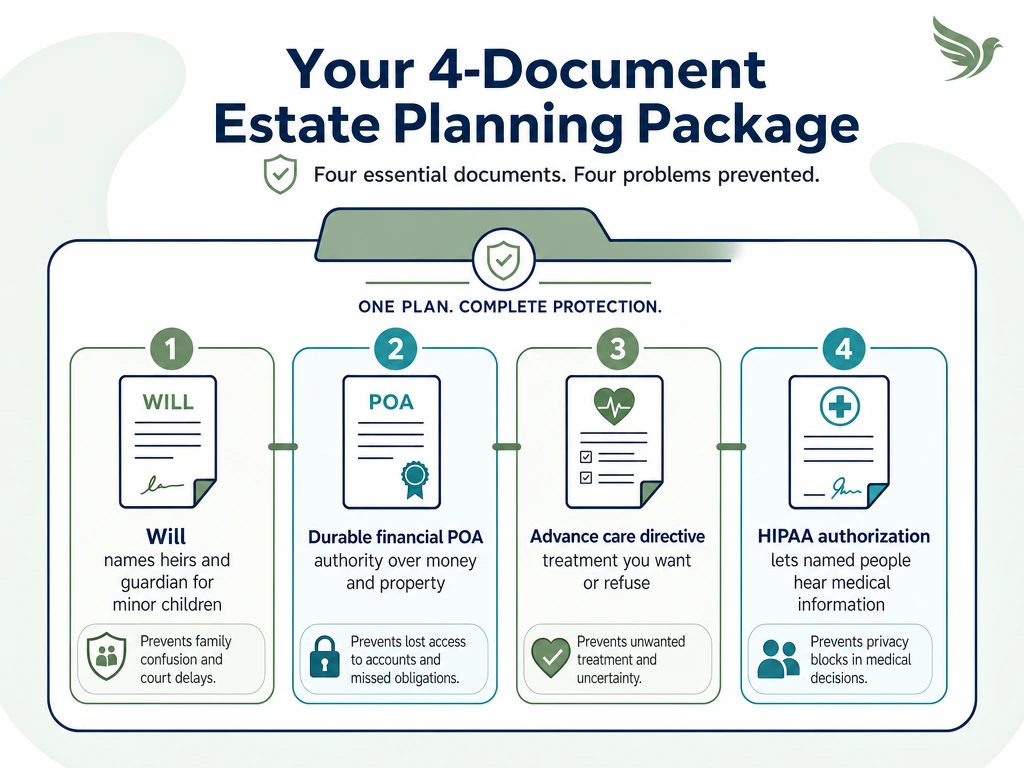
A power of attorney is one of four core estate documents, alongside a will, an advance care directive, and a HIPAA authorization. Each prevents a specific failure, and a POA specifically stops a court from appointing someone to reach your accounts.
The four-document package explained
Several 2026 estate-planning checklists list the same essentials: a durable financial POA, a healthcare POA, an advance directive, and a HIPAA authorization. As MyEstateAngel frames the package, each document prevents a specific problem: the will names heirs and a guardian for minor children, the advance care directive sets out the treatment you want or refuse, the POA hands one trusted person authority over money and property, and the HIPAA authorization lets named people hear your medical information. Because HIPAA privacy rules (in effect since 2003 under the 1996 Act) impose penalties for disclosing protected health information, providers withhold data from anyone but the patient, so a current HIPAA clause makes the medical POA work in practice.
POA vs advance directive vs will
A will covers what happens after death; a POA covers management during your life. A durable POA specifically prevents a court from appointing a conservator to reach your accounts. Choose your agent with the same care you would apply to an executor, and guard against POA abuse (self-dealing, unauthorized gifts, changed beneficiaries) by informing other relatives or advisors and asking your agent to report transactions regularly.
Quick Answers to Six Questions Families Ask Before Signing
What are the four types of power of attorney?
The four types are limited, general, durable, and springing. A limited POA covers one transaction, a general POA grants broad authority but ends at incapacity, a durable POA survives incapacity, and a springing POA activates only on a trigger such as a doctor certifying incapacity. Many families add a fifth, a medical/healthcare POA, as a separate document.
What is the difference between a guardianship and a power of attorney?
A power of attorney is voluntary: you choose your agent in advance while you still have capacity. Guardianship is court-ordered: a judge appoints someone after you lose capacity without a valid POA. Guardianship is slower, more expensive, and a matter of public record, while a durable POA keeps the decision, and your privacy, in your hands.
What three decisions cannot be made by a legal power of attorney?
No agent under a power of attorney can make or change your will, cast your vote, or marry on your behalf. These acts are personal by law. Most jurisdictions specifically prohibit using a POA to vote, and only a court can remove someone’s voting rights, and only with a specific finding.
Who can override a power of attorney?
You can override your own POA at any time while you have capacity by revoking it in writing and notifying your agent and institutions. A court can also override it by finding the agent breached their fiduciary duty or by appointing a guardian. At your death, the document ends and your executor takes over.
Does a power of attorney need to be notarized?
Requirements vary by state, but most require a notary, two witnesses, or both. A POA that is both witnessed and notarized is far less likely to be questioned by a bank. New York, for example, requires two witnesses (one may be the notary) since 2021. Check your state’s statutory form to be sure.
When does a power of attorney expire?
A power of attorney ends in five situations: a set expiration date, completion of the specified task, your death, a declaration of incapacity for a non-durable POA, or revocation. A durable POA does not expire at incapacity, that is its purpose, but no POA survives death; authority then passes to your estate’s executor.
The Power of Attorney Mistakes That Cost Families the Most, and How to Avoid Them
In real cases, the costliest error is choosing a springing POA that waits on a doctor’s certification, then discovering no physician will sign in the week a family needs access to accounts. Pick a durable POA instead, use your state’s statutory form, keep it recently dated and notarized, and pair it with the other three documents: a will, an advance care directive, and a HIPAA authorization. Sign while you still have capacity. That one decision, made early, is what keeps your family out of a courtroom.
Sources
- consumerfinance.gov/ask-cfpb/what-is-a-power-of-attorney-poa-en-1149 – CFPB: definition of a POA, financial agent authority, guardianship avoidance, and POA abuse prevention.
- caringinfo.org/planning/advance-directives/power-of-attorney-and-caregiving – CaringInfo: fiduciary duty, durable vs springing, medical POA, capacity, document handling, death termination.
- irs.gov/forms-pubs/about-form-2848 – IRS: Form 2848 Power of Attorney and Declaration of Representative.
- en.wikipedia.org/wiki/Uniform_Power_of_Attorney_Act – Wikipedia/ULC: Uniform Power of Attorney Act (2006) and state adoption count.
- guides.sll.texas.gov/powers-of-attorney/durable-powers-of-attorney – Texas State Law Library: durable POA definition and survival of incapacity.
- georgia-estatelaw.com/what-is-a-springing-power-of-attorney – Georgia Estate Law: springing POA trigger and physician certification requirement.
- bankofamerica.com/signature-services/power-of-attorney – Bank of America: banks note POA laws vary by state; advises legal advisor.
- web.law.duke.edu/sites/default/files/clinics/healthjustice/how_to_revoke_a_power_of_attorney5.pdf – Duke Law Health Justice Clinic: how to revoke a POA in writing and notify institutions.
This article is for informational purposes only and does not constitute legal advice. U.S. law is complex and varies by state and circumstance. For your specific situation, consult a licensed attorney.