Most people assume that when they die, everything they own goes to their spouse. In much of the United States, that is not how it works. Without a valid will, intestate succession applies, and the estate is usually split between the spouse and the children under a formula set by state law. Below you will find who actually inherits, who names a guardian for your children, how probate works and what it costs to make a will.
Key takeaways
- Without a will, your estate is divided by state intestacy law, which differs in each of the 50 states, not by your wishes.
- Your spouse usually does not inherit everything when there are children; in New York, for example, the spouse receives half of the estate.
- In the 9 community property states (including California and Texas), a spouse holds an automatic 50 percent share of marital property.
- If your will does not name a guardian, a judge chooses who raises your children under 18.
- In 49 states a will needs only the testator’s signature and two witnesses, and notarization is not a condition of validity.
- An online will costs $50-400, and an attorney charges $300-1,000 (about $890 on average).
- Probate takes 6-9 months for simple estates and 1-2 years or longer when there is a dispute.
What Happens to Your Estate Without a Will: Intestate Succession in the US
Without a valid will, your estate is divided under intestate succession, a set of state rules, not your wishes. A state court, not you, decides who gets what. The law describes a person who dies without a will as having died intestate.
Intestacy Laws Are State Law, Not Federal
Intestacy is the body of rules that distributes the estate of someone who died without a will. Without a will, your estate falls under exactly these state rules, and they decide who inherits. The rules differ across all 50 states: New York splits an estate one way, while Florida, Texas and Georgia each do it differently. No federal law makes them uniform.
The Uniform Probate Code (UPC) of 1969 brings partial standardization. It was meant to apply in every state, but only about 17-18 states have adopted it, in whole or in part. The rest kept their own rules, which often differ.
Inheriting Under a Will vs. Under Intestacy
With a will, your property goes where you directed. Without one, a rigid statutory formula divides the estate along the family tree. A popular myth says that without a will the state government takes everything, and that is not true. The estate passes to family, and even a distant cousin or aunt can inherit. The state takes the estate only when no living relative can be found.
Who Inherits When There Is No Will: Your Spouse Does Not Get Everything
In most states a surviving spouse does NOT inherit the entire estate. When the person who died leaves children, the estate is split between the spouse and the children, which surprises almost everyone. The exact shares depend on the state.
How the Estate Is Split Between Spouse and Children
The Uniform Probate Code formula gives the spouse the first $50,000 of the intestate estate plus half of the rest, and the children receive the remainder. New York works differently: in a marriage with children, half of the estate goes to the spouse and the children share the rest equally. Both examples lead to the same conclusion, because in neither one does the spouse take everything.
If you have children with someone other than your current spouse, the estate is divided between that spouse and those children. This protects children from earlier relationships, but it rarely matches what people assume.
Community Property vs. Common Law States
9 states follow the community property system: Arizona, California, Idaho, Louisiana, Nevada, New Mexico, Texas, Washington and Wisconsin. In each of them a spouse holds an automatic 50 percent share of marital property acquired during the marriage. The remaining states use the common law system, where property belongs to whoever holds formal title to it.
| System | Number of states | Rule for the spouse |
|---|---|---|
| Community property | 9 | Automatic 50% share of marital property |
| Common law | 41 | Split under that state’s intestacy rules |
The Order: Parents, Siblings, Extended Family
When the person who died has no spouse or children, the estate moves up and across the family tree. In New York, the estate of a single person with no children goes first to parents, then to siblings, then to grandparents, and after that to aunts, uncles or their children. This scheme is called the modified parentelic system. Even a distant relative comes ahead of a charity or a friend you may have wanted to provide for.
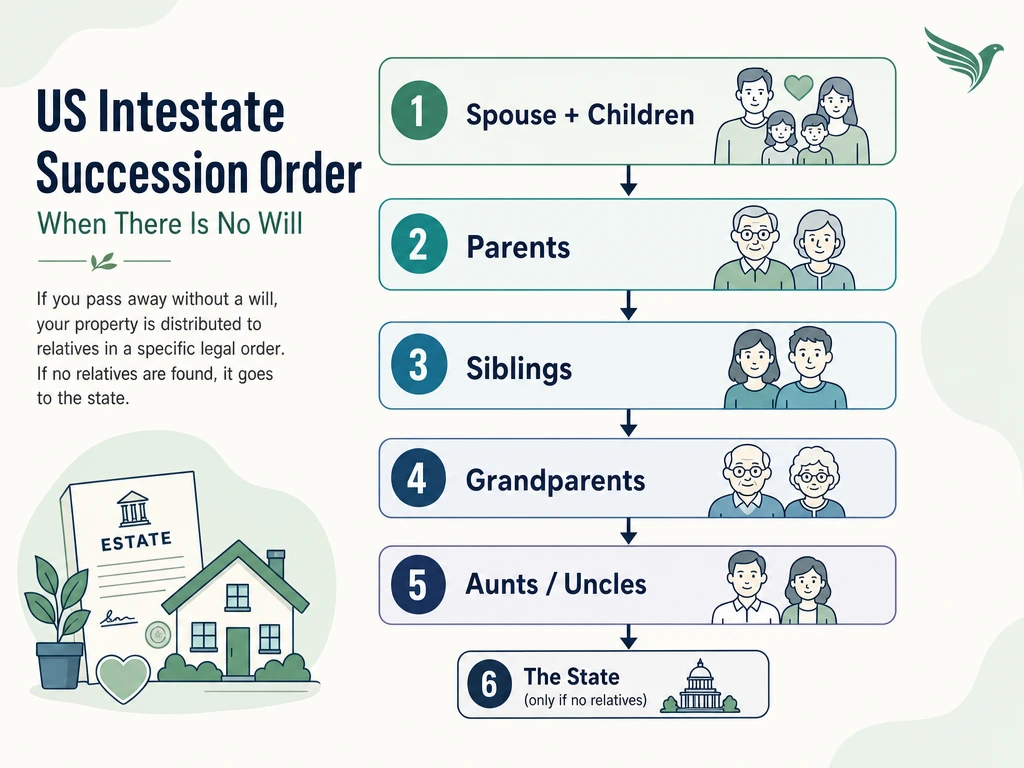
Modified parentelic system: the order of inheritance without a will
A Court, Not a Parent, Names the Guardian for Your Children
Without a guardian clause in your will, a judge who has never met your family chooses who raises your minor children. It is the most often skipped clause and the one the court relies on most.
Why the Guardian Clause Gets Skipped
A will lets you name guardians for children under the age of majority, which in New York is 18. People focus on money and the house, so the guardian clause drops out of view. The result can be serious, because leaving it out hands the whole decision to a judge who has never seen your family.
The Court Weighs Your Choice but Is Not Bound by It
Naming a guardian does not formally bind the court, but it carries real weight in the ruling. A judge usually honors the parent’s choice as long as the person is fit for the role. A will can also set up a support trust for a child and name a trustee; parents often extend control over the inheritance beyond the age of majority, most often to age 25-30.
Naming a Backup Guardian
You can name a second guardian in case the first cannot take on the role. It is a simple provision that closes the gap if your first choice declines or is not available. Without a backup, the decision goes back to the judge.
What a Last Will and Testament Is and What It Contains
A will is a legal document that states who inherits your property after you die. Four roles define its content: the testator, the executor, the beneficiaries and the guardians.
Testator, Executor, Beneficiaries, Guardians
The testator is the person who makes the document and states how the property should be divided. The executor is a fiduciary who must act honestly toward the person who died and the heirs. The executor’s duties are to gather and manage the assets, pay debts and taxes, and finally distribute the property as the will directs.
- Beneficiaries – people or organizations that receive property
- Guardians – caretakers named for minor children
- Executor – the person who runs the whole process
- Testator – the author of the document
A proper US will begins with the person’s full name and a clear statement that this is their last will and testament.
A Will vs. a Living Will (Advance Care Directive)
A living will, also called an advance care directive, covers medical decisions during your lifetime when you cannot express them yourself. A last will takes effect only at death. The two documents complement each other but act at completely different moments: one guides medical care, the other the estate.
How to Write a Will in the US, Step by Step
A valid will comes together in five steps: taking inventory of your assets, naming an executor and beneficiaries, choosing a guardian for your children, signing before two witnesses and storing the document safely.
- Take inventory of your assets – real estate, accounts, insurance policies, valuables
- Name an executor and beneficiaries – who handles the estate and who inherits
- Name a guardian for children under 18
- Sign the document before two witnesses
- Store it where your family and executor know to look
Steps 1-2: Inventory Your Assets and Name an Executor and Beneficiaries
Start with an inventory of what you own, then assign each item to a specific person. Your choice of executor decides who handles all the paperwork, so pick someone organized and trustworthy.
Steps 3-4: A Guardian for Your Children and Signing Before Witnesses
In 49 states a valid will requires the testator’s signature and two witnesses, and notarization is usually not a condition of validity. A witness should not be a beneficiary. Under the interested witness rule, the will stays valid, but a court may void a gift to a witness who is also an heir, and the whole document becomes open to a claim of undue influence.
A self-proving affidavit is a separate statement the testator and witnesses sign before a notary. It allows probate to proceed without calling the witnesses into court, which speeds up the process.
Step 5: Where to Keep the Document
Free and low-cost online tools, such as FreeWill.com, a partner of the American Red Cross, let you create a valid document without visiting a lawyer. Wherever you keep it, make sure your executor can get to it, because a will nobody can find leaves your family in the same position as having no will.
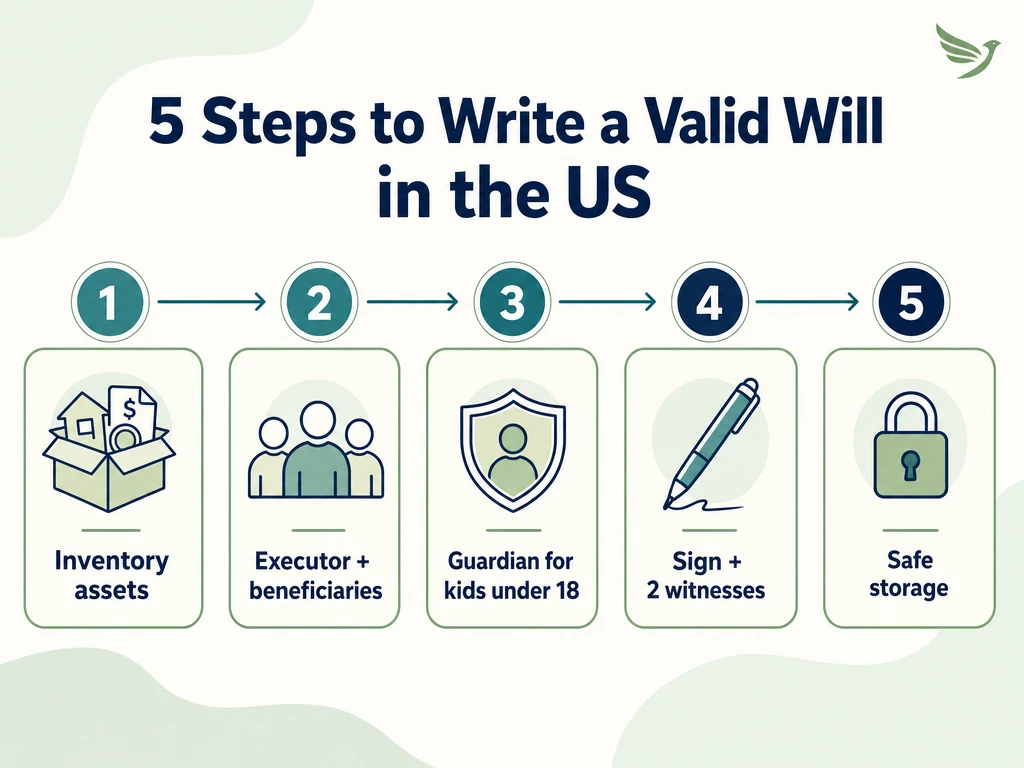
5 steps to a valid will in the US
Probate: Why Even an Estate With a Will Goes to Court
A will does not avoid probate. Probate is a court-supervised process that validates the document and oversees the transfer of the estate. It is public, it takes months, and your executor handles the paperwork.
What the Executor Does During Probate
The probate court approves the executor and supervises administration, including the distribution of estate assets. The will is validated first, debts are paid next, and only then does the property pass to the heirs. Typical timelines are 6-9 months for simple estates, 9-18 months for average ones and 1-2 years or longer when there is a dispute.
| Case complexity | Probate timeline |
|---|---|
| Simple | 6-9 months |
| Average | 9-18 months |
| Contested / complex | 1-2 years or longer |
Not everything goes through this process. Joint accounts, retirement accounts and life insurance policies pass directly to the named people through a beneficiary designation and do not become part of the probate estate.
When to Consider a Trust Instead of a Will
A living trust transfers assets during your lifetime and lets them bypass probate, which makes it a popular alternative given the time and cost of probate. It has one condition: assets avoid court only if you actually transfer them into the trust. The document alone, without moving the property, changes nothing.
How Much a Will Costs in the US and Whether You Can Change It Later
An online will costs from $50 to $400 depending on the scope, and an attorney charges from $300 to $1,000. You can change it at any time as long as you are alive and have testamentary capacity.
Pricing: Online vs. an Attorney
Online services span a wide range: Trust&Will charges about $199 per person and $299 per couple, LegalZoom goes up to $399, and NCOA points to offers starting at $50-150. MetLife cites an average of about $160 for online plans. An attorney costs more, and the average cost of having a lawyer prepare the document is about $890, according to Thumbtack.
| Method | Cost | Source |
|---|---|---|
| Basic online | $50-150 | NCOA |
| Online (couple/premium) | $199-399 | Trust&Will, LegalZoom |
| Attorney | $300-1,000 | LegalZoom |
Notary fees vary by state, and state law sets the maximum rates: in New Jersey they run from a few dollars to around a dozen dollars per notarial act. Many banks, such as Bank of America, notarize documents free of charge.
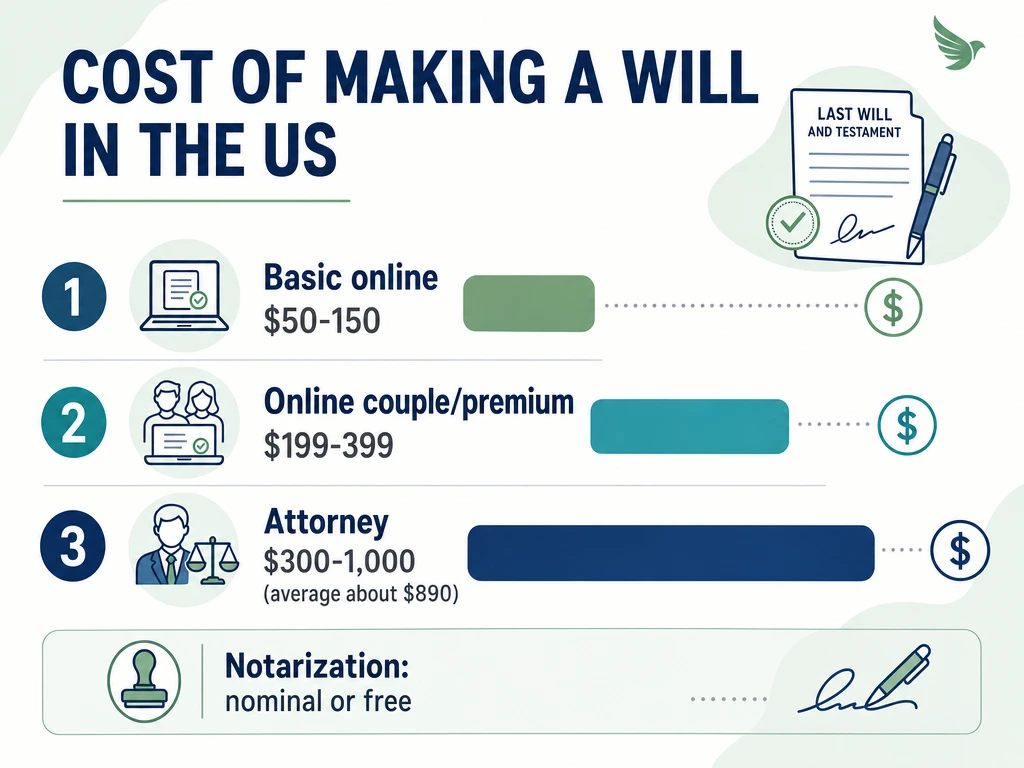
Source: NCOA, LegalZoom, Trust&Will, Thumbtack
Changing or Revoking a Will
You can change or revoke your will at any time by making a new will or destroying the old one. Moving to another state is the most common reason to update it, because the rules on validity and inheritance differ between jurisdictions. After a move, it is worth reworking the document for the new state’s law and re-signing only the parts that have actually changed.
What to Know: 5 Reader Questions
What happens to my estate if I die without a will in the US?
Without a will, your estate is divided under your state’s intestacy rules, not your wishes. A rigid formula splits the estate along the family tree: first the spouse and children, then parents, siblings and extended family. The myth that the government takes everything is false, and the state inherits only when there are no relatives at all.
Does my spouse automatically inherit everything?
Usually not. If you leave children, the estate is split between your spouse and your children. In New York the spouse receives half and the children the rest. The UPC formula gives the spouse the first $50,000 plus half of the remaining estate. In the 9 community property states, a spouse holds an automatic 50 percent share of marital property.
Does a will have to be notarized?
No. In 49 states the testator’s signature and two witnesses are enough, and notarization is not a condition of validity. A notary is useful for a self-proving affidavit, a statement that removes the need to call witnesses into court and speeds up probate.
Who will care for my children if I don’t name a guardian?
A judge who has never met your family will decide. A will lets you name a guardian and even a backup. The court is not formally bound by your choice, but it carries real weight, and judges take it seriously. Leaving it out hands the entire decision to the court.
How much does it cost to make a will in the US in 2026?
Online you will pay from $50 to $400, depending on the plan and whether it covers one person or a couple. With an attorney, the cost falls between $300 and $1,000, with an average of about $890. Notarization is often nominal or free, for example at a bank branch.
Intestacy vs. Your Own Wishes: Two Decisions Not to Leave to a Court
Two surprises come up most often: the estate being split with the children when people expected the spouse to take everything, and a judge deciding who becomes the guardian. One document solves both. This week, take inventory of your assets, choose an executor and a guardian for your children, then make a will online or with an attorney. Half an hour of work closes a gap that state law would otherwise fill.
Sources
- calvaryhospital.org/what-is-a-last-will-and-testament-and-why-do-you-need-one – Calvary Hospital: guide to wills, executors, guardians and myths about dying without a will.
- thenytrust.org/news/consequences-of-dying-without-a-will-in-new-york-state – The NY Trust: consequences of dying without a will in New York State.
- docrlaw.com/articles/what-happens-when-someone-dies-without-a-will – DOCR Law: what happens to an estate after dying without a will, and how states differ.
- law.cornell.edu/uniform/probate – Cornell Law: the Uniform Probate Code and its adoption by the states.
- en.wikipedia.org/wiki/Uniform_Probate_Code – Wikipedia: the 1969 Uniform Probate Code and the number of states that adopted it.
- en.wikipedia.org/wiki/Community_property_in_the_United_States – Wikipedia: the 9 community property states and the spouse’s 50% share.
- irs.gov/irm/part25/irm_25-018-001 – IRS: list of community property states and the rules for marital property.
- en.wikipedia.org/wiki/Will_and_testament – Wikipedia: definition of a will as a document expressing the testator’s wishes.
- nationalnotary.org/notary-bulletin/blog/2012/01/faq-difference-between-living-will-last-will-and-testament – National Notary: the difference between a living will and a last will and testament.
This article is for informational purposes only and does not constitute legal advice. U.S. law is complex and varies by state and circumstance. For your specific situation, consult a licensed attorney.