
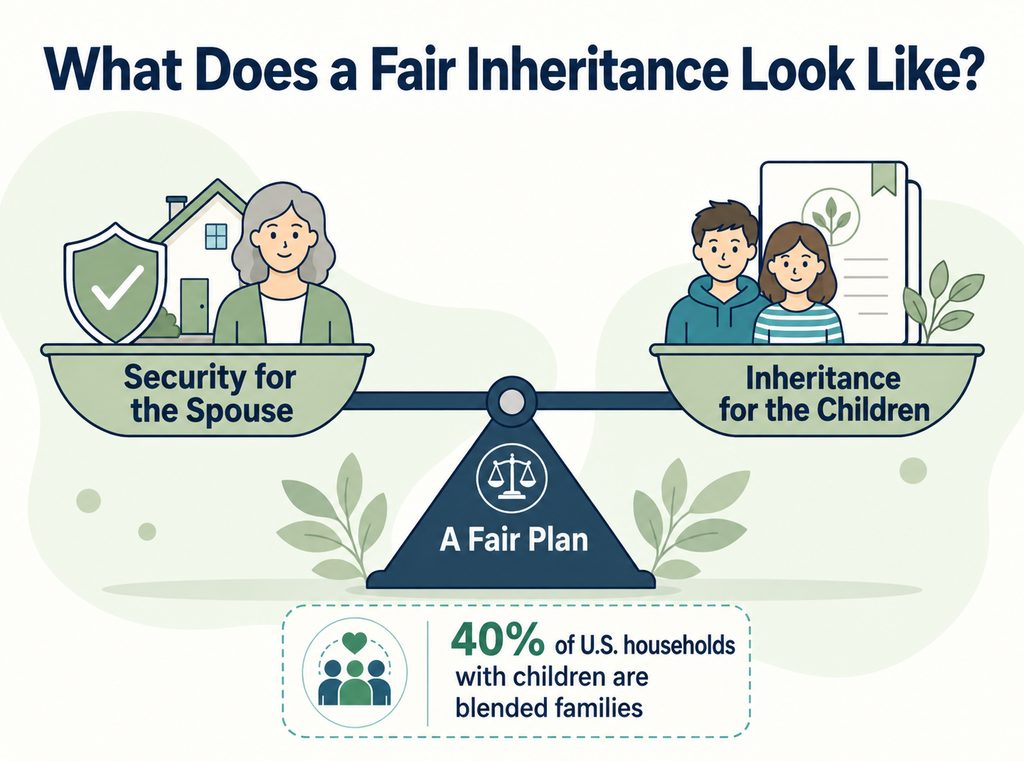
What is fair in a second marriage and estate planning comes down to balancing your current spouse’s financial security against the inheritance you want to leave your children. Fair almost never means an automatic 50/50 split, and inheritance law alone rarely delivers what blended families really expect.
The principles below are based on U.S. law and vary between states. I will show the specific tools, pitfalls, and mistakes that most often trigger family conflicts.
In short
About 40% of U.S. households with children are now blended families, which makes inheritance after a second marriage a common problem.
In most common law states, the so-called elective share guarantees the surviving spouse one-third to one-half of the estate, even against the will.
The most common mistake is leaving everything to the spouse in the hope that they will take care of the stepchildren, even though nothing legally obliges them to do so.
Retirement accounts such as IRAs and 401(k)s are inherited through beneficiary designations, not through the will, so an outdated form can disinherit your children.
Stepchildren do not inherit automatically unless they have been legally adopted, so they must be named in the will, trust, or beneficiary form.
The three main tools are a QTIP trust (income for the spouse, protected principal for the children), a life estate in the home, and an outright bequest, which risks disinheriting the children.
A prenuptial or postnuptial agreement can waive the right to the elective share, but it requires full disclosure of assets and voluntariness; otherwise a court may invalidate it.
What Fairness Actually Means in Second Marriage Estate Planning
Fairness in second marriage estate planning means balancing your current spouse’s financial security against the inheritance you intend for your children. It rarely means an equal 50/50 split, and default law alone will not deliver what most blended families actually want.
This matters at scale. An estimated 40% of U.S. households with children are now blended families, which makes the second-marriage inheritance problem one of the most common planning challenges in American practice. The rules below reflect U.S. law and vary significantly from state to state.
Why ‘fair’ is not the same as ‘equal’
Equal inheritance gives each child the same share. Equitable inheritance gives a larger share to the child with greater financial need. These are not interchangeable goals.
Without a clear, written plan that spells out which standard you intend, the ambiguity frequently sparks disputes among children after a parent dies. If one child earns little and another is financially secure, an “equal” split may feel unjust, and an “equitable” one may feel like favoritism. State your reasoning in the plan itself.
Why default intestacy law usually fails blended families
When there is no valid will, U.S. intestacy statutes divide the estate between the surviving spouse and children in proportions that vary by state. Community property states and common law states treat marital assets very differently.
These defaults were never designed for stepfamilies. Where incomes differ sharply, a lower-earning spouse may need other assets, such as joint accounts with right of survivorship, to feel secure. Consult a qualified attorney licensed in your state.
What a Second Spouse Actually Receives When You Die
A surviving second spouse is rarely left with nothing. Even where a will tries to disinherit them, estate planning in a second marriage runs into default protections built into US law. In most common law states, the elective (or forced) share guarantees a surviving spouse roughly one-third to one-half of the estate, which can override a will and quietly shrink what your children receive.
Intestate succession when there is no will
When someone dies without a will, state intestacy rules take over. These typically split the estate between the surviving spouse and the children, in proportions that vary significantly by state. Community property states and common law states treat the division differently, so the same facts can produce very different outcomes.
The spousal elective share and why it overrides a disinheriting will
The elective share is the law’s answer to spouses cut out of a will. A surviving spouse can elect against the will and claim their statutory minimum regardless of what the document says. In California, a resident can leave 100% of separate property and half of community property, but giving away an entire community asset to a non-spouse requires the spouse’s consent.
What happens to the family home
Two mechanisms often bypass the will entirely. Retirement accounts like IRAs and 401(k)s pass by beneficiary designation, not by will, and homestead rights in states such as Florida and Texas protect the family home for the surviving spouse. Because these rules change and differ by state, confirm the specifics with an attorney licensed where you live.
Protecting Children From a First Marriage Without Disinheriting Your Spouse
The core problem is timing. An outright gift to your spouse gives them full control but can quietly disinherit your children, while leaving everything to your kids may strip your spouse of security. Second marriage estate planning solves this tension with three tools: correct asset titling, coordinated beneficiary designations, and trusts that stagger who gets what and when.
The disinheritance-by-remarriage trap
The single most common mistake is leaving everything to the spouse, assuming they will provide for your stepchildren. Once your spouse inherits outright, they can remarry, redirect the assets, or simply name their own children. Nothing legally binds them to your kids. Verbal promises carry no weight here, and relying on outdated beneficiary forms only deepens the problem.
A plan built on trust alone is not a plan. If you want children from a first marriage to inherit, name them explicitly through a trust or a binding written structure.
Separate titling of pre-marital assets
Assets you brought into the marriage can lose their separate character if you mix them with marital funds. This is called commingling, and it blurs what is yours versus shared. Keep pre-marital accounts, property, and investments titled in your name alone, and avoid depositing marital income into them. Clean separate titling is a key protection that keeps those assets available for your children.
Updating beneficiary designations so they match your plan
Beneficiary designations on retirement accounts override your will. Per IRS guidance, these forms control distribution by contract, regardless of what your will says. If your will names your son from the first marriage as heir to an IRA but the account still lists your ex-wife, she receives the funds and your son gets nothing. Review every form after major life changes, and confirm the details with an attorney licensed in your state.
Comparing the Main Estate Planning Tools for Blended Families
Estate planning in a second marriage usually comes down to a few core tools, each one balancing spouse and children differently. A QTIP trust, a life estate, and an outright bequest sit at opposite ends of a control spectrum. There is no single right answer, and the best fit depends on your assets, your family, and your state’s law.
QTIP and marital trusts: lifetime income, protected principal
A QTIP, short for Qualified Terminable Interest Property trust, gives your surviving spouse income for life while locking in the remainder for children you name. Your spouse cannot redirect the principal. The trade-off is cost: a trustee must administer the assets, and those fees recur. Trust rules and taxation vary by state and change over time.
Life estate in the family home
A life estate secures your spouse’s right to occupy the home for life. When that spouse dies, ownership passes automatically to your biological children as remainder holders. It is simpler than a trust but less flexible if the house must be sold or the spouse relocates.
Outright bequest and its disinheritance risk
An outright bequest gives your spouse full control, which also means full power to leave nothing to your children.
|
Tool |
Spouse gets |
Children get |
Main trade-off |
|---|---|---|---|
|
QTIP trust |
Income for life |
Protected remainder |
Trustee/admin costs |
|
Life estate |
Occupancy of home |
Home after spouse dies |
Low flexibility |
|
Outright bequest |
Full ownership |
Nothing guaranteed |
Disinheritance risk |
Life insurance can balance these interests, paying children cash while the spouse keeps the home. Confirm the specifics with an attorney licensed in your state.
Prenups, Postnups, and Written Agreements That Make a Plan Enforceable
Legal documents are what turn intentions into enforceable outcomes. In estate planning for a second marriage, a valid prenuptial or postnuptial agreement can waive the elective share rights that would otherwise override your will, keeping assets on the path you actually intended for your children.
How a prenup or postnup can waive spousal share rights
Marriage itself forms a legal contract that carries financial obligations. A prenup is signed before the wedding to protect children and assets you bring into the new marriage; a postnup does the same work but is executed after you have already married. Both can include a knowing waiver of the surviving spouse’s statutory share.
Enforceability is the whole point, and courts scrutinize it closely. Full financial disclosure is usually required, so neither spouse signs blind. Many states also demand that each party have separate, independent counsel, or at minimum that the signing be genuinely voluntary. An agreement signed under duress, pressure, or without disclosure can be challenged and thrown out.
Why wills and trusts must be coordinated, not contradictory
A waiver only helps if the rest of your plan agrees with it. Your will, your trust, and any beneficiary designations must say the same thing, because contradictory documents undermine each other and invite litigation. A QTIP trust, for example, loses its purpose if a beneficiary form still routes an account elsewhere.
State rules on these agreements vary, so confirm the requirements with an attorney licensed where you live.
Red Flags and the Mistakes That Trigger Family Disputes
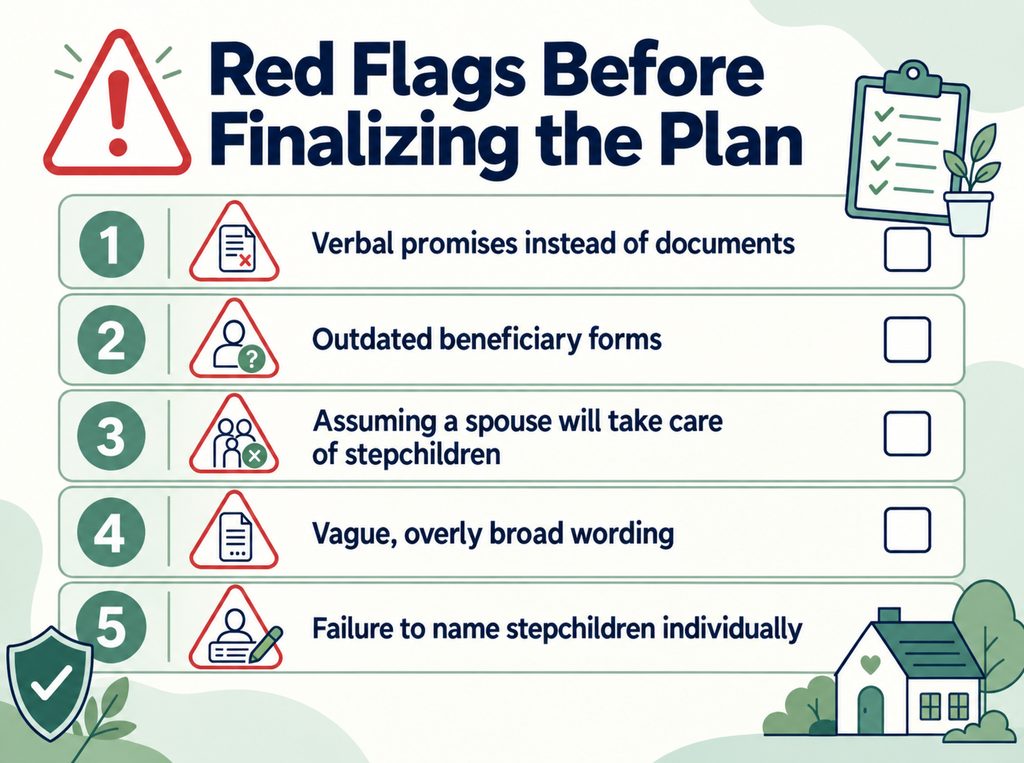
The biggest red flags are relying on verbal promises, keeping outdated beneficiary forms, and assuming your spouse will simply “do the right thing” for your stepchildren. These are the most common and most litigated mistakes in estate planning in a second marriage, and each one quietly undoes what you intended. Failing to update the plan after a death or divorce belongs on the same list.
Red flags before you finalize a plan
The most common blended-family error is assuming an existing plan still works. It usually ignores the new family structure entirely. Failing to update beneficiaries on policies, wills, and trusts is another: stale forms push assets into probate and drag out proceedings.
Lack of open communication is the third. Silence breeds suspicion, and suspicion breeds litigation. Vague language is just as dangerous, so use specific percentages and dollar amounts, and itemize real estate, heirlooms, and financial accounts.
Why stepchildren must be named explicitly
Here is a trap many couples miss. Stepchildren do not inherit automatically under intestacy unless they have been legally adopted. If you want them to receive anything, name them explicitly in your will, trust, or beneficiary forms. A verbal understanding with your spouse carries no legal weight.
What happens if a prior spouse has already died
A plan built during a first marriage rarely fits the second. Update it after any prior spouse’s death or divorce, or old documents may route assets to the wrong people. A disciplined rebuild follows six steps: inventory your documents, identify conflicts, rebuild the beneficiary strategy, set up medical and financial powers of attorney, test scenarios (who dies first), and communicate the plan to the family. Even funeral decisions spark conflict: naming who controls burial arrangements prevents a common dispute.
Confirm details with an attorney licensed in your state.
Questions Blended Families Ask Us Most About Fairness and Inheritance
What does a second wife get when her husband dies without a will?
Without a will, US intestacy law takes over, and a surviving second wife rarely gets nothing. In most common law states she receives a statutory share, often a large portion of the estate split with the deceased’s children. The exact proportions vary significantly by state, so confirm your state’s rules with an attorney.
What is the most common inheritance mistake in second marriages?
The single most common mistake is leaving everything to the spouse while assuming they will provide for your stepchildren. There is usually no legal obligation to follow through. A close second is failing to update beneficiary designations on retirement accounts, which override the will entirely regardless of your intentions.
What are the red flags to watch for before finalizing an estate plan?
Watch for three warning signs: relying on verbal promises instead of binding documents, keeping outdated beneficiary forms after a death or divorce, and vague language that invites disputes. Use specific percentages and amounts, and name stepchildren explicitly rather than trusting a spouse to act fairly later.
What happens to a blended-family estate plan if the first spouse has already died?
The plan still needs a full rebuild. Entering a second marriage after a first spouse’s death resets the picture entirely, so work through a disciplined checklist: inventory everything (wills, trusts, accounts, policies, titles), add legal guardrails, then align every beneficiary designation with your new intentions.
Do stepchildren automatically inherit from a stepparent?
No. Stepchildren do not inherit automatically under intestacy unless they were legally adopted. To include them, you must name them explicitly in your will, trust, or beneficiary forms. Because these outcomes turn on state law and specific facts, consult a qualified attorney licensed where you live.
Sources / Bibliography
siegellawgroup.com/blog/second-marriages-and-blended-families-navigating-estate-planning-complexities – Siegel Law Group – Second Marriages and Blended Families: Navigating Estate Planning Complexities
sarahslawfirm.com/2021/04/estate-planning-and-a-second-marriage – Sarah’s Law Firm – Estate Planning and a Second Marriage
archlegacyfirm.com/blog/what-changes-when-you-enter-your-second-marriage – Arch Legacy Firm – what changes when you enter your second marriage