
Estate planning after divorce does not happen automatically: divorce by itself does not put your estate plan in order, and neglecting it is one of the most common post-divorce mistakes. Beneficiary designations, powers of attorney, and the choice of a guardian for your children require manual updating, and the specific rules differ by state.
This guide shows step by step what to change: your will and inheritance, insurance policies and retirement accounts, medical directives, and protecting your children through a trust and by appointing a manager for their assets.
Key takeaways
Divorce does not automatically update your entire estate plan: many documents must be changed manually, and the rules differ between U.S. states (not Polish law).
In the first 30 days after divorce, draft a new will, check the beneficiaries of your insurance policies and retirement accounts, and revoke old powers of attorney.
Legal separation during divorce does NOT invalidate a financial or medical power of attorney granted to your former spouse, so these must be revoked in writing.
In most U.S. states, a final divorce decree revokes will provisions in favor of a former spouse, treating them as if they predeceased the testator.
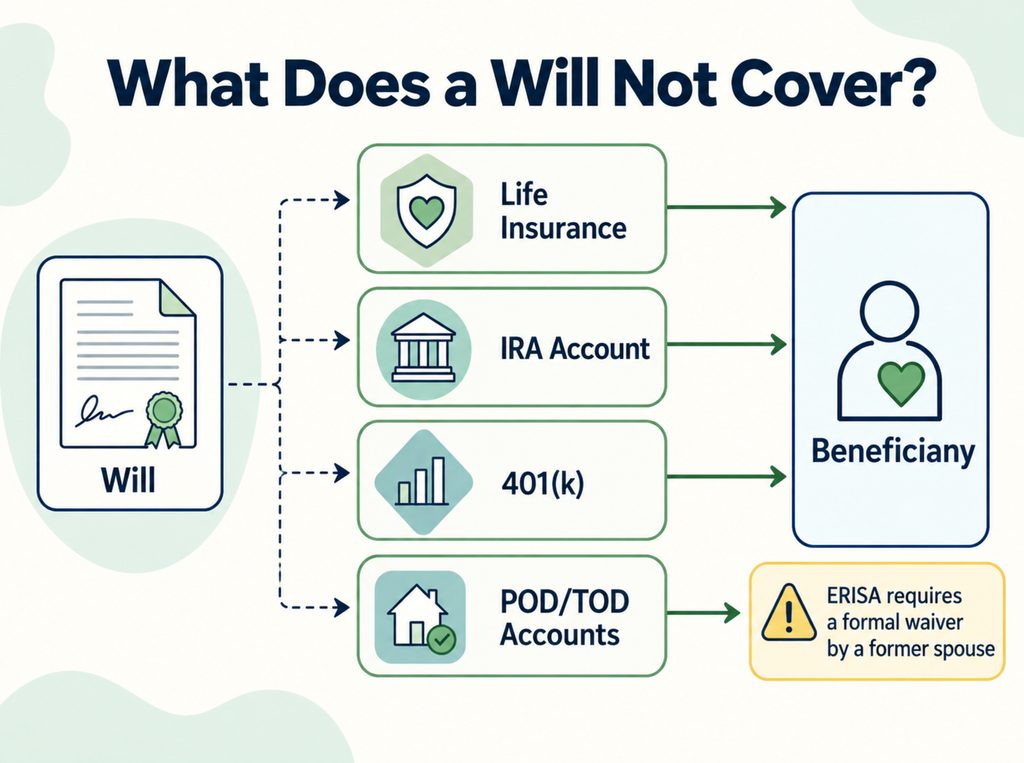
POD/TOD accounts, insurance policies, IRAs, and 401(k)s pass outside the will; in North Carolina, after divorce but before the beneficiary is changed, the funds will still go to the former spouse.
ERISA-governed retirement plans (401(k), 403(b)) require a formal waiver from the former spouse on the appropriate form before you remove them.
In your will, name a guardian for minor children and establish a trust with a neutral trustee; otherwise your former spouse may end up managing your children’s assets.
What to Do With Your Estate Plan Right After Divorce
The moment your divorce is final, your estate plan is almost certainly out of date and legally risky. A divorce decree does not automatically update every estate planning document: many must be revised by hand, and the specifics vary by state. Create a new will and verify your beneficiaries immediately, so your former spouse no longer controls your assets.
A note on jurisdiction. The principles below describe U.S. state law, not Polish law, and they differ across states such as Pennsylvania, Connecticut, North Carolina, and Indiana. Treat them as general guidance and confirm your own rules with a qualified attorney.
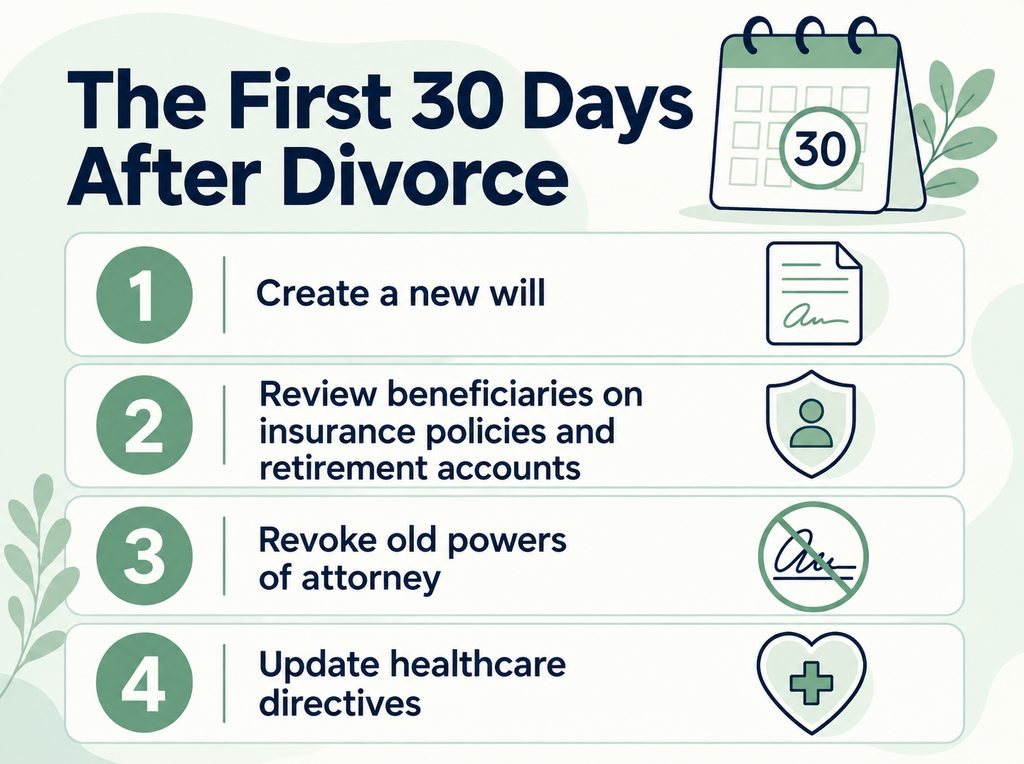
The first 30 days: a priority checklist
Start with the documents that courts and institutions treat independently of the decree. Draft a new will. Review beneficiary designations on life insurance and retirement accounts. Revoke any power of attorney or health care directive that still names your ex.
These act separately from your divorce judgment, so silence is not protection.
Why waiting is the biggest estate-planning mistake after divorce
Timing can be decisive. If a spouse dies during a pending divorce, before the final decree, the surviving spouse may, depending on state law, still inherit or serve as executor or trustee.
That said, do not race ahead recklessly. Consult a divorce attorney before changing documents, moving beneficiary designations, or transferring assets. Careless changes while the case is open may violate divorce law or amount to a fraudulent conveyance. Act promptly, but act with counsel.
How Divorce Affects Your Will and Who Inherits
In most U.S. states, a final divorce decree automatically revokes the revocable provisions in your will that favor a former spouse, treating that person as if they predeceased you. This removes them from both bequests and fiduciary roles like executor or trustee. Important: these are American state-law principles, not Polish law.
A quick caution before any specifics. Rules vary by state, and some trigger revocation at filing rather than at the final decree. Sound post-divorce estate planning treats this timing as central, not a footnote.
Automatic revocation statutes and their limits
Revocation statutes reach the will, but not every document. Trusts, powers of attorney, and health care directives are generally not revoked by statute. Connecticut illustrates the fine print: wills signed on or after January 1, 1997 stay valid post-divorce, with the ex treated as predeceased, while earlier wills are revoked and can push the estate into intestacy.
What happens if you die without updating your will
Timing can decide everything. Until a divorce is final, your spouse receives an intestate share even if you have lived apart for decades. If you die during a pending divorce, the surviving spouse may still inherit or serve as executor, depending on state law. A will generally remains valid, but statute or decree usually voids the provisions favoring your ex, so signing a new will is still necessary.
Is my ex entitled to my inheritance after divorce?
Some states grant a surviving spouse an elective share against the will. In Pennsylvania, that spouse may claim one-third of the augmented estate, but the right ends once divorce proceedings have been commenced. The only reliable fix is a new will drafted with counsel.
Updating Beneficiary Designations on Life Insurance and Retirement Accounts
A quick note on scope: post-divorce estate planning in this guide follows U.S. (state) law, not Polish law. Life insurance policies, 401(k)s, IRAs, and payable-on-death accounts do not change automatically when your divorce is finalized. These assets pass by contract, outside your will, so you must update each designation directly.
Why these assets override your will
Payable-on-death (POD) and transfer-on-death (TOD) accounts move straight to the named beneficiary. They never enter probate, and a will cannot redirect them. Even in states where a divorce decree automatically revokes a spousal beneficiary designation, the result is rarely clean.
Why? Because a previously unlikely contingent beneficiary, an ex-spouse’s relative, say, may suddenly become primary. Verify every designation by name.
ERISA and federal plans: a special caveat
Employer retirement plans governed by ERISA behave differently. On a 401(k) or 403(b), you generally cannot remove a soon-to-be ex-spouse until that person formally waives their rights on the plan’s required waiver form. After the decree, you update beneficiaries according to its terms.
State revocation-on-divorce statutes often do not reach these federal plans, and results vary by state. In North Carolina, if you die after divorce but before removing an ex-spouse from a contract-based account, IRA, 401(k), investment account, or life insurance, those funds pass to the ex-spouse anyway.
When to change a beneficiary after divorce
Update promptly once the decree is final, but consult counsel before touching anything while the case is pending. A qualified attorney protects you where state law could change the outcome.
Revoking Powers of Attorney and Health Care Directives
Your ex-spouse was almost certainly named as your financial agent and health care proxy. In post-divorce estate planning under U.S. state law, you should revoke both documents immediately and appoint a new, trusted person. Otherwise your former spouse may still make money or medical decisions for you.
Here is the trap most people miss. Legal separation during a divorce does NOT invalidate a power of attorney. If you named your spouse as your financial agent, that authority survives the separation and, in many states, survives the divorce itself, so it must be revoked immediately. Separation status alone does not strip the spouse of these powers.
Financial power of attorney
A durable financial power of attorney lets your agent sign checks, move investments, and manage property. Revoke it in writing without delay, and sign a new one naming someone you trust today.
Health care proxy and advance directives
Your health care proxy and living will decide who speaks for you if you are incapacitated. Replace them at the same time, so your ex is not left controlling medical choices.
How to formally revoke and notify institutions
Sign a written revocation, then distribute it. Send copies to banks, your doctors, hospitals, and anyone holding the old document, because actual notice matters.
Rarely, a divorced person genuinely wants an ex-spouse to keep serving as agent. There is a legal presumption against that, so the documents must expressly state the divorce and your intent. State rules vary, so confirm the details with a qualified attorney.
Protecting Your Children: Guardians, Trusts, and Who Manages Their Money
If you have minor children, name a guardian in your will and set up a trust so a neutral party manages their inheritance. Otherwise, under U.S. state law, assets left to minors can end up controlled by your ex-spouse on the children’s behalf.
Naming a guardian vs. a financial trustee
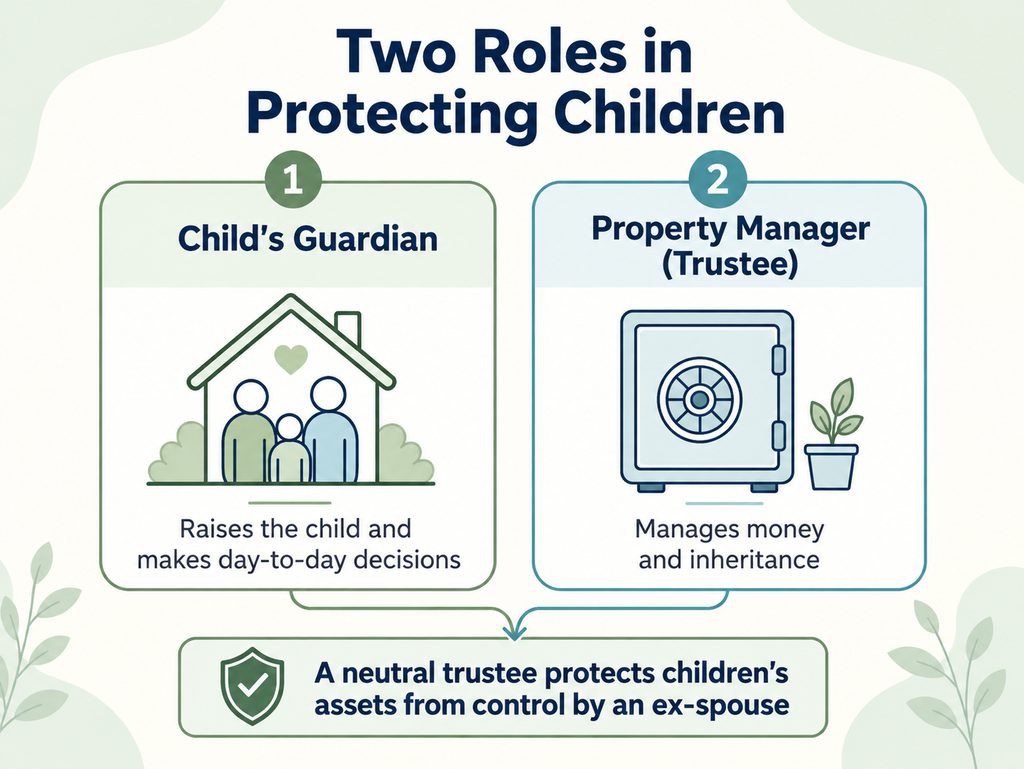
These are two distinct roles. A guardian of the person raises the child and makes daily decisions. A financial trustee (sometimes called a guardian of the estate) manages the money. The same person need not hold both jobs, and often should not.
Absent a trust, a court typically appoints a property manager to oversee a minor’s assets. In practice, that surviving parent is frequently your ex-spouse, which is precisely the outcome many divorced clients want to avoid.
Why a trust can keep your ex from managing the money
Qualified plans create a specific trap. If you name minor children as beneficiaries of an IRA or 401(k), the ex-spouse may gain control of those funds. Creating an IRA trust with a neutral trustee lets a chosen fiduciary manage the child’s inheritance and shields it from the children’s future creditors and spouses.
Dying intestate is worse. The state decides distribution and does not create protective trusts for children, so assets passed to minors may fall under your ex-spouse’s control.
Special-needs considerations
Irrevocable trusts are not automatically modified by divorce. An ex-spouse may remain trustee, co-trustee, trust protector, or beneficiary, and removing them can require decanting or a nonjudicial settlement agreement: a slow, costly process. State law varies, so confirm the mechanics with a qualified attorney.
Dividing Titles, Property, and the Costs of a New Plan
Before you consider your post-divorce estate plan complete, confirm that your homes, vehicles, and business interests have actually been retitled to match the divorce decree. Post-divorce estate planning treats a signed decree and an updated title as two different things. These are U.S. state-law principles, and the mechanics vary by state.
Retitling real estate and vehicles after the decree
A decree may award you the house, but it does not move the deed by itself. Changing ownership of real estate titled in both spouses’ names requires both signatures. Here is the trap people miss: removing a spouse from the deed does not release that person from the mortgage. Lenders usually require a refinance to drop a co-borrower.
Separate vs. marital property basics
Separate property principles differ sharply across the country. Community-property states and common-law states apply different default rules, so assets you treat as yours may be classified differently depending on where you live. Confirm the classification with a qualified attorney.
How much a new will and estate plan typically cost
Costs for a new will versus a trust vary widely by state and complexity, so treat any figure as a dated estimate rather than a fixed price. Budget separately for new deeds, recording fees, and beneficiary changes.
|
Document |
General cost driver |
|---|---|
|
Simple will |
Low; flat-fee in many offices |
|
Revocable living trust |
Higher; funding adds work |
|
Deed transfer |
Recording fees plus drafting |
After divorce, the benefit of combining spousal estate-tax exemptions disappears and deferral shortens from two lives to one.
Quick Answers to the Questions Divorced Clients Ask Most
The answers below follow U.S. state law, not Polish law, and timing plus your home state can change every outcome. Treat these as general principles, then confirm the specifics with a qualified attorney before you act.
Is my ex-spouse entitled to my inheritance after divorce?
Generally no, once the divorce is final. In most U.S. states, a final divorce decree automatically revokes the gifts and fiduciary roles you left your former spouse, treating them as if they predeceased you. The catch is timing. Until the divorce is final, a spouse can still receive an intestate share, even after decades of separation.
Do I have to share my inheritance if I get divorced?
This depends on state law and how the property was handled. An inheritance kept separate is often protected, but it can lose that protection if you commingle it with marital assets. Property questions like this belong to divorce law, not estate planning, so raise them with your divorce attorney early.
How much does it cost to update a will after divorce?
Costs vary widely by state, attorney, and complexity, so treat any figure as a dated estimate and request a written quote. A straightforward new will costs less than a trust-based plan. Either way, signing a new will after divorce is still necessary to avoid costly disputes, even though the decree already voids most provisions favoring your ex.
Can a gift I made to my former spouse be reversed?
Usually not automatically. A completed gift generally stands, and assets placed in an irrevocable trust may keep your ex as trustee or beneficiary unless you decant or reach a settlement agreement. Ask an attorney before you attempt any transfer during a pending case.
What financial steps should I take first after a divorce?
Start by rewriting your will and amending any revocable living trust that still names your ex; the trust remains valid but must be amended. Then update beneficiary designations, revoke old powers of attorney, and confirm titles match the decree. State rules differ, so a qualified attorney should anchor the plan.
Sources / Bibliography
ballardspahr.com/insights/alerts-and-articles/2026/07/when-marriage-ends-estate-planning-begins-the-importance-of-estate-planning-during-and-after-divorce – Ballard Spahr – When Marriage Ends, Estate Planning Begins
kkc-law.com/resources/blog/when-youre-no-longer-a-couple-estate-planning-after-divorce-or-death – KKC Law – Estate Planning After Divorce or Death
klenklaw.com/practices/estate-planning/important-documents-for-life-events/estate-planning-and-divorce – Klenk Law – Estate Planning and Divorce