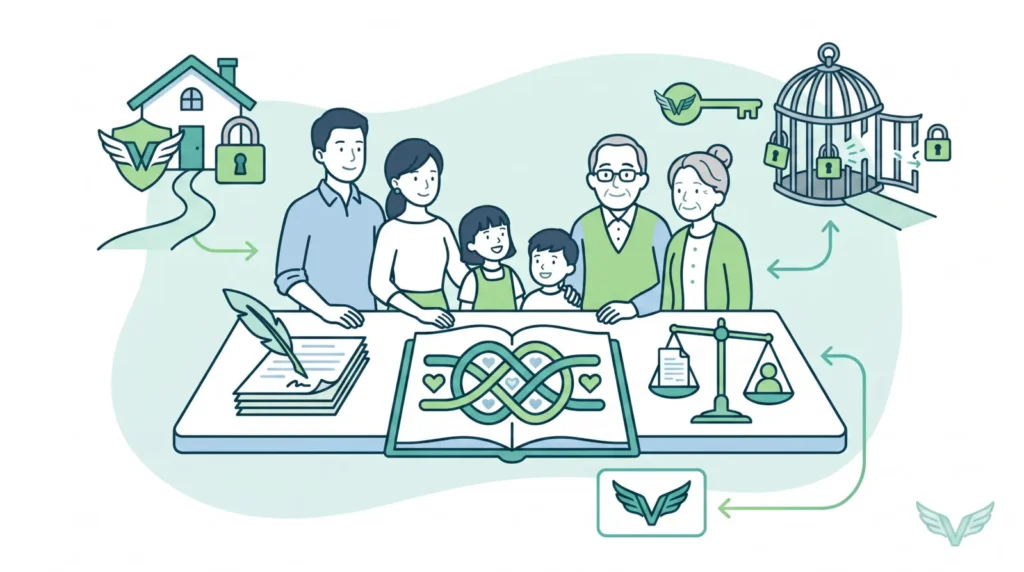
Estate planning for blended families protects your spouse and your children from a prior marriage at the same time – two goals that default state law frequently puts in conflict. Leave everything outright to a new spouse, and your biological children can inherit nothing once that spouse remarries or rewrites their own will. This guide walks through the intestacy risks, the QTIP and bypass trusts that solve them, the beneficiary-form mistakes that override any will, and the six documents every remarried couple needs in 2026.
Key takeaways
- More than 50% of Americans are part of a stepfamily at some point, so blended-family planning is mainstream, not niche.
- Leaving everything outright to a new spouse can disinherit your own kids, since that spouse can remarry or rewrite their will at the second death.
- Even with a will, most states give a surviving spouse an elective share of about one-third of the estate that you cannot fully disinherit around.
- A QTIP trust gives your surviving spouse income for life while guaranteeing the remaining principal passes to your children.
- Beneficiary forms on a 401(k), IRA, or life insurance override your will, so an outdated ex-spouse listing inherits regardless of the will.
- The 2026 federal estate-tax exemption is $15 million per individual, letting a married couple shelter close to $30 million with portability.
- Every blended family needs six documents: a will, trust, durable power of attorney, healthcare proxy, updated beneficiary forms, and a prenup or postnup.
Why Estate Planning for Blended Families Is Uniquely High-Stakes
A standard will or default state law often sends everything to your new spouse first, quietly disinheriting your biological children. The core tension is simple to state and hard to solve: provide for a surviving spouse while preserving assets for kids from an earlier relationship. This is mainstream planning, not a niche problem. More than 50% of Americans have been or will be part of a stepfamily during their lifetime, and 17% of U.S. children under 18 live in a blended household most or all of the time. Roughly 21% of opposite-sex couples are blended.
The accidental disinheritance risk
Here is the trap that defines accidental disinheritance in a blended family. Leaving property outright to a surviving spouse does not guarantee your children ever benefit. That spouse can remarry, rewrite their will, or direct everything to their own biological children, cutting your kids out at the second death. About two-thirds of divorced Americans remarry, and close to 40% of new marriages are a remarriage for at least one partner. The scenario is common, not rare.
Commingled assets and ex-spouse complications
Separate property is what you owned before the marriage; commingled property is what got mixed together afterward, like a joint account both spouses fund. Once separate funds blend into shared accounts, tracing who owned what gets difficult, and that ambiguity fuels disputes between a surviving spouse and adult stepchildren.
What Happens With No Will: Intestate Succession and a Spouse’s Right of Election
Die without a will, and state intestacy law decides everything – usually splitting assets between your spouse and biological children in fixed shares, while a non-adopted stepchild inherits nothing. Even with a will, most states grant a surviving spouse a statutory right of election to claim roughly one-third of the estate. That single rule reshapes almost every blended-family plan.
How intestacy divides a blended estate
Without a will, a typical split lets the surviving spouse keep their marital or community-property share, while the decedent’s separate share passes to biological or adopted children. Exact fractions turn on state law and on whether you live in a community-property or common-law state. Stepchildren inheritance rights do not exist under intestacy: a stepchild collects nothing unless legally adopted or specifically named.
The elective share you cannot disinherit around
The elective share is a floor, not a suggestion. A surviving spouse can claim it even when your will leaves them less, and it is paid out of the assets you meant for your children. Percentages vary widely by state and, sometimes, by the length of the marriage.
| State approach | Elective share | Note |
|---|---|---|
| Uniform Probate Code baseline | ~1/3 | Common default |
| Florida | Fixed 30% | Statutory rate |
| North Carolina | 33% if married 10-15 yrs; 50% if 15+ | Sliding scale |
Because the elective share cannot be waived by will alone, remarried couples usually address it with a prenup, a postnup, or a trust structure that satisfies the spousal claim while protecting the children’s principal.
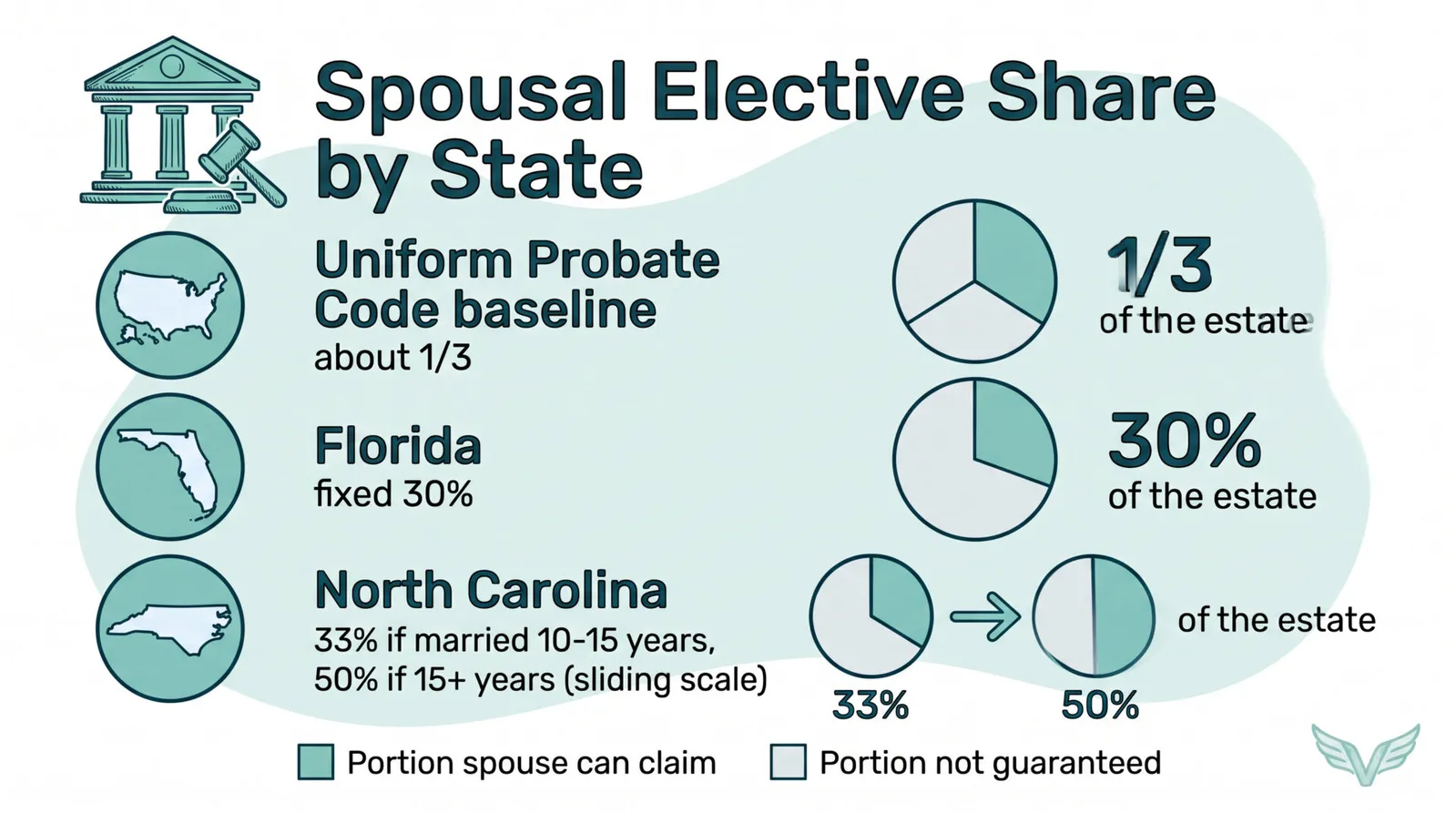
Source: Uniform Probate Code, Fla. Stat. Ch. 732, North Carolina elective-share statute
The Best Trusts for a Blended Family: QTIP, Revocable Living, and Bypass Trusts
The QTIP trust blended family strategy is the go-to tool. A Qualified Terminable Interest Property (QTIP) trust gives your surviving spouse income for life while guaranteeing the remaining principal passes to your children. Revocable living and bypass trusts add day-to-day control and tax efficiency on top.
How a QTIP trust works
Your spouse receives a life estate – income and the right to live in the home – but never ownership or the power to redirect the principal. At the spouse’s death, whatever remains flows to the children you named. QTIP assets also qualify for the marital deduction, so no estate tax is due at the first death. The 2026 federal estate-tax exemption sits at $15 million per individual after the One Big Beautiful Bill amendments, up from $13.99 million in 2025. Portability lets a married couple shelter close to $30 million.
How a QTIP trust balances a surviving spouse’s income with the children’s inheritance
Revocable living trust vs bypass (credit shelter) trust
An AB or bypass trust splits assets in two. Trust A stays revocable and lets the survivor manage their own share; Trust B is irrevocable, holds the deceased spouse’s assets, and names beneficiaries the survivor cannot change. That structure shelters the exemption and locks in the deceased spouse’s heirs.
Naming a neutral co-trustee
Naming a professional or corporate co-trustee alongside the surviving spouse lowers the odds of a family fight over discretionary payouts. A neutral fiduciary answers to the trust terms, not to one side of the family.
How to Leave Assets to Both Your Spouse and Children From a Prior Marriage
You do not have to choose between your spouse and your kids. A life-estate arrangement, an ILIT-funded insurance payout, and a clear equal-versus-unequal decision let you provide for both. This is where protecting children from a previous marriage inheritance becomes concrete.
Using life insurance and an ILIT to equalize inheritances
An irrevocable life insurance trust (ILIT) owns the policy, so the death benefit stays outside your taxable estate. The trust collects the payout and distributes it under its own terms, and it can fund the liquidity to cover estate taxes on illiquid assets like a home or business. Naming children from a prior marriage as insurance beneficiaries frees up other assets for a younger spouse, so the kids do not wait years to inherit.
Equal vs unequal shares for step and biological children
Fairness is not the same as equality. One father who split his estate equally among two biological children and a stepson faced a backlash from his own kids and reconsidered the plan. Separate, independent trusts – one for biological children, one for other family members – prevent commingling and reduce that friction.
The family home dilemma
The marital home is usually the most emotionally charged asset. A life estate lets the surviving spouse live there while guaranteeing the property passes to your biological children at the survivor’s death, with conditions attached: the spouse pays taxes, insurance, and upkeep.
The Ex-Spouse Trap: Beneficiary Designations and Retirement Accounts
Your 401(k), IRA, and life insurance pass by beneficiary designation and override your will completely. If an ex-spouse is still listed, that person inherits no matter what your will says – the single most overlooked step for remarried couples.
Why beneficiary forms beat your will
A beneficiary-designation conflict in a blended family usually starts with an outdated form. When the form and the will disagree, the form wins. Updating retirement and insurance beneficiaries after remarriage takes minutes and prevents years of litigation. Digital and crypto assets deserve the same review, since many pass by account access rather than by will.
Retirement accounts and the SECURE Act payout rules
The SECURE Act 10-year rule forces most non-spouse beneficiaries who inherit in 2020 or later to empty an inherited IRA within 10 years, replacing the old lifetime stretch and accelerating the income tax due. Account type also drives consent rules. A 401(k) governed by ERISA makes your current spouse the automatic primary beneficiary, so naming anyone else requires written, notarized spousal consent. IRAs generally do not require that consent.
Essential Documents, the 5 by 5 Rule, and When to Update After Remarriage
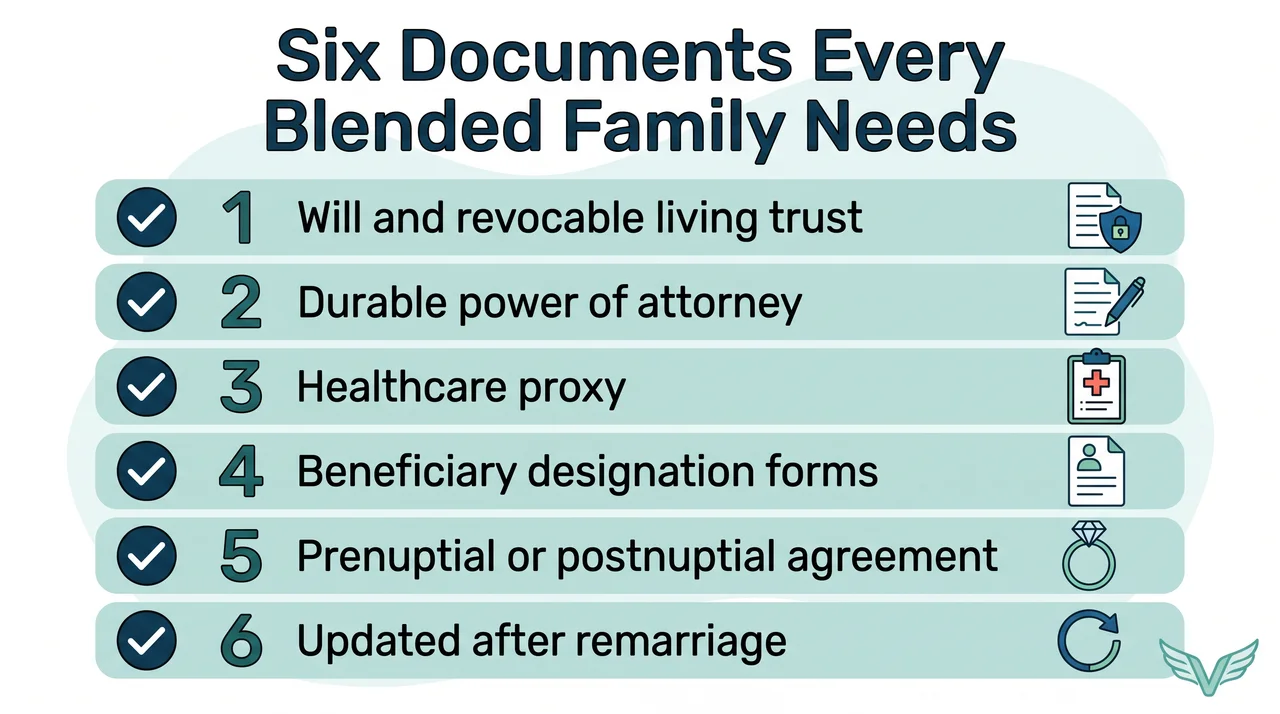
Every blended family needs six core documents: a will, a trust, a durable power of attorney, a healthcare proxy, updated beneficiary forms, and a prenup or postnup. The 5 by 5 rule lets a trust beneficiary withdraw the greater of $5,000 or 5% of the trust’s fair-market value each year. Review the whole plan within months of remarriage.
The 6-document checklist
- Will and revocable living trust
- Durable power of attorney
- Healthcare proxy
- Beneficiary designation forms
- Prenuptial or postnuptial agreement
Do not automatically name your spouse or eldest child as executor or power of attorney; a neutral party avoids conflict over money and medical decisions.
What the 5 by 5 rule means
On a $200,000 trust, the beneficiary may withdraw up to $10,000 in a year, because 5% exceeds the $5,000 floor. The rule gives access to funds without handing over full control – a balance that suits blended families.
Prenups, postnups, and the remarriage trigger
A prenuptial or postnuptial agreement keeps assets separate and spells out obligations to a prior spouse or children, protecting a vacation home or business for your own kids. Remarriage is the clearest review trigger there is.
Quick Answers to 6 Questions Readers Ask Most
What is the 5 by 5 rule in estate planning?
The 5 by 5 rule lets a trust beneficiary withdraw the greater of $5,000 or 5% of the trust’s fair-market value each year. On a $200,000 trust, that means up to $10,000 annually. It gives beneficiaries limited access to funds while a trustee still controls the bulk of the principal for long-term protection.
How do I protect my assets from my stepchildren?
Use a trust that names your biological children as remainder beneficiaries, so a surviving spouse receives income but cannot redirect the principal. Separate trusts for each side of the family prevent commingling. Keep beneficiary forms current, and consider a prenup or postnup that defines which assets stay yours.
How do blended families handle inheritance?
Most combine a QTIP or bypass trust with life insurance and clear beneficiary designations. The trust supports the surviving spouse for life, then passes principal to the children from a prior marriage. Life insurance or an ILIT equalizes shares, and a neutral co-trustee reduces disputes among spouse, biological children, and stepchildren.
What is the best trust for a blended family?
The QTIP trust is the most common choice because it supports the surviving spouse with income for life while guaranteeing the remaining principal goes to your children. Bypass trusts add estate-tax sheltering, and a revocable living trust adds control and probate avoidance. The right mix depends on your assets and state law.
Can a stepchild inherit if they are not named in a will?
Generally no. A stepchild who was never legally adopted inherits nothing under intestacy and is left out of most state minor-child protections unless specifically named in your will or trust. If you want a stepchild to inherit, name them explicitly or complete a legal adoption.
When should a blended family update its estate plan?
Review the plan within months of a remarriage, and again after any birth, adoption, death, divorce, or major asset change. Remarriage is the strongest trigger because it changes elective-share rights, beneficiary priorities, and guardianship needs. Updating beneficiary forms is the fastest, highest-impact step to complete first.
Blended Family Estate Planning in Practice: 3 Moves That Prevent the Costliest Family Fights
After watching how these plans hold up, three moves matter most. First, update every beneficiary designation today – it overrides your will and takes minutes. Second, build the plan around a QTIP or revocable trust so your spouse is cared for without disinheriting your children. Third, have an open conversation with all the children before anything is signed. The disputes I see are rarely about the law; they are about surprise. Confirm your state’s elective-share and community-property rules with a blended-family estate attorney, then talk it through while everyone can still ask questions.
Sources
- financialplanningassociation.org/article/journal/JAN22-navigating-estate-planning-blended-families-OPEN – Financial Planning Association: journal analysis of blended-family estate planning, elective share, life estates, ILITs, and core documents.
- pewresearch.org/short-reads/2026/04/21/5-facts-about-u-s-children-living-in-blended-families – Pew Research: 5 facts about U.S. children in blended families, April 2026.
- firstcitizens.com/wealth/insights/estate-planning/estate-planning-for-blended-families – First Citizens Bank: estate planning for blended families, QTIP, bypass trusts, ILIT, Census 21% figure.
This article is for informational purposes only and does not constitute legal advice. U.S. law is complex and varies by state and circumstance. For your specific situation, consult a licensed attorney.