
Probate is a public court process that can take 3-7% of an estate’s gross value and run from six months to more than two years. Probate Avoidance Strategies move assets out of the probate estate while you are alive, so they pass straight to your heirs. The three strongest levers are a funded revocable living trust, beneficiary designations on financial accounts, and survivorship ownership of property. This guide breaks down each strategy by asset type, covers state rules for California, Texas, Florida, and New York, and flags the mistakes that quietly void an otherwise solid plan.
In Brief
- Probate can consume 3-7% of an estate’s gross value in court costs and legal fees.
- Probate usually runs from six months to over two years, while California probate typically takes 9 to 18 months.
- California’s statutory probate fees can leave a mid-sized estate owing $46,000 to $86,000 before heirs receive anything.
- Attorney-drafted revocable living trusts cost $1,500-$3,500 nationally ($2,000-$6,000 in California), versus $300-$600 for a basic will.
- POD/TOD accounts, IRAs, 401(k)s and life insurance with a living named beneficiary skip probate automatically.
- Transfer-on-death deeds are available in about 30 states plus Washington, D.C., and Maryland adds one on October 1, 2026.
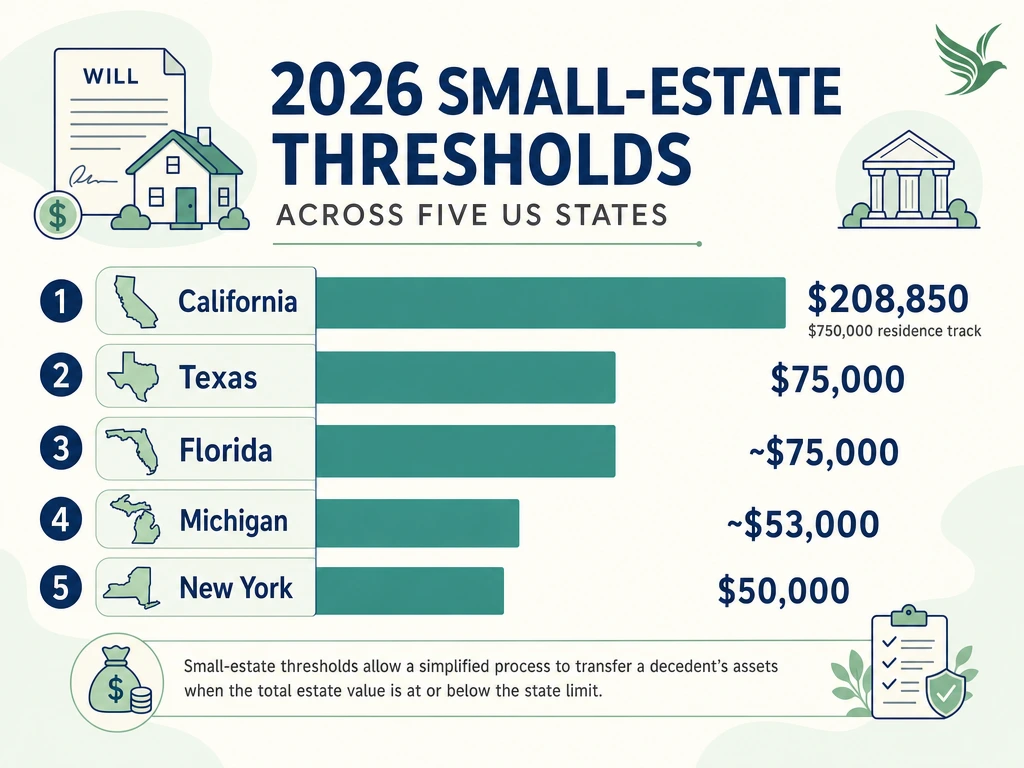
- Small estate thresholds vary: $75,000 in Texas and Florida, $50,000 in New York, and $208,850 in California.
Why Probate Avoidance Strategies Matter: Cost, Time, and Privacy
Probate typically consumes 3-7% of an estate’s gross value in court costs and legal fees, runs from six months to more than two years, and every filing becomes a public record. Cost, delay, and exposure are the three pressures that push most estate plans toward keeping assets out of court.
How much probate costs and how long it takes
California shows how steep the bill gets. The state applies a statutory fee schedule to the gross estate: 4% on the first $100,000, 3% on the next $100,000, 2% on the next $800,000, then smaller tiers above that. A mid-sized estate can owe $46,000 to $86,000 in combined fees before heirs receive anything. Timelines stretch too. California probate usually takes 9 to 18 months, while the national range spans six months to over two years.
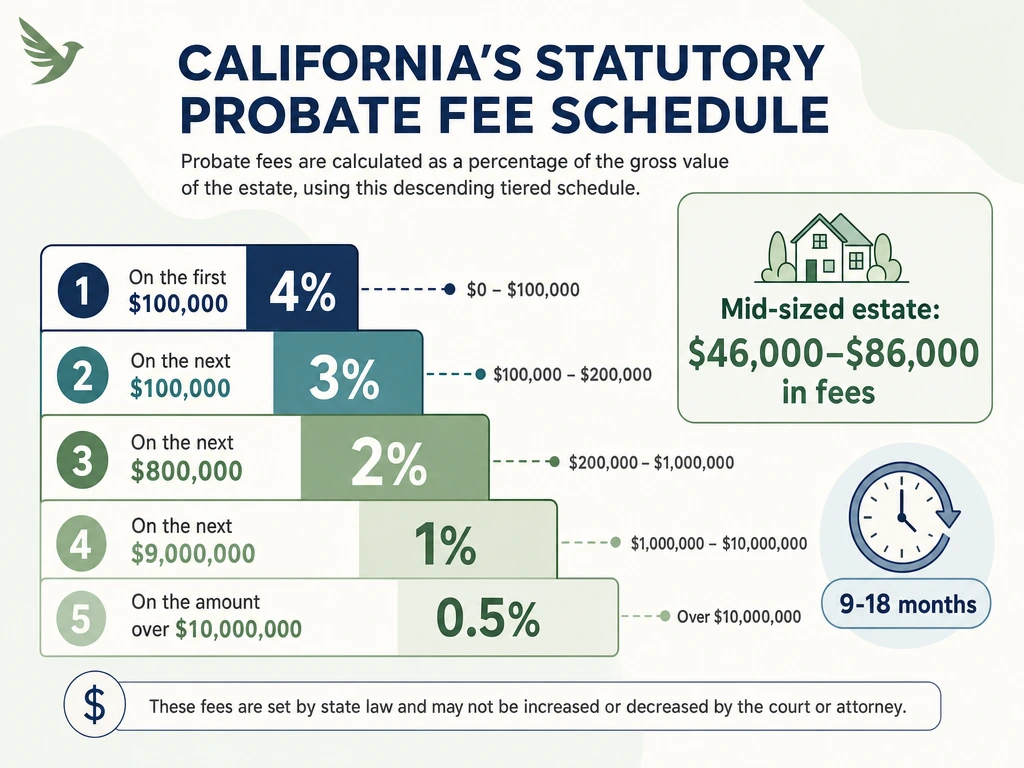
Source: California statutory fee schedule; Neptune Society and Probate Calculator data
When probate is not the problem
Small estates often skip full probate. When assets fall under a state threshold, such as $75,000 in Texas, families can use a simplified transfer instead. If your estate is modest and already held in survivorship form, an aggressive plan may add cost without benefit. An honest asset audit beats a reflexive trust purchase.
Revocable Living Trust: The Single Strongest Probate Avoidance Strategy
A revocable living trust holds legal title to your assets, so at death they pass to beneficiaries without court involvement. A will alone does not do this. In California, a will must still be filed with the county within 30 days of death and can send assets straight into probate.
How a living trust avoids probate
Because the trust, not you personally, owns the property, there is no probate estate to administer. You act as your own trustee while alive, keep full control, and name a successor trustee to distribute assets privately after death. Attorney-drafted revocable trusts typically cost $1,500 to $3,500 nationally, and $2,000 to $6,000 in California, versus $300 to $600 for a basic will. DIY and online trusts start near $400.
Trust funding and the pour-over will
A trust works only if you fund it by retitling accounts and deeds into the trust’s name. Any asset left out can fall into probate. In California, a Heggstad petition can pull an omitted asset into the trust for roughly $6,000 to $8,000, cheaper and faster than probate. A pour-over will acts as a backup, catching stray assets and naming guardians for minor children.
Irrevocable vs revocable trust
Both avoid probate, yet they differ on control and taxes. A revocable trust gives privacy and flexibility but offers no creditor protection and no estate tax reduction. An irrevocable trust removes assets from your taxable estate and shields them from creditors, at the cost of giving up control.
Beneficiary Designations, POD, TOD, and Joint Tenancy: Transfers Without a Trust
When a trust feels too costly, assets can still skip probate through a beneficiary designation, a payable-on-death (POD) or transfer-on-death (TOD) account, or co-ownership with survivorship rights. Probate reaches only assets owned solely by the deceased with no named beneficiary and no co-owner.
Payable-on-death and transfer-on-death accounts
Payable-on-death applies to bank accounts, while transfer-on-death covers brokerage and investment accounts. Both let you keep full control while alive, with the balance passing to your named person at death. Setting one up takes three steps:
- Ask your bank or brokerage for a beneficiary or POD form.
- Name a primary beneficiary and at least one contingent beneficiary.
- Sign, submit, and keep a copy with your records.
Joint tenancy with right of survivorship
Joint tenancy with right of survivorship (JTWROS) passes a co-owner’s share automatically. But joint tenancy without a written right of survivorship does not avoid probate, because the deceased owner’s share goes to their heirs instead. Survivorship must be created in writing.
Keeping designations current
Beneficiary and POD/TOD designations override both your will and your trust, so review them every few years and after major life events. A trust can even be named as beneficiary to protect minor children.
Probate Avoidance Strategies for Your Home: TOD Deed and Lady Bird Deed
Real estate can pass outside court through a transfer-on-death (beneficiary) deed or an enhanced life estate deed, often called a Lady Bird deed, with no trust required. A second home in another state needs extra attention to avoid a separate probate case.
Transfer-on-death deed step by step
A TOD deed is available in about 30 states plus Washington, D.C., under the Uniform Real Property Transfer on Death Act. You keep full ownership while alive and can sell or revoke at any time; the property transfers only at death. Some states, including Pennsylvania and Georgia, do not offer it, and Maryland adds it on October 1, 2026. To use one, record the signed deed with the county land records before death.
Lady Bird deed
A Lady Bird deed exists in five main states: Florida, Texas, Michigan, Vermont, and West Virginia. The owner keeps full control and can sell or change beneficiaries without consent. In Texas, the transfer-on-death deed has been available since September 1, 2015, must be recorded before death, and takes priority over a will.
Ancillary probate for an out-of-state home
Property in another state can trigger ancillary probate, a separate case in each state where you own real estate. A trust or a TOD/Lady Bird deed on that property avoids the second proceeding.
Avoiding Probate by Asset Type: IRA, 401(k), Life Insurance, Brokerage, Vehicles, and Digital Assets
Retirement accounts, life insurance, and brokerage accounts with a named beneficiary or TOD registration pass outside probate automatically. Vehicles and digital assets are the traps people forget.
Retirement accounts and insurance
An IRA, 401(k), or life insurance policy with a living named beneficiary bypasses probate. The common error is naming “my estate” or “all my heirs,” which forces the asset back through court. A second error is skipping a contingent beneficiary; if the primary dies first, the asset lands in probate.
Brokerage accounts and vehicles
Brokerage accounts use TOD registration to name a beneficiary. Several states allow a TOD or beneficiary on a vehicle title, including California, Virginia, South Carolina, and Nevada. In Texas, spouses can add survivorship through a DMV form while alive, and heirs use an Affidavit of Heirship after death.
Cryptocurrency and digital accounts
Access to digital assets is governed by RUFADAA, adopted in most states. An executor or trustee can reach crypto and online accounts only when your planning documents expressly grant that authority, and platform terms of service still matter. Tangible items without a title or co-owner, such as furniture and jewelry, remain probate assets.
State-by-State Probate Avoidance Strategies: California, Texas, Florida, New York, and Small Estate Affidavits
Rules shift by state. Community property with right of survivorship helps spouses in California and Texas, Florida adds homestead protection, and New York probate is costly enough to justify layered planning. For modest estates, a small estate affidavit shortens or removes the process.
California and Texas survivorship
Community property with right of survivorship is available in community property states, including Arizona, California, Nevada, Wisconsin, and Texas. The whole marital asset passes to the surviving spouse without court. California generally requires full probate above roughly $208,000 unless assets sit in a trust or survivorship form.
Small estate thresholds
Thresholds vary widely in 2026, as the table shows.
| State | Small estate threshold (2026) |
|---|---|
| California | $208,850, plus a $750,000 residence track |
| Texas | $75,000 |
| Florida | ~$75,000 (summary administration) |
| New York | $50,000 |
| Michigan | ~$53,000 |
California’s $208,850 limit took effect on April 1, 2025, with a separate track up to $750,000 for a residence under AB-2016.
Florida and New York specifics
New York’s Surrogate’s Court process is formal and expensive, which is why practitioners list more than a dozen avoidance techniques there. Florida offers summary administration for estates around $75,000, and its homestead rules shape how the family home passes.
Planning for Couples, Singles, Blended Families, and Aging Parents
Married couples get spousal survivorship shortcuts that singles do not, blended families risk unintentionally disinheriting children, and adult children helping a parent should start with a title audit. Each situation changes which probate avoidance tools fit.
Married couples vs a single person
Spouses can use a joint revocable living trust or, in Texas, community property with right of survivorship recorded at the county. Assets then pass to the survivor without court. A single person has no spousal shortcut and must rely on a trust, POD/TOD accounts, and beneficiary designations.
Blended families and business owners
In a blended family, JTWROS and survivorship arrangements can send assets to a co-owner or new spouse and then on to their heirs, cutting out children from a first marriage. A business owner faces a similar gap, since an LLC interest without a buy-sell agreement or trust transfer passes through probate.
Helping an aging parent with no will
Start with an audit of every title and beneficiary designation. Without a will, assets pass by intestacy under state rules. Some states, such as Arizona, offer a beneficiary deed and POD/TOD tools that transfer directly and keep the home out of court.
Quick answers to 6 reader questions
Is avoiding probate a good idea?
Usually yes, if your estate would otherwise face meaningful cost or delay. Probate can take 3-7% of estate value and months to years. For a small estate under your state’s threshold, though, a simplified transfer may cost less than building a trust.
Do bank accounts go through probate?
A bank account goes through probate only if it is solely owned with no payable-on-death beneficiary and no joint owner. Add a POD beneficiary and the balance transfers directly, outside court.
Which assets automatically avoid probate?
Assets with a beneficiary or survivorship feature skip probate: POD/TOD accounts, IRAs and 401(k)s, life insurance with a named beneficiary, JTWROS property, and real estate held in a trust or under a TOD deed.
Who determines if probate is necessary?
The probate court, sometimes called Surrogate’s Court, decides, based on what the deceased owned alone. Assets titled solely in their name with no beneficiary generally require probate.
Does having a will help you avoid probate?
No. A will does not avoid probate; it directs how probate assets are distributed and still passes through court. In California, the will must be filed with the county within 30 days of death.
How do you avoid probate without a trust?
Use beneficiary designations, POD/TOD accounts, JTWROS or community property survivorship, and a TOD or Lady Bird deed for real estate. These transfer assets directly without the cost of drafting and funding a trust.
Probate avoidance in practice: 3 mistakes that void even a good estate plan
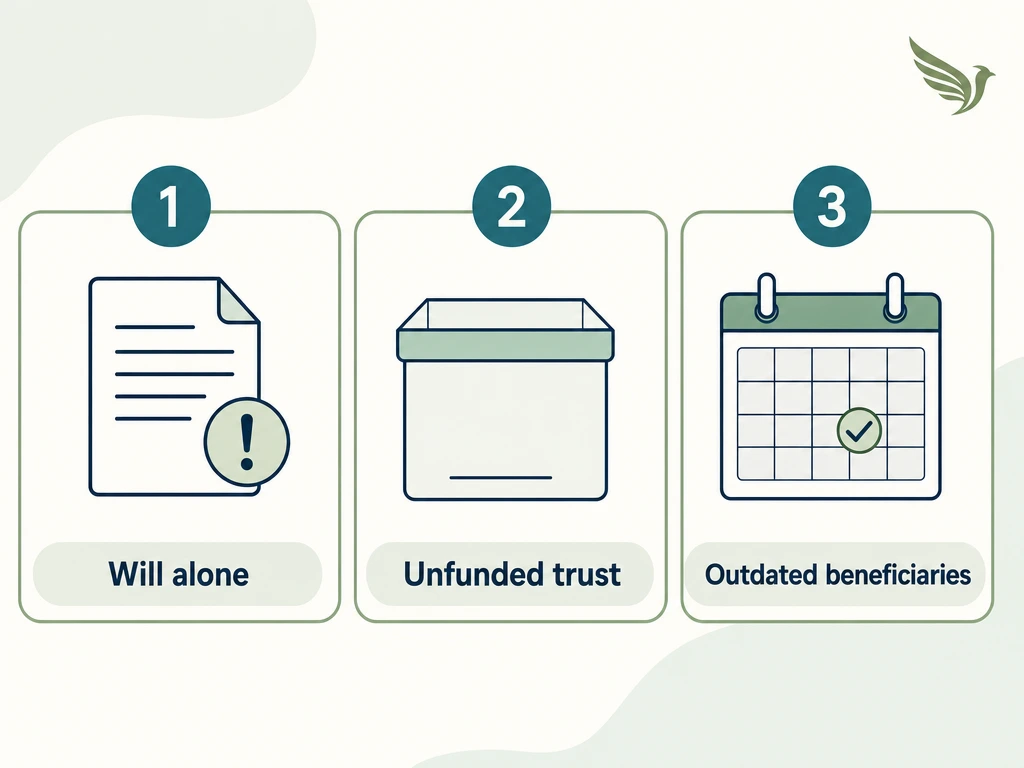
Three errors show up again and again. First, believing a will avoids probate; it does not, and treating it as your whole plan guarantees a court case. Second, drafting a trust and never funding it, which leaves assets exposed. Third, letting beneficiary designations go stale, so an ex-spouse or a deceased primary beneficiary still controls an account. Your next step is concrete: audit each asset (home, bank, IRA/401(k), life insurance, vehicle, business) and confirm the trust is funded.
Sources
- probatecalculator.org/insights/probate-costs-by-state – Probate Calculator: probate cost percentages by state.
- selfhelp.courts.ca.gov/probate/formal-probate – California Courts self-help: formal probate timeline.
- lifegenlawgroup.com/5-reasons-to-avoid-probate-and-how-to-do-it – Lifegen Law Group: reasons probate is slow, costly, and public.
This article is for informational purposes only and does not constitute legal advice. U.S. law is complex and varies by state and circumstance. For your specific situation, consult a licensed attorney.