
A revocable living trust avoids probate only for the assets you legally retitle into its name. A signed trust that owns nothing sends your estate through probate anyway, which defeats the reason you paid for it. The document is step one. The funding process – moving your house, accounts, and business interests into the trust – is what actually delivers privacy and probate avoidance. This guide walks the funding checklist asset by asset, flags the accounts that skip the trust by design, and corrects the biggest myths about protection, taxes, and Medicaid.
Key takeaways
- A revocable living trust avoids probate only for assets you legally retitle into its name; a signed but unfunded trust still sends your estate to probate.
- Retirement accounts like a 401(k), IRA, and 403(b) should not be retitled into the trust and instead pass by beneficiary designation.
- A revocable trust gives no creditor protection, no lifetime tax savings, and no Medicaid shield because you keep full control, and Medicaid applies a 5-year look-back.
- A pour-over will catches assets you forgot to transfer but still sends those specific assets through probate before they enter the trust.
- Real estate is retitled with a new deed, often a quitclaim deed, that must be signed, notarized, and recorded; Maryland charges a $40 flat recording fee.
- An attorney-drafted revocable trust for a simple estate typically costs about $2,000 to $3,500 in 2026, while online options run roughly $400 to $1,000.
- Simple estates release assets within weeks, while full settlement of a complex estate can take up to 18 months, still beating probate.
Why a Signed Revocable Living Trust That Owns Nothing Does Nothing
A living trust is ineffective until the grantor transfers money or property into it. The trustee holds legal power only over assets actually held in the trust and has no authority over anything left outside it. Sign the paperwork, skip the funding, and your estate still lands in probate.
The gap between signing and funding
Funding a revocable living trust means retitling ownership so the trust, not you personally, holds legal title. This differs from signing, which only creates the legal container. If you fail to retitle your home into the trust, that property will most likely pass through probate despite the trust existing. Correct deed titling is what makes the plan work as intended.
Why probate happens even with a trust
Assets avoid probate because legal title belongs to the trust rather than the individual, and that formal transfer of ownership is the mechanism doing the work. An unfunded or underfunded trust is a common, well-documented problem that produces probate, family disputes, and litigation. The Certificate of Trust in your binder proves nothing if the deed still names you.
How a Revocable Living Trust Works: Grantor, Trustee, and Successor Trustee
You create the trust as grantor, name yourself initial trustee to keep full control, and pre-select a successor trustee who takes over if you become incapacitated or die. The trust stays fully changeable while you are alive and competent.
The three roles explained
Three roles run every revocable living trust: the settlor (also called grantor or trustor) who creates it, the trustee who manages the assets, and the beneficiaries who receive them. During life the grantor usually serves as their own trustee. The successor trustee steps in only when the current trustee can no longer serve because of death or incapacity.
Trustee vs executor difference
A trustee is a fiduciary with legal power to spend and invest trust property for beneficiaries, but never over assets outside the trust. An executor handles the probate estate under a will. The successor trustee responsibilities cover only what the trust holds, which is exactly why funding decides how much they can manage.
When a revocable trust becomes irrevocable
A revocable trust becomes irrevocable at the grantor’s death, and from that moment no one can change its terms. It then distributes assets to beneficiaries while keeping them outside heirs’ personal estates. Full settlement of a complex estate can take up to 18 months, though simple estates release assets in weeks and still beat probate.
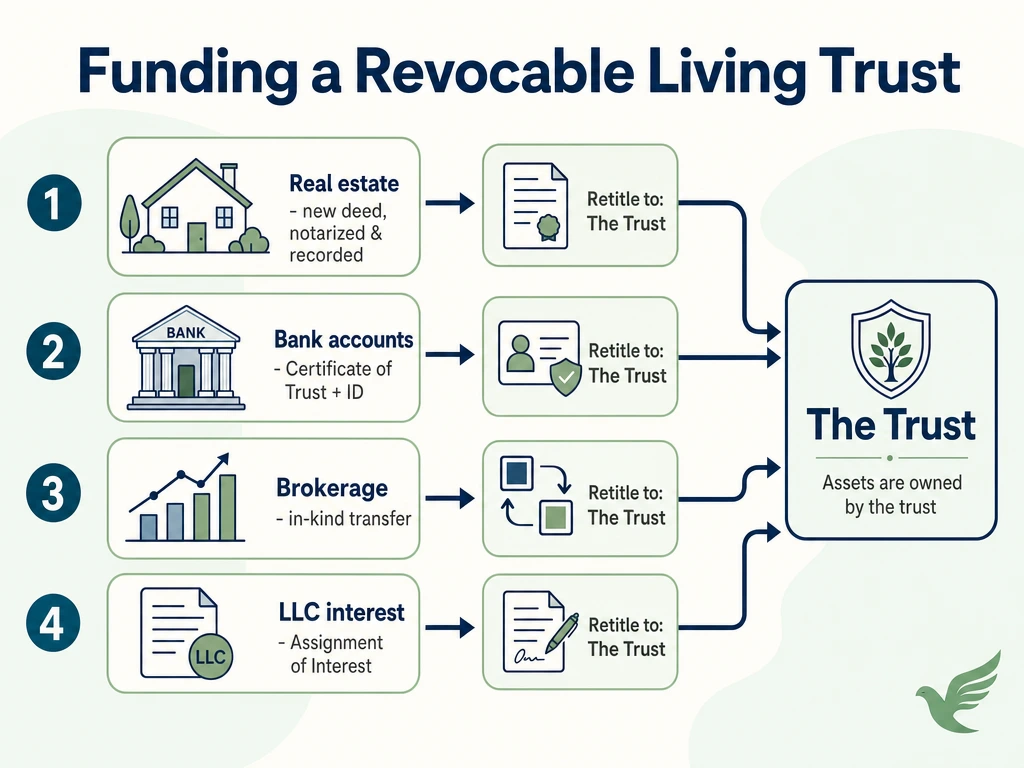
The Funding Checklist: Deeds, Bank Accounts, Brokerage, and LLC Interests
Funding means retitling each asset into the trust’s name, one at a time. Bank and brokerage accounts are usually straightforward, while real estate needs a new deed, filing, and possibly transfer fees. This is the core of how to fund a revocable living trust.
Retitling real estate: the deed
Real estate is typically transferred into a revocable living trust via a quitclaim deed, though a warranty deed may be preferable when title-warranty and title-insurance considerations matter. A quitclaim moves title without warranties of title quality. The deed must be signed, notarized, and recorded with the county. Recording fees vary widely: Maryland charges a $40 flat fee for most land instruments, while North Carolina charges $26 for the first 15 pages plus $4 per additional page. Some states offer transfer-tax exemptions for transfers into a revocable trust, so verify locally. Mortgaged property can still be transferred, though some lenders handle trust-owned property clumsily. For a revocable living trust for out-of-state property, holding that real estate in the trust avoids separate ancillary probate in each state, eliminating duplicate proceedings.
Transferring bank accounts to the trust
Bring your complete trust documents, a Certificate of Trust, and valid ID to the bank. Banks require their own internal trust-ownership form and a Letter of Instruction and will not retitle based only on your assignment document. Plan a short visit per institution rather than a single mailed form.
Brokerage and investment accounts
Set up a corresponding trust account at the firm, use the firm’s trust registration form, then journal-transfer holdings in kind. Transferring into a revocable trust carries no immediate tax consequence because the IRS still treats the assets as yours. Nothing sells, so no capital-gains event triggers.
LLC and business interests
For a revocable living trust for business owner planning, draft an Assignment of Interest transferring your membership interest to the trust. Review the operating agreement first and obtain written member or manager consent if it requires one. Skip that consent step and the transfer can be void.
Beneficiary Designations That Override Your Trust Entirely
Retirement accounts, life insurance, and payable-on-death accounts pass by beneficiary designation, not through your trust. A named beneficiary beats the trust document every time, so these forms need deliberate coordination.
Which assets skip the trust by design
Retirement accounts like a 401(k), IRA, and 403(b) should not be retitled into a revocable trust, because changing ownership could trigger adverse tax consequences. They pass instead by beneficiary designation. Payable-on-death bank accounts and transfer-on-death brokerage registrations behave the same way, moving directly to the named person outside both the trust and probate.
When to name the trust as beneficiary
Naming a trust as an IRA beneficiary carries real tax weight. Under the SECURE Act, most trust beneficiaries of an inherited IRA must drain it within 10 years, which can spike income taxes versus the old stretch timeline. A trust named as IRA beneficiary has post-death distributions calculated under the stretch, 10-year, or 5-year rule depending on whether it qualifies as a valid see-through trust.
Common coordination mistakes
Beneficiaries must include taxable distributions in gross income, and a non-qualifying trust can force even faster payout. The frequent error is funding the trust perfectly, then leaving a stale or blank beneficiary form on a life insurance policy. Review every designation the same day you fund the trust.
The Pour-Over Will: Your Backstop for Unfunded Assets
A pour-over will catches assets you forgot to transfer and directs them into the trust at death. It does not avoid probate for those assets, which is exactly why full funding during your lifetime matters.
How the pour-over will works
A pour-over will ensures any probate assets get distributed, or poured over, into the revocable trust, acting as a safety net alongside it. Its value lies in getting unfunded assets into the trust eventually, not in avoiding probate for those assets. Think of it as coverage for the account you opened last month and forgot to retitle.
Why it still means probate for leftover assets
Assets already in the trust bypass probate, but anything transferring through the pour-over will still passes through probate before it enters the trust. So the will covers any assets left in your probate estate, intentional or not. The lesson is direct: every asset you fund now is one the court never touches.
What a Revocable Living Trust Will Not Do: Asset Protection, Taxes, and Medicaid
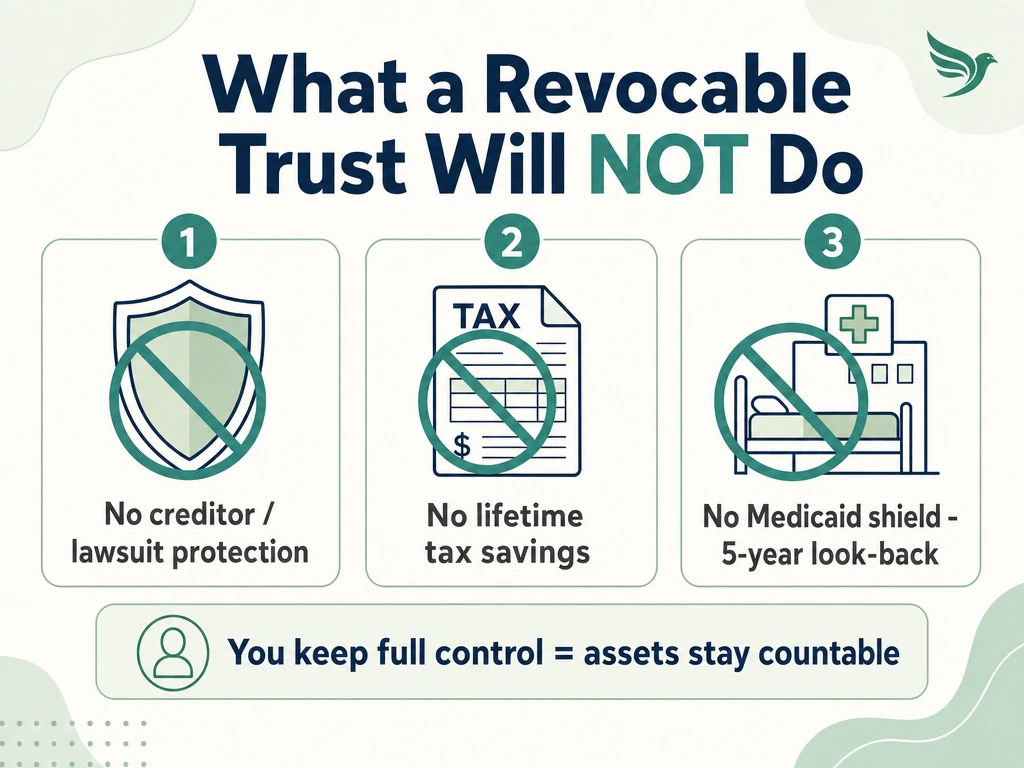
Because you keep full control, a revocable trust gives no creditor protection, no lifetime income or estate tax savings, and no shield against Medicaid nursing-home spend-down while you are alive. The IRS treats you and the trust as the same taxpayer.
No creditor or lawsuit protection
A revocable living trust provides no creditor or lawsuit protection because the grantor retains full control. Only an irrevocable trust makes assets unavailable to claims by surrendering that control. Anyone selling a revocable trust as a shield against disadvantages of revocable living trusts like lawsuits is misstating the law.
No lifetime tax breaks and grantor trust rules
A revocable trust does not change tax treatment. The grantor reports income on their individual return under their own SSN, and the trust is a grantor trust not required to file Form 1041 while the grantor is alive. That means no income tax savings during life. It also does not by itself avoid estate tax.
Medicaid and nursing home cost myths
Medicaid applies a 5-year look-back, and assets in a revocable trust stay countable and available because the grantor keeps control. Only an irrevocable trust can remove assets from the taxable estate and shield them from the lookback and estate recovery. A revocable trust does nothing for revocable living trust and Medicaid planning on this point.
Step-up in basis at death
Assets held in the trust still receive a step-up in basis at death, a benefit the revocable structure preserves for heirs. At the grantor’s death, grantor-trust status ends, the trust becomes a separate taxpayer that must obtain a TIN/EIN, and pre-death activity reports on the grantor’s final income tax return. The 2026 annual gift tax exclusion is $19,000 per recipient.
Revocable vs Irrevocable Trust and Trust vs Will: Choosing the Right Tool
A revocable trust trades protection for flexibility and probate avoidance; the alternative locks assets away in exchange for protection and tax benefits. Against a plain will, the trust’s edge is privacy and skipping probate.
Revocable vs irrevocable at a glance
The core difference is control. A revocable trust keeps full owner control and can be freely modified or revoked while you are alive. The irrevocable alternative practically cannot be changed, and exceptions require all beneficiaries’ consent through a long approval process, sometimes before a judge.
| Feature | Revocable trust | Irrevocable trust |
|---|---|---|
| Owner control | Full, freely amended | Surrendered to independent trustee |
| Probate avoidance | Yes, if funded | Yes |
| Creditor/asset protection | No | Yes |
| Estate-tax benefit | No | Yes |
| Step-up in basis | Yes | Varies |
The trade-off is clean: revocable means flexibility, control, probate avoidance, and step-up in basis but no asset or tax protection, while irrevocable means asset protection and estate-tax benefits in exchange for giving up control.
Trust vs will: privacy and probate
Probate is a public, potentially costly, and lengthy process. A revocable living trust avoids it while letting the grantor keep using the assets. A will distributes through probate over months, in the public record, while trusts stay private and distribute in weeks.
Durable power of attorney vs the trust for incapacity
A revocable trust handles incapacity for trust-held assets, while a durable power of attorney covers your non-trust assets. The two documents complement each other; neither replaces the other for a complete incapacity planning setup.
Cost, DIY Versus Attorney, and Keeping the Trust Current
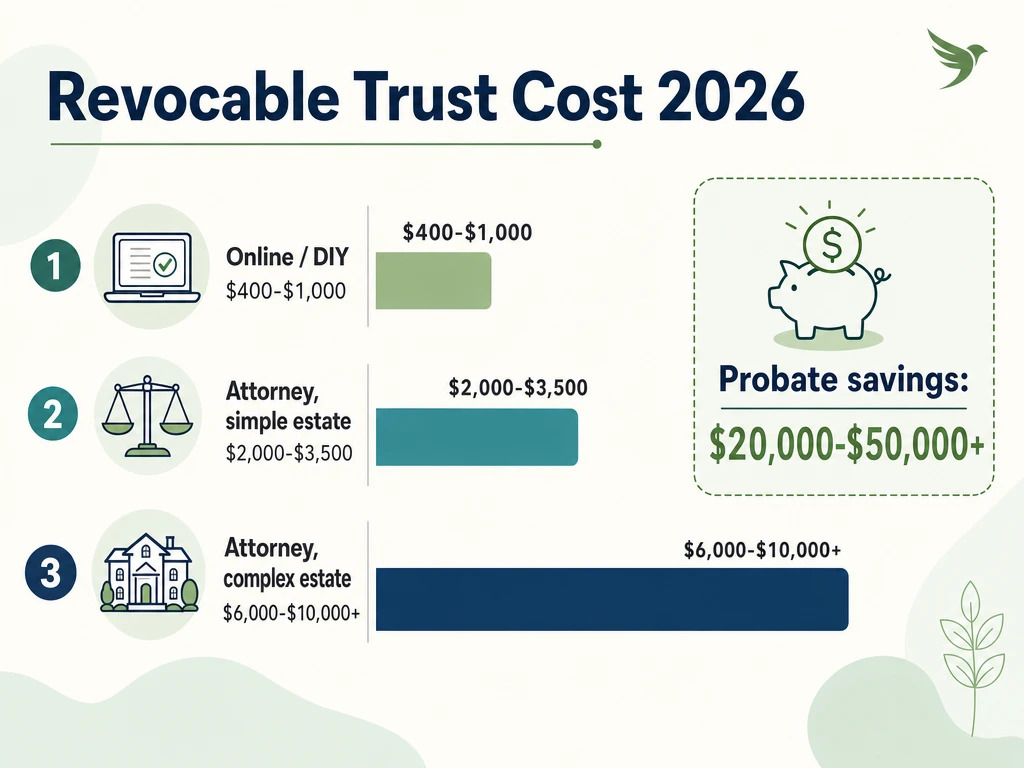
An attorney-drafted revocable trust typically runs about $2,000 to $3,500 in 2026 for a simple estate, while online services cost far less but leave funding to you. Either path works only if you amend the trust after major life events.
Cost to set up: attorney vs online
Attorney-drafted trusts for simple estates often start near $2,500 and reach $6,000 to $10,000+ for complex estates, with overall living-trust costs spanning roughly $400 to $5,000+. Online or DIY options land in the $400 to $1,000 range. A properly funded revocable trust can save families $20,000 to $50,000+ in probate fees, which anchors the value against the cost.
| Option | Typical cost (2026) | Funding help |
|---|---|---|
| Online/DIY | $400-$1,000 | You do it alone |
| Attorney, simple estate | $2,000-$3,500 | Guided |
| Attorney, complex estate | $6,000-$10,000+ | Guided |
Online revocable living trust vs attorney-drafted
Online or DIY trust services run roughly $400 to $1,000 but leave the funding responsibility on you. Doing a living trust correctly takes time and expert advice tailored to your situation, since a template does not retitle your deed or coordinate your beneficiary forms. That is where most DIY plans quietly fail.
Amending or revoking the trust after life changes
Because the trust is revocable, you amend it after marriage, divorce, a new child, or a large asset purchase, and you can revoke it entirely. Re-verify titling after each event so newly acquired assets actually sit inside the trust. Funding is not a one-time task; it is maintenance.
Quick Answers to Six Questions Readers Ask Most
What are the disadvantages of a revocable living trust?
A revocable living trust gives no creditor or lawsuit protection, no lifetime tax savings, and no Medicaid shield, because you keep full control. It also costs more upfront than a will and demands ongoing funding work. Every asset you buy later must be retitled, or a pour-over will sends it through probate anyway.
What is Dave Ramsey’s advice about revocable trusts?
Dave Ramsey’s general position is that most people with straightforward estates do not need a living trust and can rely on a will, naming trusts as more useful for larger or more complex estates. Treat that as a starting heuristic, not legal advice. Your state, probate costs, real estate in multiple states, and privacy goals change the math, so confirm with an estate planning attorney.
Is it a good idea to put your house in a revocable trust?
Often yes, because titling your home in the trust keeps it out of probate and, for out-of-state property, avoids separate ancillary probate in each state. You transfer it with a new deed, usually a quitclaim deed, then record it with the county. Mortgaged homes still qualify. Skip this step and the house likely goes through probate despite the trust.
Should a bank account be put in trust?
Usually yes for accounts you want to avoid probate. Retitle the account by bringing your trust documents, a Certificate of Trust, and valid ID to the bank, which will use its own internal form. A payable-on-death designation can achieve a similar direct transfer for a single beneficiary without full retitling.
Do revocable living trusts file tax returns?
Not while you are alive. A revocable trust is a grantor trust, so you report its income on your individual return under your own SSN, and it is not required to file Form 1041. At your death, grantor-trust status ends, the trust becomes a separate taxpayer, and it must obtain a TIN/EIN.
How long does it take to settle a revocable living trust after death?
Simple estates can release assets within weeks, faster than probate, while full settlement of a complex estate can run up to 18 months. The timeline depends on asset types, creditor claims, and tax filings. Even at the long end, trust distribution generally beats a probate proceeding that also runs months.
The One Estate Planning Failure I See Most: Trusts That Were Signed but Never Funded
The single most common estate planning failure is not a bad document. It is a good document attached to a house, accounts, and business interests still titled in the owner’s personal name. Work the checklist asset by asset: record the deed, retitle each account with a Certificate of Trust, assign LLC interests, and confirm which assets pass by beneficiary designation instead. Then re-verify titling after every major life event. Funding is the work that turns a signed binder into a plan that actually keeps your family out of probate.
Sources
- consumerfinance.gov/ask-cfpb/what-is-a-revocable-living-trust-en-1775
- floridabar.org/public/consumer/pamphlet028
- trustlawpartners.com/unfunded-trusts-cause-problems-in-trust-and-estate-litigation
- lewisvansickle.com/blog/what-happens-to-a-revocable-living-trust-after-you-die
- mdcourts.gov/clerks/cecil/recordingfees
- irs.gov/retirement-plans/plan-participant-employee/retirement-topics-beneficiary
- irs.gov/businesses/small-businesses-self-employed/abusive-trust-tax-evasion-schemes-questions-and-answers
- moravecslaw.com/post/how-much-should-a-living-trust-cost-in-california-in-2026
This article is for informational purposes only and does not constitute legal advice. U.S. law is complex and varies by state and circumstance. For your specific situation, consult a licensed attorney.