
A living trust is a legal document you create during your lifetime to hold your assets and transfer them to your beneficiaries after you die. It takes effect the moment you fund it, giving you full control while you are alive and a smoother handoff when you are gone.
This guide explains who does what in a trust, the real benefits, the downsides most articles skip, and how a living trust stacks up against a will or an irrevocable trust.
Key information
- A living trust is a common-law legal arrangement that does not exist in the Polish legal system.
- A trust takes effect during the grantor’s lifetime once it is properly funded, unlike a will, which generally takes effect only after death.
- A trust involves four roles: grantor, trustee, successor trustee, and beneficiary. One person can serve in three of these roles at the same time.
- The main benefits are avoiding probate and keeping the details of the estate private.
- Probate can take years to complete. The estate of musician Prince, for example, was not closed until August 2022, six years after his death in 2016.
- Disadvantages of a trust include higher costs than a will, the need to properly transfer assets into the trust (funding), and the fact that a revocable living trust generally does not provide tax benefits by itself.
- Retirement accounts such as 401(k)s and IRAs, HSAs, and certain vehicles generally remain outside the trust; only 24% of American adults have a will.
Living Trust Explained: A Legal Agreement You Control While Alive
A living trust is a legal document you create during your lifetime to hold your assets and pass them to beneficiaries after you die. Also called a revocable inter vivos trust, it takes effect immediately once funded, unlike a will, which only becomes effective after death.
The grantor sets up the trust, names a trustee to manage the assets, and directs how they pass to beneficiaries under the trust’s terms. One important note for readers outside the US: the living trust comes from Anglo-American law and does not exist in the Polish legal system, so treat it here as a description of a foreign institution.
Revocable vs irrevocable living trust
A living trust is revocable: you can change or cancel it at any time, and as trustee you keep full control over the assets. That flexibility is the core appeal. An irrevocable trust, by contrast, locks the terms in place.
Cornell Law’s Wex entry, last reviewed in February 2022, notes that revocable trusts may carry higher tax and creditor liability than irrevocable ones, precisely because you retain that control.
How a living trust actually works
The name says it all: the trust operates while you are alive. It goes into effect during your lifetime, once you fund it, in contrast to a will that becomes effective only after death. You transfer ownership of chosen assets into it, then continue using and directing them as usual.
Because the trust is active from day one, it can also manage your affairs if you become incapacitated, without a court stepping in. That living, flexible character is what separates it from a will.
The 4 Key People in a Living Trust and What Each Does
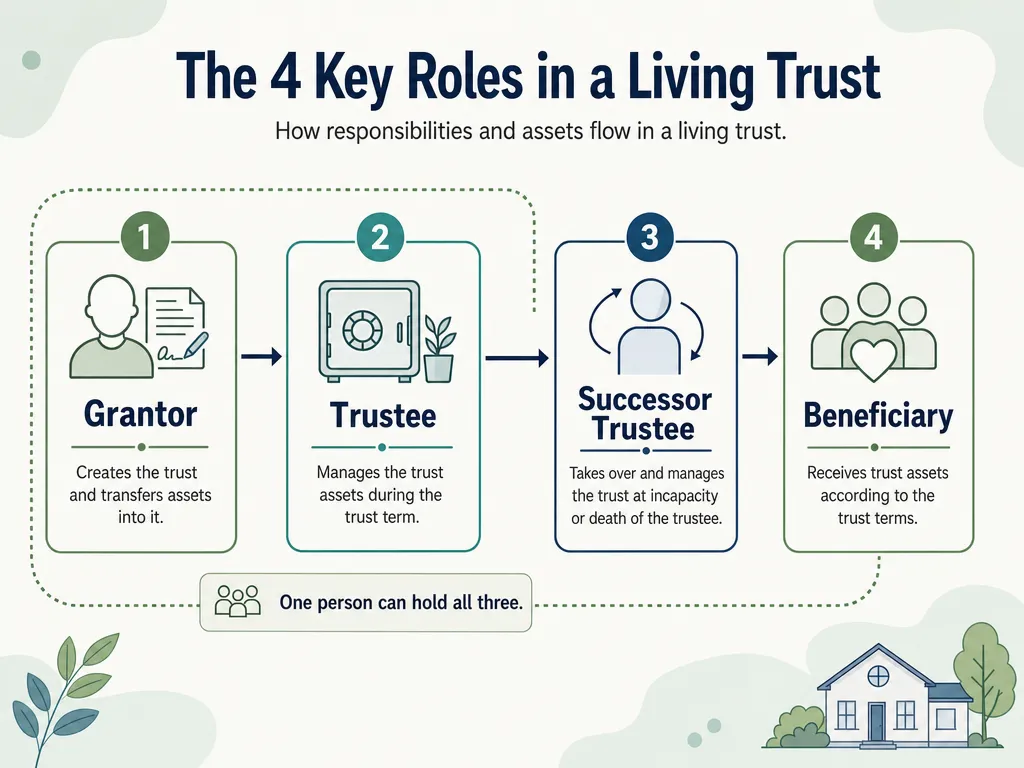
A living trust is a legal agreement with four roles: the grantor who creates it, the trustee who manages it, the successor trustee who takes over later, and the beneficiary who receives the assets. One person can fill three of those roles at once. That flexibility is what surprises most people.
Grantor and trustee: usually the same person
The grantor sets up the trust and moves assets into it. While alive, the grantor typically serves as the trustee too, keeping full control of the property even though the trust formally owns it.
So who owns the house in a living trust? Legally, the trust does. But as your own trustee, you buy, sell, and refinance exactly as before. A single individual can be grantor, trustee, and beneficiary at the same time without losing a thing.
Successor trustee: who takes over and when
You must name a successor trustee. This person steps in if you become incapacitated, and again after your death, managing and distributing assets according to the trust’s terms. It is often a family member.
The successor trustee carries a fiduciary responsibility: they must act in the beneficiaries’ interest, not their own. Choose carefully. Naming a child who then controls everything immediately may not match your wishes.
Beneficiary: who receives your assets
The beneficiary receives what the trust holds. During your lifetime that is usually you. After your death, your successor trustee distributes the remaining assets to the beneficiaries you named, without a probate court directing the process.
Why People Set Up a Living Trust: 4 Core Benefits
People choose a living trust for four reasons: it avoids probate, keeps them in control while alive, manages their affairs during incapacity, and keeps the estate private. Together, these benefits address the biggest weaknesses of a plain will. Remember that the living trust is a US institution, not a fixture of Polish law.
Avoiding probate court
The main draw is skipping probate. Assets you transfer into a living trust are no longer titled in your name, so at death they never enter the court-supervised probate process. Your successor trustee distributes them quickly and privately, following the trust’s terms.
Probate can drag on for years. Consider the estate of the musician Prince: he died in 2016, but his probate did not close until August 2022, six years later. A funded trust sidesteps that entirely.
Other tools can also bypass probate, including joint tenancy, life insurance, and in-trust-for accounts.
Keeping control and managing incapacity
Because a living trust is revocable, you keep full control. You can change or cancel it at any time while you remain competent, and you typically serve as your own trustee.
The trust also protects you while you are alive. If you become incapacitated, your successor trustee can manage the trust assets without a court appointing a guardian or conservator. That avoids a costly, public court proceeding at the worst possible time.
Maintaining privacy of your estate
A will becomes a public record during probate, and anyone can request a copy from the court. A living trust stays private and is not open to public inspection.
One caveat: when you move a mortgaged property into a trust, the lender often requires recording the trust document with the county, which can push it into public records.
The Downsides of a Living Trust Most Guides Skip
A living trust carries three real tradeoffs: higher setup cost than a will, an ongoing funding requirement, and no built-in tax advantage. Understanding these upfront saves you from expensive surprises later. Keep in mind this is a US legal instrument, so it has no equivalent in Polish law.
Setup cost and complexity
Creating a living trust involves more legal work than drafting a will. You pay for both the trust document itself and the process of transferring assets into it, which pushes attorney fees above what a simple will costs.
The main thing a trust saves you is probate expense. But probate of a straightforward, uncontested will can be minimal in many cases, so the savings are not always dramatic.
Do not expect tax relief either. A living trust gives you no inherent estate tax advantage: the same tax savings can be written into a will. For income tax, the grantor is treated as the owner under grantor trust rules, so you report all trust income on your personal return.
The funding requirement people forget
Signing the trust is only step one. To make it work, you must transfer title of your assets, bank accounts, stocks, and real estate, into the trust, a step called funding.
Skip this, and you lose the benefits entirely. Assets left in your own name still land in probate.
This is why you also need a pour-over will. It sweeps any assets left in your name into the trust after death, though those assets still pass through probate first.
Living Trust vs Will vs Irrevocable Trust: How to Choose
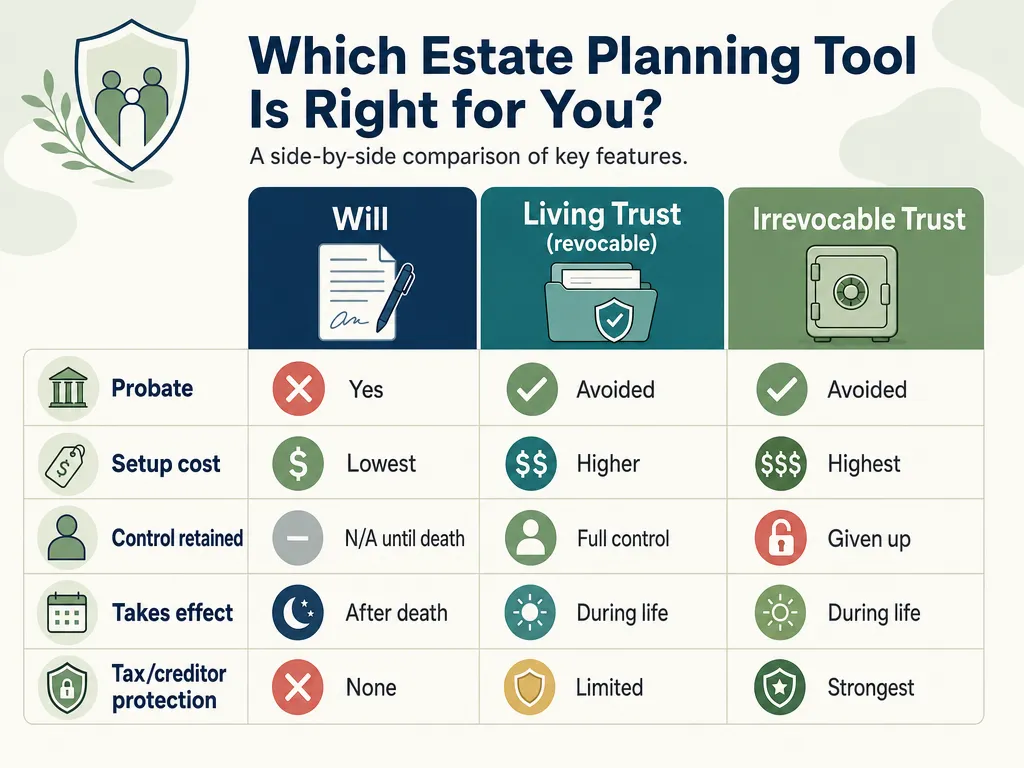
Choose based on three tradeoffs: cost, probate, and control. A will is the cheapest option but passes assets through probate. A revocable living trust avoids probate but costs more to set up and fund. An irrevocable trust adds tax and creditor protection, yet you surrender control.
Living trust vs will
A will is the most common estate planning document. In it you name an executor who files it with the court and guides your estate through probate. A common myth: a will does not avoid probate. Assets stay titled in the deceased person’s name and must still pass through the court process; the will simply serves as a guide.
Timing is the other key difference. A living trust takes effect during your lifetime, immediately once funded, while a will only takes effect after death. That gap matters if you become incapacitated.
Despite the stakes, only 24% of American adults have a will.
Revocable vs irrevocable trust
A revocable living trust lets the settlor amend or terminate it at any time, unlike an irrevocable trust. That flexibility comes at a price: a living trust can carry higher tax and creditor exposure than an irrevocable trust. An irrevocable trust locks the assets away, which shields them but removes your control.
Remember: this is a US, common-law institution and has no direct equivalent in Polish law.
What Goes Into a Living Trust and What Cannot
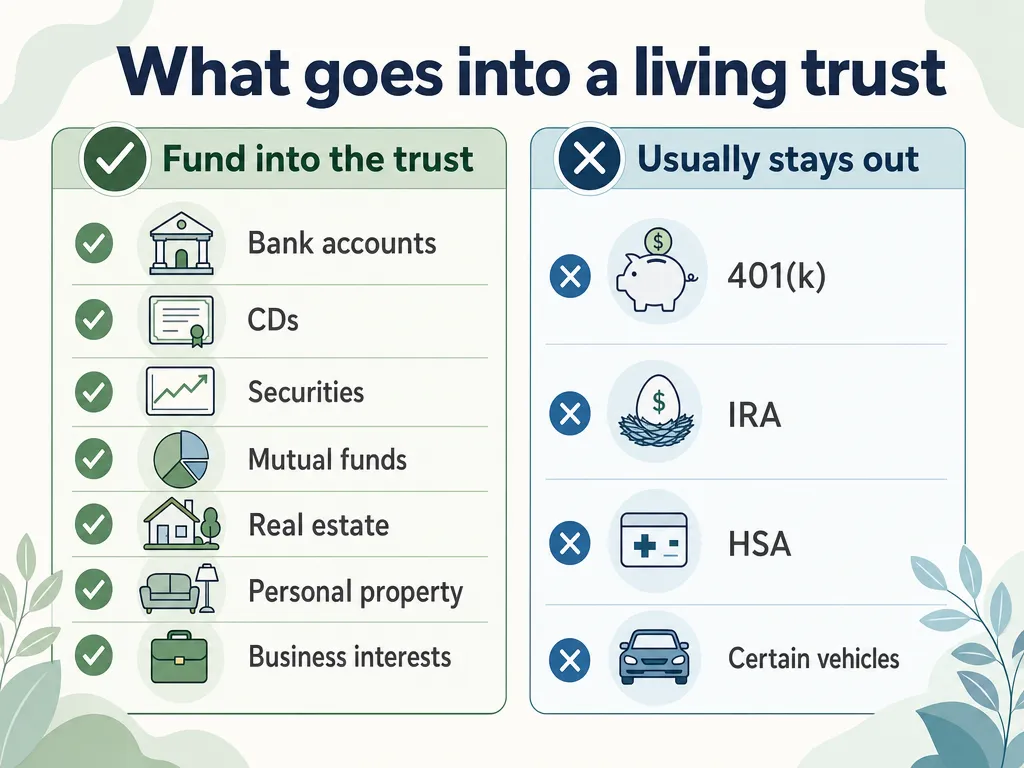
Most property can go into a living trust: your house, bank accounts, and investments. But retirement accounts, HSAs, and certain vehicles usually stay out. Titling the assets correctly, a step called funding, is what actually makes the trust work.
Assets you should fund into the trust
A living trust can hold a wide range of property. You can fund it with bank accounts, certificates of deposit (CDs), securities, and mutual funds, along with real estate, personal property, and business interests. Complex assets, like a share in a family company, may need a lawyer to transfer cleanly.
Your house is often the centerpiece. To make it part of the trust, the title must be retitled from your name into the name of the trust. Until that deed change happens, the property still sits in your name and the trust does nothing for it.
Assets that cannot or should not be placed in a trust
Some accounts are better left out. Tax-advantaged retirement accounts such as 401(k)s and IRAs, plus HSAs, generally cannot be owned by a trust without triggering unwanted tax consequences, so they pass by beneficiary designation instead. Certain vehicles are also commonly excluded, since titling and insurance can get complicated.
Anything you forget to fund does not simply vanish. This is where the pour-over will comes in: it directs leftover assets into the trust after death, though those assets still pass through probate first. Fund carefully, and the trust does its job. Miss an asset, and probate quietly claims it.
Quick Answers to the Living Trust Questions People Ask Most
What is the downside to a living trust?
The main downside comes in three parts: a living trust costs more to set up than a will, it requires ongoing funding to transfer asset titles into the trust, and it offers no built-in reduction in estate tax. The grantor is treated as the owner for income tax purposes and reports all trust income on a personal return under grantor trust rules. Skip the funding step and you lose the benefits entirely.
Who owns the house in a living trust?
The trust legally owns the house once you retitle it into the trust’s name. In practice, though, you keep full control. While you are alive and serving as your own trustee, you buy, sell, refinance, or live in that home exactly as before. The transfer of legal title is what lets the property skip probate later, while your day-to-day authority stays unchanged.
Why would someone want a living trust?
Most people set up a living trust to avoid probate, which lets assets pass to heirs quickly and privately without a court process. A second major reason is protection during incapacity: your successor trustee can manage trust assets if you become unable to, with no court-appointed guardianship required.
What assets cannot be placed in a trust?
Retirement accounts such as 401(k)s and IRAs, HSAs, and certain vehicles usually stay outside a living trust (see the earlier section on funding). Most other property fits fine: bank accounts, CDs, securities, mutual funds, real estate, personal property, and business interests.
How much does a living trust cost to set up?
A living trust generally costs more than a simple will because you pay for both drafting and funding the trust. The corpus does not fix an exact attorney fee, so request a quote locally. Note that Spanish speakers may see a living trust called a fideicomiso en vida.
Sources
- law.cornell.edu/wex/living_trust – Cornell Law School Wex – Living Trust
- lawhelpny.org/resource/living-trusts – LawHelpNY – Living Trusts
- youtube.com/watch?v=CBbdFmTRyy4 – Expert explainer on trust roles