
A no-contest clause is not the only tool for keeping heirs out of court, and litigation is not the only outcome. Mediation and arbitration clauses in a trust route disputes over interpretation and administration into a private forum instead of a public probate courtroom. The hard part is that a clause cannot always bind a beneficiary who never signed the trust. This article covers what the clause can and cannot bind, the state-law split on enforceability, and how to draft language that actually holds up.
Key takeaways
- A mediation and arbitration clause in a trust sends disputes to a private forum instead of public probate court.
- In tiered clauses parties must try mediation first, with binding arbitration only if mediation produces no signed settlement.
- Texas binds beneficiaries via direct-benefits estoppel (Rachal v. Reitz, 2013), while California and Virginia refuse to bind nonsigning beneficiaries.
- Arizona, Florida, Missouri and several other states authorize trust arbitration by statute, but validity challenges must go to a court.
- Most mediations end within one or two days, versus an average probate estate settling in 16 months per EstateExec.com.
- Settlors pick arbitration for confidentiality, expertise and speed, though arbitration fees can exceed a probate trial’s cost.
- An estimated $41 trillion in wealth will transfer over the next 40 years, and wills generate more disputes than any other instrument.
What a Mediation and Arbitration Clause in a Trust Actually Does
A mediation and arbitration clause in a trust is a dispute-resolution provision written into the trust instrument that directs beneficiaries and trustees to resolve conflicts through alternative dispute resolution (ADR) instead of a courtroom. It is a provision in the trust instrument that channels disputes to a private forum, mediation or arbitration, rather than to the probate court. It is distinct from a no-contest clause. One channels a dispute; the other deters one.
A mediator is a neutral party, often an attorney or a retired judge, who helps the parties reach agreement but does not impose a decision. An arbitrator functions like a private court. The arbitrator hears evidence and renders an award, binding or non-binding, that a court can confirm to give it the force of a judgment.
Mediation vs arbitration: the core difference
The core distinction turns on when the outcome binds. In mediation, the result binds only if both parties agree and sign a settlement agreement. In arbitration, the arbitrator’s decision is legally binding regardless of whether the parties later consent. That single line, consent versus adjudication, drives almost every drafting choice that follows.
Some writers also separate facilitative mediation, where the neutral fosters communication rather than evaluating positions, from evaluative mediation, where the neutral offers an opinion on the merits. Trust mediations usually run facilitative because family relationships are part of what is at stake.
How it sits alongside a no-contest clause
A no-contest clause, also called an in terrorem clause, threatens disinheritance if a beneficiary challenges the trust. It punishes. An ADR clause does not punish; it selects a private forum for the fight. The two mechanisms solve different halves of one problem, and sophisticated trusts often carry both. A later section explains how a settlor should choose between them.
Mediation First, Arbitration Second: How Tiered Clauses Work
Most well-drafted trust ADR clauses are tiered. Parties must attempt mediation before anyone can demand binding arbitration. Mediation comes first because it costs less, stays voluntary, and preserves family relationships. Arbitration follows only if mediation fails.
Under the med-arb model, parties first attempt mediation, and if the dispute remains unresolved, the same or a different neutral moves into the arbitrator role and renders a binding decision. That structure adds negotiation pressure, since the parties know an unresolved issue will be decided quickly rather than dragged out.
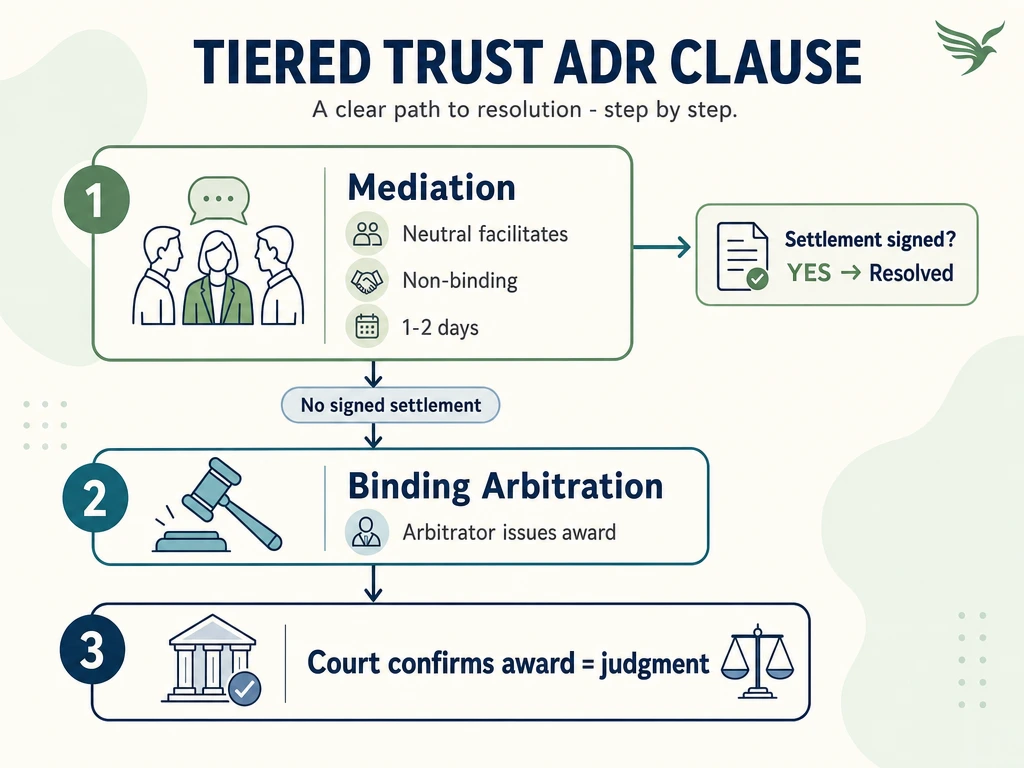
The med-arb structure: mediation first, binding arbitration only if no settlement is signed.
What happens in a trust mediation session
Trust mediation is a structured negotiation in which a neutral mediator facilitates conversation among family members, beneficiaries, and trustees without imposing a resolution. Because it is faster, it is usually cheaper than arbitration.
Speed is the headline number. Most mediations conclude within one or two days, versus months or years in court. Per EstateExec.com, the average probate estate takes 16 months to settle, and complex assets can push that to several years. Full trust-and-estate litigation typically runs 12 to 24 months, with early mediated cases resolving in 6 to 12 months and extensive-discovery cases stretching past two years.
When the dispute escalates to a binding award
If mediation produces no signed settlement, the tier escalates and the arbitrator issues an award. That award, once confirmed by a court, carries the force of a judgment. Cost allocation matters here. Institutional fee schedules apply. JAMS charges a $2,500 counterclaim filing fee, and the clause typically defines how costs split among trustees, beneficiaries, and the trust estate.
Where Courts Refuse to Enforce Arbitration Against a Beneficiary Who Never Signed
The central legal tension is straightforward. A beneficiary who never signed the trust may not be bound to arbitrate, and courts split sharply. Texas binds beneficiaries under direct-benefits estoppel; California and Virginia generally refuse to enforce an ADR clause against a nonsignatory beneficiary. The split is genuine, not a matter of degree.
The nonsignatory problem
A trust is a donative instrument, not a signed bilateral contract. Beneficiaries receive rights without ever agreeing to terms. That gap is why enforcement against a nonsignatory beneficiary is the recurring fight in this area, and why no single national rule exists.
Direct-benefits estoppel: the Texas approach
In Rachal v. Reitz, 403 S.W.3d 840 (Tex. 2013), the Texas Supreme Court held an arbitration clause in a trust enforceable against a beneficiary under direct-benefits estoppel. The Texas Arbitration Act requires only an agreement to arbitrate future conflicts, not a formal contract, so a beneficiary who accepts any benefit from the trust is estopped from challenging the mandatory clause.
The doctrine has a plain logic. A non-party who obtains or seeks substantial benefits under an instrument cannot cherry-pick, accepting the benefits while ignoring the arbitration clause.
Other states reject that reasoning outright. In McArthur v. McArthur, 224 Cal. App. 4th 651 (2014), a California court found no actual or implied beneficiary consent to arbitrate, confirming that simple arbitration clauses in California trusts are not enforceable and that arbitration there stays voluntary. In Boyle v. Anderson, 871 S.E.2d 226 (Va. 2022), the Virginia Supreme Court rejected Rachal, holding a trust arbitration clause unenforceable because a trust is not a contract, it is a donative instrument creating a fiduciary rather than consensual relationship.
Why trust validity itself usually cannot be arbitrated
An arbitration provision cannot be enforced to decide whether the trust document itself is valid. That is the bootstrapping paradox. The clause cannot supply its own authority, so a validity challenge must go to a court. Academic literature identifies several theories for binding a nonsignatory, including suing on the agreement, where a beneficiary who sues to enforce rights under the instrument is stuck with its arbitration clause, but none is fully settled.
State-by-State Enforceability: Texas, Arizona, Florida, and California Compared
Enforceability of a binding arbitration clause in a trust turns entirely on state law. Arizona expressly authorizes mandatory ADR clauses by statute, Texas enforces them through case law, Florida permits them with a hard limit, and California routinely declines to compel nonsigning beneficiaries.
Statutory authorization: Arizona and the Uniform Trust Code
Arizona A.R.S. 14-10205 states that a trust instrument may provide mandatory, exclusive and reasonable procedures to resolve issues between the trustee and interested persons. The Arizona Court of Appeals limits mandatory binding ADR to disputes involving the administration of a trust, not its validity, and only where the parties agreed.
Uniform Trust Code § 816(23) authorizes a trustee to use mediation, arbitration, or other ADR for interpretation or administration disputes, but it does not address whether a settlor-drafted arbitration clause binds beneficiaries. The UTC stays silent on ADR-clause enforceability in most states, leaving it an open issue except where express statutes or clear case law exist.
Case-law states vs statute states
States with express statutory authorization of trust arbitration include South Dakota, New Hampshire, Florida, Arizona, Washington, Ohio, Missouri, and Nevada. Missouri’s MO Rev Stat § 456.2-205 (2021) makes mediation and arbitration clauses enforceable except for trust-validity disputes, which require the consent of all interested persons. Florida’s Section 731.401 permits arbitration in a will but bars enforcement where a party challenges the will’s validity, which a court must decide.
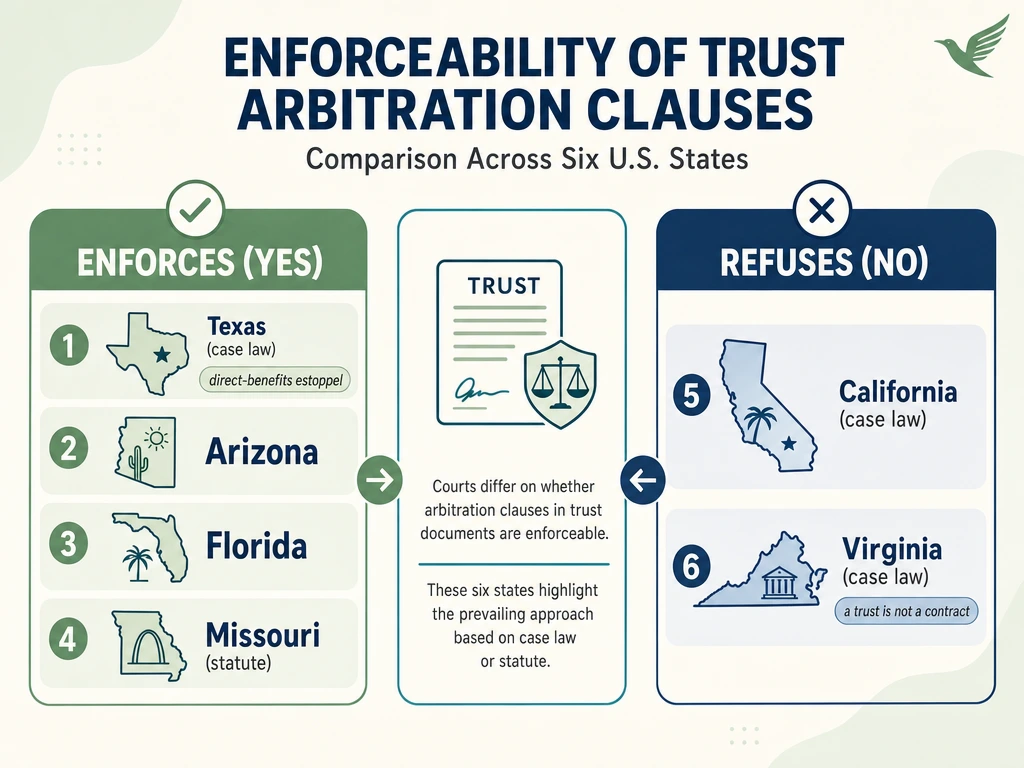
State-law split on enforcing trust arbitration clauses against beneficiaries.
| State | Basis | Enforceable against nonsignatory beneficiary? | Key limit |
|---|---|---|---|
| Texas | Case law (Rachal v. Reitz, 2013) | Yes, via direct-benefits estoppel | Cannot decide trust validity |
| Arizona | Statute (A.R.S. 14-10205) | Yes, for administration disputes | Validity excluded |
| Florida | Statute (§ 731.401) | Yes, in wills | Validity challenges go to court |
| Missouri | Statute (§ 456.2-205, 2021) | Yes | Validity needs all-party consent |
| California | Case law (McArthur, 2014) | Generally no | Consent must be a condition of benefit |
| Virginia | Case law (Boyle, 2022) | No | “A trust is not a contract” |
The jury trial waiver concern
An arbitration clause waives a beneficiary’s right to a jury trial, and that constitutional concern is a live argument where beneficiaries never consented. The stakes climb with an irrevocable trust, because a beneficiary of an irrevocable trust cannot opt out of a mandatory arbitration clause in an irrevocable trust.
Why Settlors Choose Arbitration Over Probate Court
Beyond avoiding a public courtroom fight, settlors choose arbitration for three concrete advantages: confidentiality, expertise, and speed. A probate dispute becomes public record; an arbitration stays private.
Privacy and confidentiality
Probate is a matter of public record, listing what the deceased owned and who received it. Arbitration keeps the proceeding private. For families who prize discretion, the confidentiality benefit of trust arbitration is often the deciding factor by itself.
Cost and speed versus litigation
Arbitration ends faster because an arbitral award is generally not subject to appeal. That speed is real, and the demand is growing. An estimated $41 trillion in wealth will transfer over the next 40 years through probate and non-probate transfers, and transfers by will generate more disputes than any other legal instrument.
Cost, though, cuts both ways, and honesty demands both sides. Marketing-oriented sources cite savings versus litigation, while practitioner sources warn that arbitration fees can exceed a probate trial’s cost and that arbitral awards get very limited appellate review. The honest answer is that cost depends on the complexity of the estate. Finding a qualified trust arbitrator can also prove difficult, since arbitrators with genuine trust expertise are in short supply. And beneficiaries of an irrevocable trust cannot opt out of the arbitration route once it is set.
Who selects the arbitrator
Parties may mutually agree on a selection process, which the institution administers. JAMS applies its Comprehensive Arbitration Rules and determines adversity for arbitrator selection, and both AAA and JAMS issued updated rules, AAA in January 2024 and JAMS in May 2024. Estate-experienced arbitrators are preferred for complex asset disputes. Arbitration awards also enjoy cross-border enforcement under the New York Convention’s 144 signatory countries, though some offshore jurisdictions such as the British Virgin Islands are not signatories.
Drafting a Clause That Holds Up: Sample Language and Common Mistakes
A clause that actually binds needs specific elements: a tiered mediate-then-arbitrate structure, a named institution such as AAA or JAMS, a defined scope of disputes, and language addressing beneficiary consent. Vague or overly restrictive clauses fail.
Elements of an enforceable clause
An enforceable ADR clause must specify whether arbitration is binding or non-binding, the method of arbitrator selection, jurisdictional rules, discovery scope, cost allocation among trustees, beneficiaries, and the trust, and whether arbitrators may apply equitable remedies like trustee removal. California courts have voided ADR clauses that were vague, overly restrictive, or failed to protect vulnerable beneficiaries.
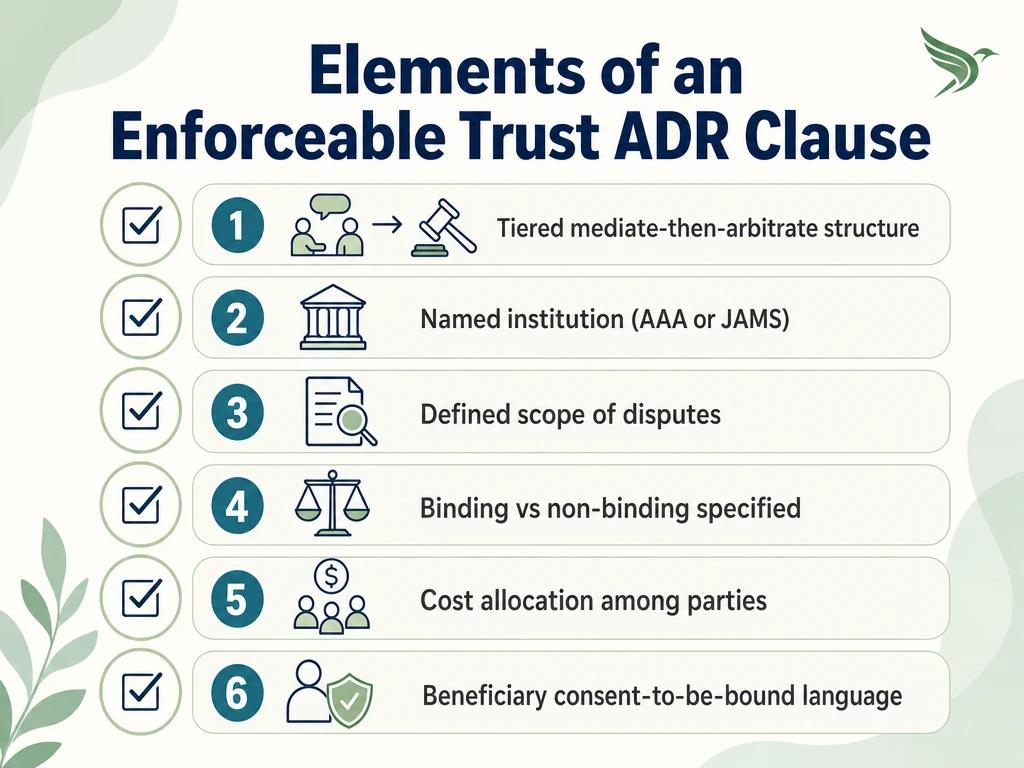
Core drafting elements a clause needs to actually bind.
Scope drafting decides who resolves what. Incorporating AAA rules can delegate scope and arbitrability issues to the arbitrator, per a 2023 Texas Supreme Court ruling, though courts generally decide whether a claim is arbitrable while the arbitrator decides challenges to the clause’s own validity. Draw the line between validity and administration precisely, or the clause loses reach.
Sample tiered ADR language
Name a recognized institution and incorporate its rules. JAMS offers a sample ADR Clause Workbook, and AAA provides worldwide-accepted arbitration and mediation clause language for drafting enforceable agreements. A representative example reads:
> “To spare my family a public spectacle and speed a prompt and economical resolution of any dispute, I direct that any dispute concerning the interpretation or administration of this instrument be resolved by an arbitrator with expertise in this field.”
That wording can be paired with an in terrorem clause protecting the arbitration provision itself against challenge.
Adding a clause to a trust you already have
To strengthen enforceability against nonsignatory beneficiaries, condition acceptance of any trust benefit on agreement to arbitrate, the California workaround. Retrofitting an existing trust runs through the trust’s amendment mechanics, so a trust amendment to add an arbitration clause follows whatever modification process the instrument allows. Avoid inconsistent dispute-resolution or jurisdiction clauses within a single instrument, since inconsistencies undermine enforceability under the Fiona Trust line of cases.
When Heirs Disagree: Choosing Between a No-Contest Clause and an ADR Clause
A no-contest clause and an ADR clause solve different halves of one problem. A no-contest clause deters challenges by threat; an arbitration clause channels the challenge into a private forum. Sophisticated trusts often use both.
Deterrence vs resolution
A settlor’s options to limit disputes fall into two camps. A no-contest clause deters litigation, unless a probate judge finds probable cause for the challenge, or a conditional gift makes the inheritance contingent on accepting the terms. An ADR clause instead routes the dispute into a private process. Deterrence stops a fight; resolution ends one.
Combining both mechanisms
Clause precision determines scope. In Burgess v. Johnson, 835 Fed. Appx. 330 (10th Cir. 2020), the court read a binding arbitration clause to allow only the trustee to elect arbitration, not to compel others into it, showing how wording controls enforcement reach. Note too that even asking a court about a no-contest clause can itself violate it, which is one reason careful trusts pair deterrence and resolution.
Special cases: irrevocable, special needs, and charitable trusts
Trustee-removal disputes are administrative and generally arbitrable, so a trustee removal dispute arbitration usually proceeds. Special needs and charitable trusts raise complications, because Attorney General involvement can limit arbitrability, and irrevocable-trust beneficiaries cannot opt out. Match the clause to the trust type before relying on it.
Before You Add an ADR Clause: Three Things a Settlor Should Confirm First
After years of watching families spend inheritances on legal fees, three checks matter more than the clause wording itself. First, confirm your state’s stance, statute, case law, or refusal, because Texas binding beneficiaries and California refusing them are opposite worlds. Second, draft the clause tiered with explicit consent-to-be-bound language. Third, fund the trust properly, since dispute avoidance starts with a clearly drafted, properly funded trust. MyEstateAngel’s trust and will plans use state-specific templates reviewed by attorneys, which addresses the first check before you ever draft the third.
Quick Answers to Five Questions Readers Ask
What is a mediation and arbitration clause in a trust?
It is a provision in the trust instrument that directs beneficiaries and trustees to resolve disputes through alternative dispute resolution instead of court. A mediator helps parties reach a voluntary agreement without imposing one, while an arbitrator hears evidence and issues a binding award that a court can confirm.
Can you sue if a trust has an arbitration clause?
Sometimes. It depends on your state and whether you accepted trust benefits. Texas binds a benefiting beneficiary under direct-benefits estoppel, so litigation is barred. California and Virginia generally let a nonsignatory beneficiary sue, because a trust is not a contract. Validity challenges usually go to court everywhere.
What comes first in a trust dispute, mediation or arbitration?
Mediation comes first under a tiered clause. Parties attempt mediation, which resolves many disputes in one or two days, and only escalate to binding arbitration if mediation produces no signed settlement. This med-arb structure lowers cost and adds pressure to settle early.
Can beneficiaries be forced to arbitrate if they never signed the trust?
It varies by state. Texas can compel a nonsignatory beneficiary who accepted trust benefits, using direct-benefits estoppel. California generally cannot, unless agreeing to arbitrate was made a condition of receiving the benefit. Virginia refuses entirely because a trust is a donative, not consensual, instrument.
Which states enforce arbitration clauses in trusts?
Arizona, Florida, Missouri, South Dakota, New Hampshire, Washington, Ohio, and Nevada authorize trust arbitration by statute. Texas enforces through case law via Rachal v. Reitz. California and Virginia decline to bind nonsigning beneficiaries. The Uniform Trust Code is silent on settlor-drafted clause enforceability in most states.
Sources
- hackardlaw.com/the-role-of-mediation-and-arbitration-in-trust-and-estate-disputes – Hackard Law: roles of mediator and arbitrator, med-arb timing, and enforceable-clause drafting elements.
- zmatlaw.com/mediation-vs-arbitration-crucial-differences-explained – ZMAT Law: core difference between mediation and arbitration on when the outcome binds.
- handwiki.org/wiki/Social:Mediation – HandWiki: facilitative versus evaluative mediation distinction.
- adr.org/rules-forms-and-fees – AAA: rules, forms, and fees governing arbitration cost allocation.
- azleg.gov/ars/14/10205.htm – Arizona Legislature: A.R.S. 14-10205 authorizing mandatory ADR procedures in trusts.
- coa1.azcourts.gov/LinkClick.aspx?fileticket=rbDfoHIN6uw%3D&portalid=1 – Arizona Court of Appeals: administration-only limit on mandatory binding ADR.
- americanbar.org/groups/business_law/resources/business-law-today/2025-march/evolution-of-mass-arbitration – American Bar Association: updated AAA and JAMS rules and arbitrator selection.