
Probate costs typically run 3 to 7 percent of an estate’s gross value, which puts a $500,000 estate somewhere between $15,000 and $35,000 once every charge lands. Most quotes name one fee and leave four hidden until the bill arrives. This guide itemizes all five charges, splits percentage-fee states from reasonable-fee states with real dollar math, and shows which assets skip court entirely. You will finish knowing how to price your own estate against the 3-7 percent range and whether a trust beats a will for your situation.
Key takeaways
- Probate typically costs 3 to 7 percent of an estate’s gross value, so a $500,000 estate runs $15,000 to $35,000.
- The estate pays all probate fees, not the heirs, which quietly shrinks what the family inherits.
- Probate costs split into five separate charges: court filing fees, representative commission, attorney fees, appraisal/referee costs, and surety bond.
- Court filing fees range from about $30 in New Mexico to $750 in Rhode Island, with California near $435 per petition.
- California sets statutory fees for both executor and attorney, so a $1 million estate generates about $46,000 in combined fees.
- Probate’s national average runs about 20 months, though simple estates can close in 3 to 6 months.
- A revocable living trust costing $499 to $599 upfront can move most assets out of court and save an estate thousands later.
How Much Does Probate Cost? The Real Number Nobody Quotes
Probate is the court-supervised process of administering an estate and transferring property at death under the terms of a will, the judicial process by which a will is proved in court. It typically costs 3 to 7 percent of an estate’s gross value, so a $500,000 estate runs $15,000 to $35,000 once every fee is added up. Statutory-fee states push toward the high end: in California, attorney and executor fees alone come to $26,000 on a $500,000 estate. Simple estates land lower.
The number is hard to quote because it is not one charge. What arrives as a single court process bill is five separate line items, and most cost pages mention only one or two of them.
Here is the part that surprises people: the estate pays, not the heirs personally. Fees come out of the assets before anyone inherits, which is why a $35,000 bill on a $500,000 estate quietly shrinks what the family receives. The court also usually requires attorney involvement, and the whole thing often takes six months or longer.
The 3-7% range and why it varies
Estate value sets the base, but the state you file in and the estate’s complexity swing the total. A $500,000 estate in a statutory percentage state costs more than the same estate handled at an hourly rate elsewhere.
Why the total is hard to quote upfront
No honest attorney can name a final figure on day one. A contested will, out-of-state property, or a missing will each add charges nobody sees at the start. The itemized breakdown below is the only way to estimate before you commit.
The Five Line Items That Make Up Probate Costs
Estate settlement fees split into five separate charges: court filing fees, the personal representative’s commission, attorney fees, appraisal and referee costs, and the surety bond. Each is billed on its own, and most cost pages surface only one or two.
Court filing fees
Court filing fees run roughly $30 in New Mexico to $750 in Rhode Island. California charges about $435 per petition, Florida lands near $235 to $402 for 2026, and Massachusetts sits at $375. A typical range is $200 to $1,200, with outliers on both ends.
Representative commission
The personal representative earns a commission for managing the estate. In Missouri, the executor and the attorney each draw a statutory percentage, and bond premiums, publication costs, court costs, and those commissions form the four cost categories. The court can waive the bond if all distributees consent.
Attorney fees
Probate attorney fees follow one of two models depending on your state, covered in the next section. In a full California example, the executor fee reached $23,000, court filing near $2,000, the referee fee $900, and a real estate appraisal $600, plus publication.
Appraisal, referee and bond costs
California’s probate referee appraises estate assets at 0.1 percent of total appraised value, a rate set by statute in Probate Code §8961. The surety bond premium typically runs about 0.5 percent of the first $250,000 of coverage, so a $100,000 bond costs roughly $500. Premiums range from 0.5 to 0.8 percent and up to 1 percent in Illinois, varying by the executor’s credit. Publication and creditor-notice fees are a separate line item.
| Line item | Typical cost |
|---|---|
| Court filing fee | $30-$750 (CA ~$435) |
| Representative commission | State-set % or reasonable |
| Attorney fee | Statutory % or $150-$500/hr |
| Appraisal / referee (CA) | 0.1% of asset value |
| Surety bond | ~0.5% of bond amount |
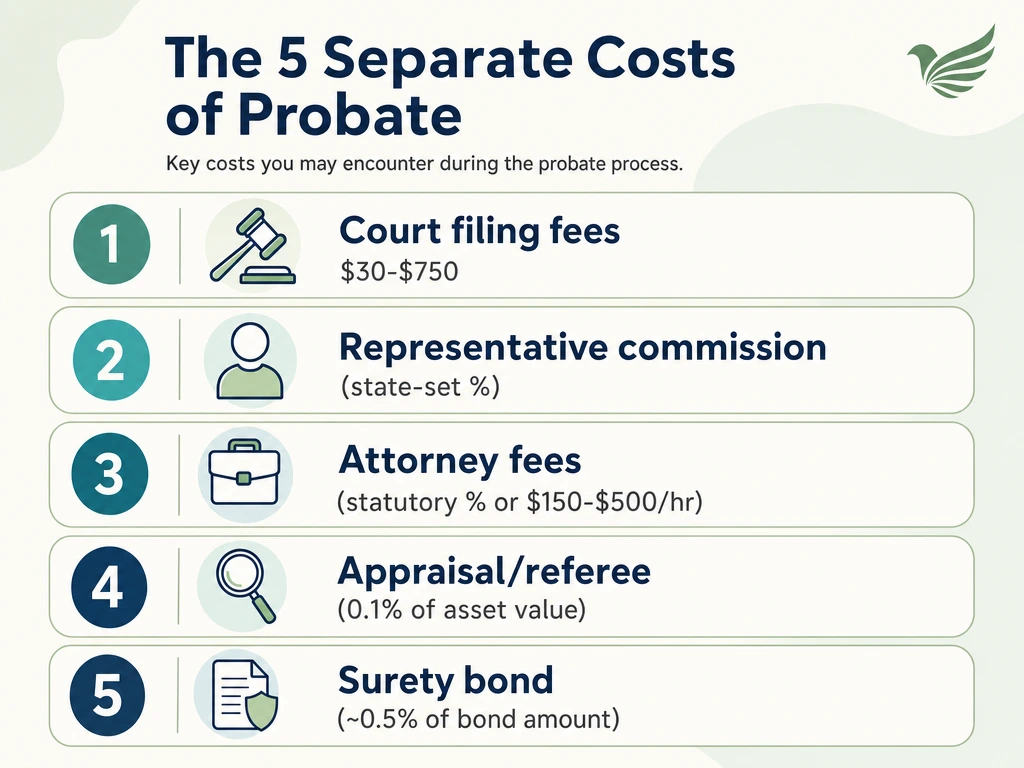
The five separate charges that combine into total probate cost.
Percentage-Fee States vs. Reasonable-Fee States
How your attorney and executor get paid depends entirely on which state you file in. California, Florida, and a handful of others set fees as a statutory percentage of the estate; most states allow only a reasonable fee for work actually done. On a $600,000 estate the gap can exceed $10,000.
Statutory percentage states (CA Probate Code 10800)
California Probate Code §10800 (executor) and §10810 (attorney) set identical tiered fees: 4 percent of the first $100,000, 3 percent of the next $100,000, 2 percent of the next $800,000, and 1 percent of the next $9 million. Both the executor and the attorney draw this schedule. Percentage-fee states include Arkansas, Missouri, California, Montana, Florida, and Wyoming.
Missouri’s statutory schedule charges 5 percent of the first $5,000, 4 percent of the next $20,000, 3 percent of the next $75,000, and lower tiers above, applied to both the representative commission and the attorney fee. Florida’s statute (Fla. Stat. 733.617) sets the representative commission at 3 percent of the first $1 million and 2.5 percent of the next $4 million.
Reasonable-fee states
Most states calculate attorney fees with the Lodestar method: a reasonable hourly rate multiplied by hours worked. Hourly rates typically run $150 to $500, with flat fees of $3,000 to $7,000 for simple estates. The court reviews the total for reasonableness rather than applying a fixed percentage.
A real number beside a real number
In California, a $1 million estate generates about $46,000 in combined statutory fees for attorney and executor. Compare Missouri: a $110,000 estate produces a $3,575 representative commission and a matching $3,575 attorney fee, 6.5 percent combined. A reasonable-fee state might settle the same $110,000 estate for a flat $4,000 to $6,000, depending on complexity.
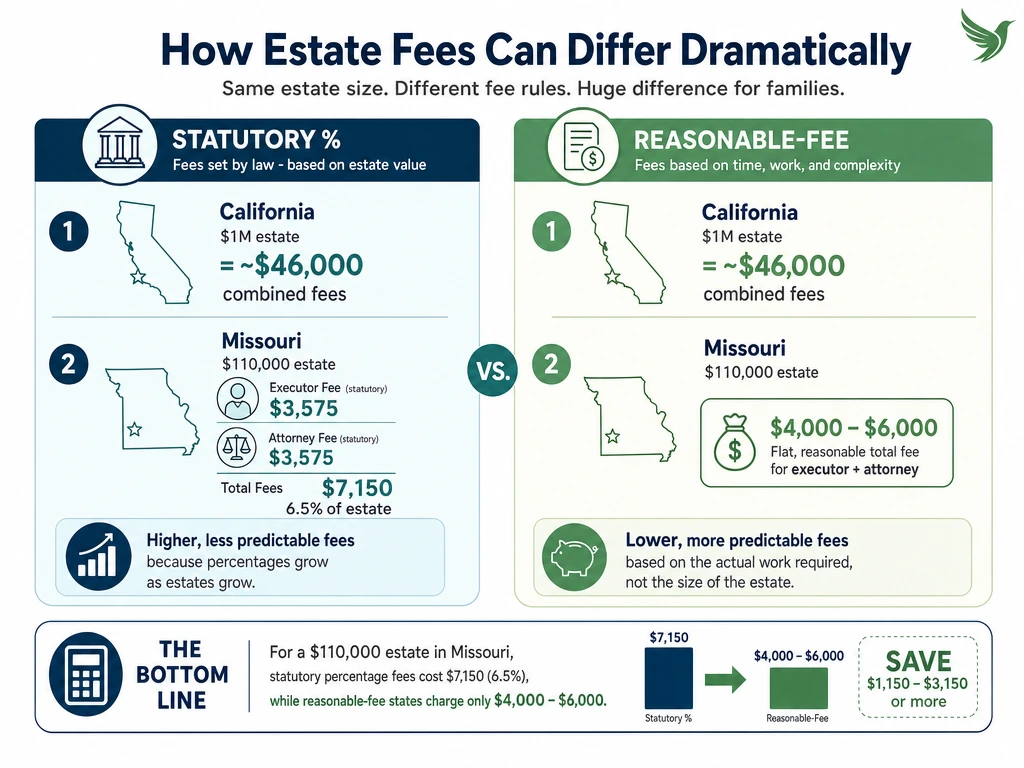
Statutory percentage states can cost thousands more than reasonable-fee states on the same estate.
What Drives Probate Costs Up (and What Keeps Them Down)
Two estates of equal value can cost wildly different amounts. The drivers are estate value, complexity, whether a will exists, and how long the process drags. A contested will or out-of-state property can double the bill.
Estate value and complexity
Ancillary probate for out-of-state property is almost always pricier, requiring two separate legal teams and two sets of court filing fees. Property in three states means three proceedings. A contested will raises both duration and cost, and the more complex the estate, the longer and costlier the process.
Probate without a will costs more
Dying intestate costs more because the court appoints a neutral administrator who must locate and contact heirs, adding time and resources. Readers on estate forums often ask whether a surviving spouse even needs probate when most assets were held jointly; the answer turns on how title was held, not on the marriage itself.
How long probate takes and why it matters
Probate’s national average runs about 20 months, with 12 to 18 months typical and simple estates closing in 3 to 6 months. Texas and Florida often finish in 6 to 12 months, while California and New York run longer. Florida’s uncontested formal probate usually takes 6 to 12 months, though estates under $150,000 can close in 4 to 8 weeks. Mandatory creditor periods set a floor: Missouri’s earliest close is roughly 6 months and 10 days after first publication, and Illinois imposes a 6-month creditor window. Every extra month adds attorney hours and administrative cost.
Which Assets Go Through Probate and Which Skip It Entirely
You only pay these fees on probate assets. Anything solely owned by the decedent at death with value goes through court: individual bank accounts and real estate titled in the deceased’s name alone. Everything else can pass directly and cost nothing in court fees.
Assets subject to probate
Solely-owned accounts and property in one name pull the estate into court. This is the trap forum users describe when a spouse dies as sole owner of the family home and the survivor cannot retitle it without a proceeding.
Non-probate assets
Non-probate assets pass outside court: jointly-owned property with right of survivorship, revocable living trust assets, life insurance, IRAs and retirement plans with named beneficiaries, and transfer-on-death accounts. IRAs, 401(k)s, and life insurance bypass the court because each contract names a beneficiary who receives the asset directly. With right of survivorship, title passes straight to the surviving co-owner on death.
- Joint tenancy with right of survivorship
- Revocable living trust assets
- Life insurance and retirement accounts with beneficiaries
- Payable-on-death and transfer-on-death accounts
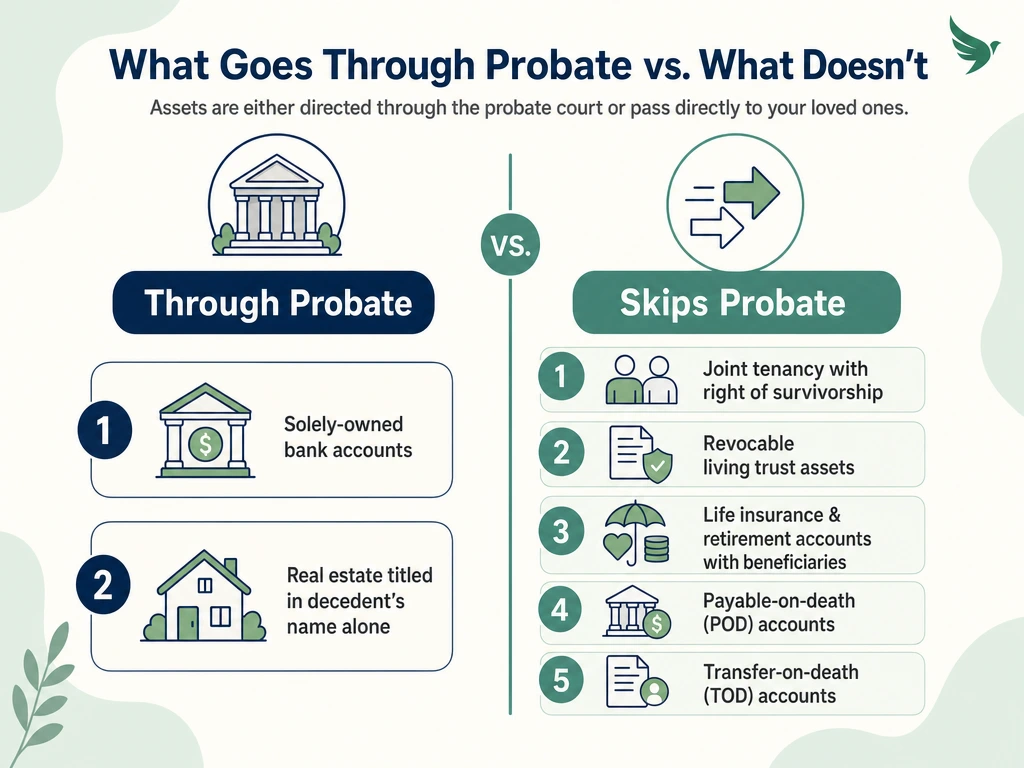
Only solely-owned assets run through probate; the rest pass directly to beneficiaries.
How to Avoid Probate Costs Before They Ever Start
The cheapest court process is the one that never happens. A revocable living trust, transfer-on-death deeds, and beneficiary designations move most estates out of court entirely. A trust that costs $499 to $599 upfront can save an estate thousands later.
Living trust vs. will for cost
A revocable living trust distributes assets by its own terms, like a will, but skips court entirely; the grantor keeps full control during life. A will still passes through the court process, which is public record. Probate files are public documents, so anyone can inspect a family’s finances, an added privacy argument for a trust.
MyEstateAngel prices both plans upfront. The Will plan costs $199 for one person or $249 for a couple; the Trust plan costs $499 or $599 for a couple; notarization adds $75 to $115, and a property deed transfer runs $399 plus the county recording fee. That deed retitles your home into the trust, usually reviewed within 4 to 12 hours and recorded in 2 to 4 weeks.
Transfer-on-death deeds and beneficiary designations
Ways to skip court include a revocable living trust with the grantor keeping control during life, joint accounts with right of survivorship, POD and TOD beneficiary deeds, beneficiary designations on policies and retirement accounts, and lifetime gifting. Naming primary and contingent account beneficiaries lets funds reach heirs promptly without a proceeding.
Small estate affidavit for qualifying estates
Small estate thresholds vary widely. California allows $208,850 in personal property, rising to $239,700 for deaths on or after April 1, 2026 under Probate Code §13100. Texas sets $75,000 excluding homestead, Missouri $40,000 with a certificate 30 days after death, Michigan about $53,000 for 2026, and Illinois requires the full process above $100,000. Below your state’s threshold, a simplified affidavit replaces the whole proceeding.
Quick Answers to 6 Questions Readers Ask Most
How much does probate cost on average?
Probate commonly costs 3 to 7 percent of the estate’s gross value. On a $500,000 estate that is $15,000 to $35,000 once court filing, representative commission, attorney fees, appraisal, and bond are combined. Statutory percentage states push toward the high end; simple estates and reasonable-fee states land lower.
Who pays probate costs, the estate or the heirs?
The estate pays, not the heirs personally. All fees come out of estate assets before distribution, which reduces what beneficiaries ultimately receive. Heirs are not billed out of pocket, though a smaller inheritance is the practical cost.
How much does a probate attorney cost?
It depends on the state. In percentage-fee states like California, the attorney draws a statutory rate: 4 percent of the first $100,000, scaling down to 1 percent on higher tiers. In reasonable-fee states, attorneys charge $150 to $500 per hour or a flat $3,000 to $7,000 for simple estates.
How long does probate take?
Simple estates close in 3 to 6 months; the national average is about 20 months, with 12 to 18 months typical. Texas and Florida often finish in 6 to 12 months, while California and New York run longer. Contested wills and out-of-state property extend it further.
What happens if you don’t go through probate?
Solely-owned assets stay legally frozen. Accounts cannot be closed and real estate in the decedent’s name alone cannot be sold or retitled without a proceeding. Assets that pass by beneficiary designation, joint tenancy, or trust transfer without court, so those need no probate at all.
How much does probate cost without a will?
Usually more. Without a will, the court appoints an administrator who must locate and notify heirs, adding time and administrative expense. The fee structure is the same as with a will, but the extra work under intestacy rules typically pushes the total higher.
Probate Costs vs. Prevention: The One Comparison That Decides It
The real question is now versus later: a $274 to $714 plan today against a five-figure court bill and months of frozen accounts tomorrow. Map your own estate first. List what passes by beneficiary, joint title, or trust, then flag what sits solely in your name. Whatever remains solely-owned is what runs through court at 3 to 7 percent. Price that number against a will or trust you can buy for a fixed amount this week. When both figures sit side by side, the choice makes itself.
Sources
- elegacylaw.com/probate.html – eLegacy Law: probate cost ranges and $500k estate example, plus timeline by state.
- ucbbank.com/resource-library/retirement-estate-planning/what-does-probate-mean – United Community Bank: probate general cost percentage and definition.
- lsmo.org/page/470/what-probate – Legal Services of Missouri: who pays probate costs.
- settledestate.com/blog/cost-of-probate-by-state – Settled Estate: court filing fees by state ($30 NM to $750 RI).
- mass.gov/info-details/probate-and-family-court-filing-fees – Mass.gov: Massachusetts probate court filing fees.
- sco.ca.gov/Files-EO/probate_guide.pdf – California State Controller: probate referee fee at 0.1% of appraised value.
- selfhelp.courts.ca.gov/probate/formal-probate – California Courts Self-Help: publication, appraiser, and referee fees as separate items.
This article is for informational purposes only and does not constitute legal advice. U.S. law is complex and varies by state and circumstance. For your specific situation, consult a licensed attorney.