
What happens to your business when you die comes down to one factor: your entity type, plus whether you left a will or trust. A sole proprietorship ends at death and its assets fall into your estate; an LLC or corporation survives as a separate legal entity, and only your ownership interest transfers. Business Succession & Estate Planning (USA) decides whether your family walks into a clean handover or a public court fight. This guide covers entity structures, probate, who inherits, business debts and taxes, and the documents that keep your company out of court.
Key takeaways
- A sole proprietorship ends at death and its assets enter probate, while an LLC or corporation survives and only your ownership interest transfers.
- Without a will, probate runs about 6 to 12 months and costs roughly 3% to 5% of estate value (around $40,000 on a $1,000,000 interest).
- The 2026 federal estate and gift tax exemption is $15,000,000 per person, so most heirs owe no federal estate tax.
- Heirs get ownership but not automatic management rights to run the company unless a document names a successor.
- Business debts are paid from the estate, not the family’s own money, unless a personal guarantee (such as on an SBA loan) exists.
- A funded revocable living trust keeps the business out of probate; a will alone still goes through court.
- Over 50% of reviewed business documents fail to address the owner’s death, defaulting the interest into probate.
What Happens to Your Business When You Die Depends on Its Legal Structure
Your entity type decides everything. A sole proprietorship ends at death because it has no legal life separate from you, and its assets and debts pass into your estate. An LLC or corporation survives as a separate legal entity, so the business keeps operating and only your ownership interest transfers. This first fork drives every other outcome in Business Succession & Estate Planning (USA).
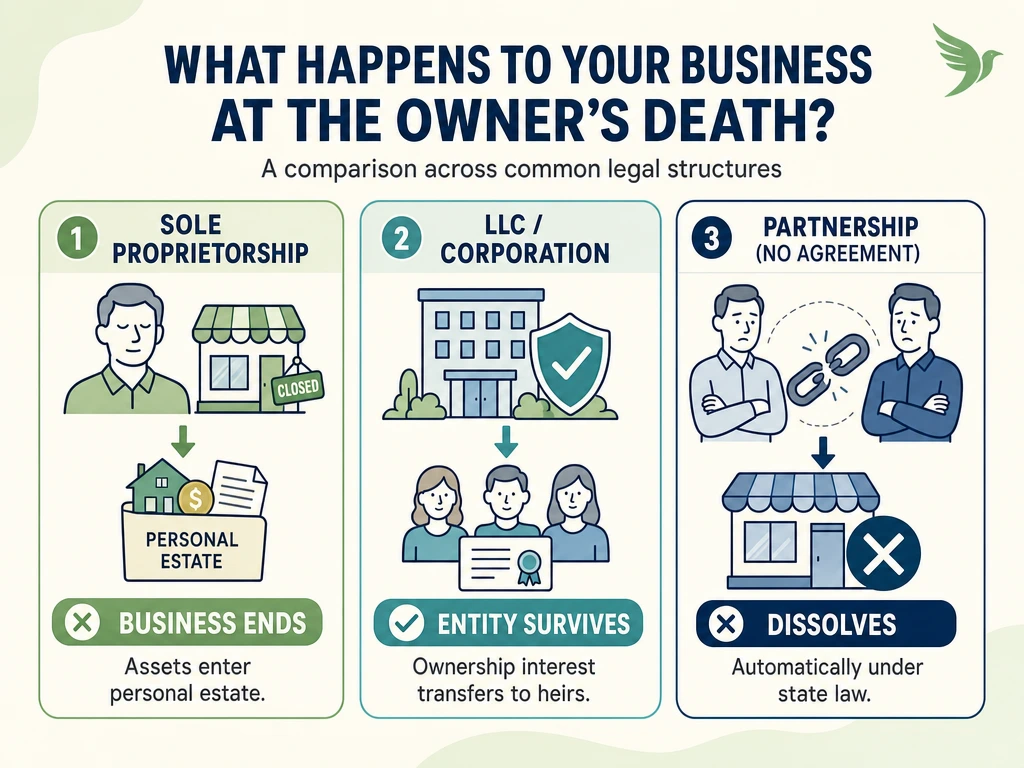
Outcome at death depends entirely on your entity structure.
Sole proprietorship: the business ends and assets enter your estate
A sole proprietorship is a legal extension of your personal estate. At death the business effectively ceases to exist, and equipment, inventory, and liabilities pass into the probate estate to be liquidated under state law. Nobody inherits “the business” as a going concern; heirs inherit whatever assets remain after debts.
LLC or corporation: the entity survives, your interest transfers
An LLC or corporation is a distinct legal person. The company continues; the only question is how your membership interest or shares move to your estate or trust. As separate legal entities, an LLC or S-Corp outlive the owner’s death, so only the ownership interest is subject to transfer. Single-member LLCs face fewer complications than multi-member ones, but in both cases management rights do not pass to heirs automatically unless the operating agreement says so. A death clause or transfer-on-death provision in the operating agreement can smooth that transfer.
Partnership: the agreement (or its absence) decides
A partnership is fragile at death. Under default RUPA/UPA rules, a partner’s death triggers dissolution or a mandatory wind-up unless a written agreement says otherwise. With an agreement, surviving partners often continue and buy out the deceased’s interest; without one, the partnership may have to liquidate. Note the recurring theme: ownership rights and management rights are legally distinct, so inheriting an interest never automatically grants the right to run the company, just as naming someone director does not transfer ownership.
Dying Without a Will: How Probate and Intestate Succession Take Over Your Business
With no will or trust, your business interest becomes part of a probate estate managed by a court-appointed administrator, and state intestate succession law decides who inherits. Probate is the court process that settles your estate; it runs roughly 6 to 12 months, values the business interest, and becomes public record. This is the default that Business Succession & Estate Planning (USA) exists to override.
What the probate process for business ownership looks like
Probate is a court process to settle the estate, and it moves slowly. Many states build in a contest window – about 90 days to challenge the will in states like Ohio – before assets fully distribute. Administration costs run roughly 3% to 5% of estate value, which is about $40,000 on a $1,000,000 interest. Third parties can contest and freeze the interest for months, sometimes years.
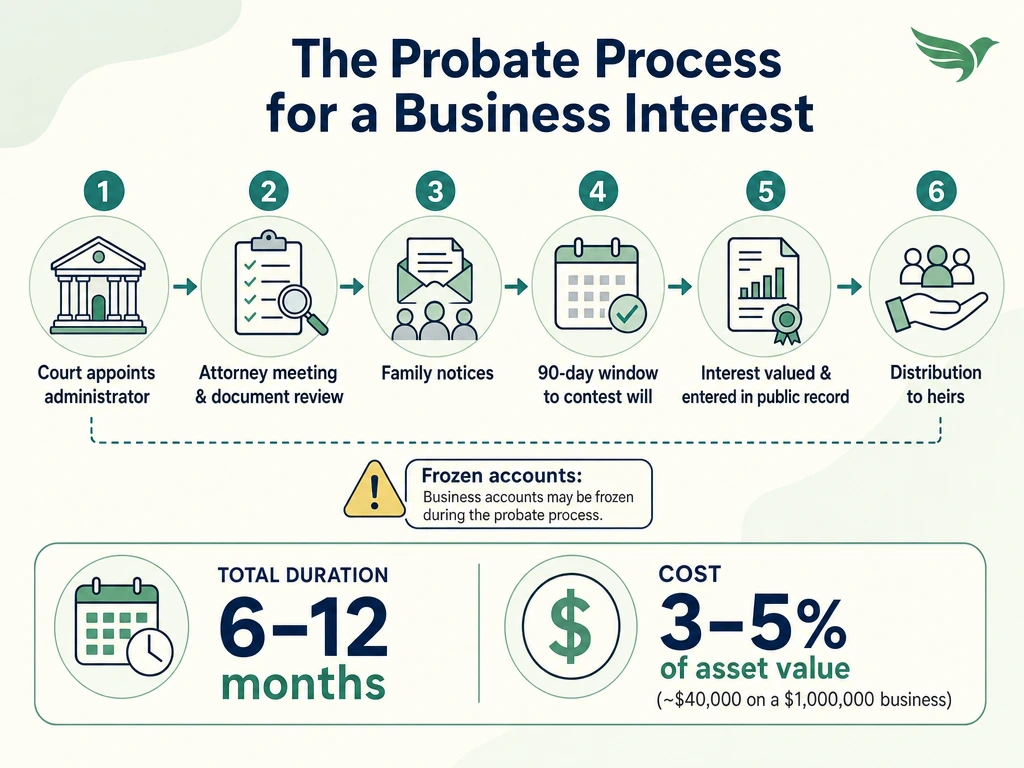
Źródło: CMRS Law — probate timelines and administration costs.
Intestate succession: the state’s default heirs
Intestate means dying without a valid will, and state law then decides everything. The hierarchy generally runs surviving spouse first, then children, then more distant family. Exact shares vary sharply by state: Florida Chapter 732 and Texas Estates Code Chapter 201 assign different spousal portions. Entity type adds further complication, since a sole proprietorship’s assets and a corporation’s shares travel different legal paths.
Who Inherits Your Business and What They Actually Control
With a will, the named beneficiary inherits the business once probate finishes. Heirs receive ownership, but the legal right to run daily operations – management rights – often needs separate authority. Being a director or manager is entirely separate from owning shares, so naming someone director does not transfer ownership. This distinction sits at the heart of Business Succession & Estate Planning (USA).
Leaving your business to a spouse or children
You can leave your interest to a spouse or your children, but fairness between multiple heirs gets complicated fast. Consider a real scenario: a 50/50 co-owner died and his non-working spouse inherited shares she never wanted, forcing the surviving partner into solo operation and awkward negotiations. A shareholders’ or buy-sell agreement would have resolved that automatically.
Ownership rights vs management rights
Heirs get ownership; management authority is a separate legal grant. Ownership rights and management or control rights are legally distinct, so inheriting an interest does not by itself give the right to run the company. An operating agreement, corporate bylaws, or a trustee appointment must name who actually signs checks and directs operations. Without that document, your beneficiary owns a stake but cannot lawfully run the company on day one.
S-Corp and family-inheritance traps
S-Corporation status is fragile. If stock passes to an ineligible shareholder or an ineligible trust at death – even briefly – the S election can terminate and the company loses pass-through taxation. A revocable trust that stops being a grantor trust at death stays a permissible shareholder for 2 years, and ESBT or QSST elections preserve the status. Without a buy-sell agreement, S-corp shares pass by default through the estate to heirs, exposing those strict eligibility rules to violation.
Business Debts, the Bank Account, and Taxes Your Heirs Face
Your business debts are paid from the estate, not from your family’s personal money, unless a personal guarantee exists. The business bank account typically freezes until an executor is authorized, and heirs usually get a step-up in basis that softens the tax hit. These mechanics are core to Business Succession & Estate Planning (USA).
Do you have to pay taxes on an inherited business?
Most heirs owe little at inheritance because of two rules. The 2026 federal estate and gift tax exemption is $15,000,000 per individual, up from $13.99M in 2025, under recent law amending IRC §2010(c)(3). Below that threshold, no federal estate tax applies. Meanwhile step-up in basis (IRC §1014) resets an inherited asset’s cost basis to fair market value on the date of death, cutting capital gains tax when heirs sell.
What happens to a business bank account when the owner dies
The business bank account generally freezes until someone holds legal authority to act. An executor or administrator, once appointed, gains access to pay obligations and manage funds. This freeze is exactly why a named successor or trustee – who can act immediately – matters so much for continuity.
Business debts and personal guarantees
Business debts do not disappear at death. The estate pays them, first from liquid funds and then by selling assets, and the executor settles them from the estate rather than the family’s own pocket. The family does not answer for the debts from their own assets unless a personal guarantee exists. The exception is a personal guarantee: on an SBA loan, for example, the guarantee turns a business debt into a claim against the estate, and lenders can pursue estate assets. Probate administration costs of 3% to 5% further reduce what heirs receive.
The Documents That Keep Your Business Out of Probate: Will, Trust, and Buy-Sell Agreement
Four tools change the outcome. A will names heirs but still runs through probate; a revocable living trust skips probate for assets funded into it; a buy-sell agreement pre-decides who buys your share; and life insurance funds the deal. Each is a lever in Business Succession & Estate Planning (USA), and each does a different job.
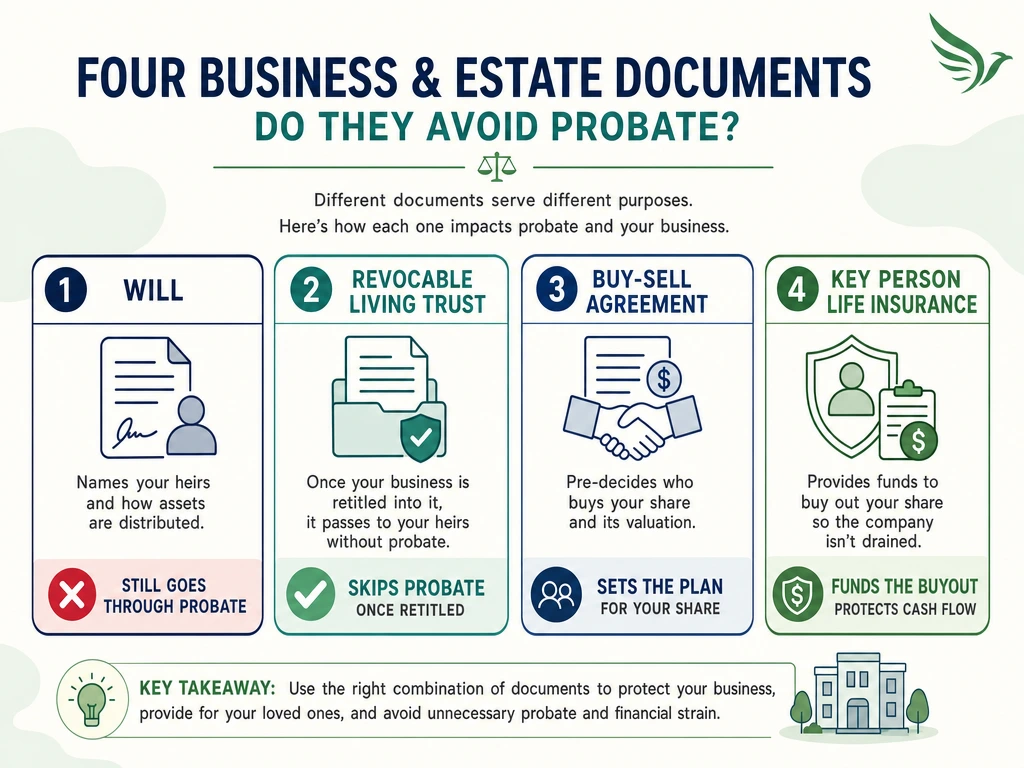
Each tool does a different job in a succession plan.
Will vs revocable living trust for business ownership
A will names heirs but the estate still goes through probate, which is public and months long. A revocable living trust keeps the business interest out of probate only for assets you actually retitle into it, letting a successor trustee manage the business immediately without court delay. MyEstateAngel prices its Will plan at $199 for an individual and $249 for a couple – still subject to probate – while the Trust plan is built to skip it. The catch is real: a trust protects nothing until you move assets into it, so retitle the bank account, update the brokerage, and re-deed the home.
Buy-sell agreement and key person life insurance
A buy-sell agreement is a legally binding contract dictating how an ownership interest transfers on death or exit and how the business gets valued. Owners commonly fund it with life insurance – either cross-purchase or stock-redemption – so the proceeds pay the deceased owner’s family for their share. One current caution: under the SCOTUS Connelly decision, company-owned insurance funding a redemption can increase the company’s estate-tax value, a real trap for closely held owners.
Operating agreement death clause and named successor
An operating agreement death clause governs member transfer and can name a successor manager who steps in without a court order. Without one, management rights do not pass to heirs automatically. A one-page, owner-signed transfer-on-death or beneficiary designation, working with the operating agreement or naming a trust, creates a clear succession line and avoids probate court.
Building a Business Succession Plan Before You Need One
A business succession plan turns a chaotic transition into a roadmap: it names a successor, sets a valuation method, and keeps operations, licenses, contracts, and the EIN alive during the handover. It is an ongoing process, not a one-time document. Treating it that way is what separates prepared owners from the majority in Business Succession & Estate Planning (USA).
Naming a successor and setting a valuation
J.P. Morgan’s framework runs in three steps: build an advisory team, set a business valuation method, and plan personal finances and estate. Practically, that means identifying priority roles, defining the competencies each requires, and naming potential successors. A pre-agreed valuation method also prevents heir disputes over what the interest is worth.
Business continuity: licenses, contracts, EIN, and digital assets
Continuity depends on details owners rarely track. You need a new EIN when ownership or entity structure changes, and executors handle estate EIN and address changes with the IRS using Form 8822. Licenses and permits are often non-transferable and can force a shutdown. Naming a temporary or interim manager – a business executor – is critical, because someone must approve payouts, pay payroll, cover rent, and sign checks after death, or value evaporates fast.
Retaining employees and communicating with clients
Much of a business’s value is goodwill tied to the owner personally, and disruption after death can permanently damage an otherwise viable company. The documentation gap is stark: over 50% of reviewed business documents – operating agreements, bylaws, close corporation agreements – fail to address the owner’s death, so the interest defaults into probate. Clear communication with key staff and clients during the transition protects the relationships that keep revenue flowing.
Quick Answers to 6 Questions Owners Ask Us Most
Who inherits a business if the owner dies without a will?
State intestate succession law decides, not you. The default order generally puts the surviving spouse first, then children, then more distant relatives, with exact shares varying by state such as Florida or Texas. The business interest passes through a court-supervised probate estate managed by a court-appointed administrator, and the whole filing becomes public record.
Does an LLC survive the death of its owner?
Yes. An LLC is a separate legal entity, so it keeps existing after the owner dies; only the ownership interest transfers to the estate or trust. Management rights are a separate matter – heirs do not automatically gain authority to run daily operations unless the operating agreement includes a death clause naming a successor.
Do heirs have to pay taxes on an inherited business?
Usually very little. The 2026 federal estate tax exemption is $15,000,000 per individual, so estates below that owe no federal estate tax. Heirs also get a step-up in basis under IRC §1014, which resets the asset’s cost basis to fair market value at death and reduces capital gains tax if they later sell.
Does my family have to pay my business debts when I die?
No, not from their own money. Business debts are paid from the estate – first liquid funds, then asset sales – and the executor settles them, not the family personally. The exception is a personal guarantee, such as on an SBA loan, which turns the debt into a claim against your estate that lenders can pursue.
What happens to a business bank account when the owner dies?
The account typically freezes until someone has legal authority to act on it. An executor or administrator appointed through probate gains access, or a successor trustee can act immediately if the account is held in a funded revocable living trust. That difference in speed is a major reason owners fund a trust rather than rely on a will alone.
How do I keep my business out of probate?
Fund a revocable living trust with the business interest, so a successor trustee manages it without court delay. Layer a buy-sell agreement funded by life insurance for co-owned firms, and add an operating agreement death clause or beneficiary designation naming a successor. A will alone does not avoid probate – it only names who inherits after the court process finishes.
The 3 Documents to Put in Place This Month Before It Falls on Your Family
Start this week. First, write down your entity type, current ownership percentages, and named beneficiaries so your family knows the structure. Second, put a will or a funded revocable living trust in place – MyEstateAngel’s Will plan starts at $199 and the Trust plan is built to keep the house and business out of probate. Third, if you have co-owners, add a buy-sell agreement with life insurance so nobody inherits a partner they never chose. State inheritance rules and S-Corp eligibility carry real nuance, so treat this as a starting map, not legal advice, and confirm specifics with an attorney in your state.
Sources
- americanbar.org/groups/business_law/resources/business-law-today/2020-january/death-of-an-llc-member-part-ii – American Bar Association: death of an LLC member, ownership vs management rights, and inheritance mechanics.
- nybusinessdivorce.com/2010/01/articles/family-owned-businesses/winding-up-an-acrimonious-partnership-following-death-of-a-partner – New York Business Divorce: winding up a partnership after a partner’s death under default rules.
- legislature.mi.gov/documents/mcl/pdf/mcl-72-1917-VI.pdf – Michigan Legislature: statutory partnership dissolution and wind-up provisions (RUPA/UPA framework).
- leg.state.fl.us/statutes/index.cfm?App_mode=Display_Statute&URL=0700-0799/0732/0732.html – Florida Legislature: Chapter 732 intestate succession and spousal shares.
- irs.gov/faqs/interest-dividends-other-types-of-income/gifts-inheritances/gifts-inheritances – IRS: gifts and inheritances FAQ, including step-up in basis at death.
- irs.gov/businesses/small-businesses-self-employed/whats-new-estate-and-gift-tax – IRS: 2026 estate and gift tax exemption of $15,000,000 per individual under recent law.
- jpmorgan.com/insights/business-planning/introduction-to-succession-planning-for-business-owners – J.P. Morgan: succession planning framework of advisory team, valuation method, and estate planning.
- irs.gov/businesses/small-businesses-self-employed/when-to-get-a-new-ein – IRS: when a new EIN is required after ownership or structure changes.
- irs.gov/businesses/small-businesses-self-employed/information-for-executors – IRS: information for executors handling estate EIN and address changes (Form 8822).