
Pay the loudest creditor first instead of following the statutory priority order, and you can owe the shortfall out of your own pocket. Executor liability and creditor priority in insolvent U.S. estates turn on one rule: creditors get paid in a fixed legal sequence, with the federal government near the top under 31 USC 3713. This guide walks the solvency test, the priority tiers, secured versus unsecured treatment, how personal liability attaches, and the notices and court steps that shield you before you distribute a dollar.
Key takeaways
- An estate is insolvent when debts exceed assets, tested at the moment of distribution, not when probate opens.
- Under 31 USC 3713, a U.S. government claim is paid first, a rule unchanged since 1797.
- The priority order runs: administration costs, funeral expenses, federal taxes, last-illness costs, state taxes, then all other claims.
- Executors who pay a lower-priority creditor before a government claim are personally liable for the shortfall under 31 USC 3713(b).
- Equal-rank unsecured creditors share pro rata: $15,000 available against $80,000 owed means each recovers 18.75%.
- Publication notice runs 3 to 4 weeks and creditor claim windows are typically 3 to 4 months, varying by state.
- In a fully insolvent estate heirs usually get nothing, and family is not liable for the decedent’s solo debts.
When an Estate Is Insolvent: The Test Every Executor Must Run First
An estate is insolvent when total debts exceed the fair market value of assets after exemptions, a balance-sheet test you run before paying anyone. Example: $150,000 in assets against $250,000 in debts is insolvent. Run this math first, because premature payment is where executor liability and creditor priority collide.
The solvency math: assets minus exempt property minus debts
The IRS applies balance-sheet insolvency under 31 USC 3713(a), meaning liabilities exceed assets (Lakeshore Apartments v. United States, 351 F.2d 349). Simple inability to pay debts as they come due does not make an estate insolvent (United States v. Oklahoma, 261 U.S. 253). Common debts that push an estate underwater include credit card balances, medical bills, personal loans, mortgages, and unpaid taxes.
Family allowance and homestead exemptions come off the top
Exempt property leaves the estate before creditors touch it. Florida’s homestead exemption is unlimited in dollar value, automatic, and requires no filing. Texas homestead is exempt from general creditor claims under Estates Code Sec. 102.004, though purchase-money and tax debts can still trigger foreclosure. Family allowance ranges widely: California sets no statutory maximum and lets the court order a reasonable amount, while Nevada scales by estate size around a $150,000 threshold.
Near-insolvent estates: why the margin matters
The critical moment for the test is the time of distribution, not the opening of probate (Schwartz v. Commissioner, 560 F.2d 311). An estate can look solvent at first, then federal priority arises if it is insolvent when you actually pay out. Treat a thin margin as insolvent and pay in strict order.
The Federal Creditor Priority Order in an Insolvent U.S. Estate
Creditors get paid in a strict statutory order, not by who calls first. Administration costs, funeral expenses, and federal tax debt sit near the top; credit cards sit near the bottom. Executor liability and creditor priority both depend on honoring this sequence exactly.
31 USC 3713: why the IRS often gets paid ahead of everyone
31 USC 3713(a)(1)(B) states a claim of the United States shall be paid first when a deceased debtor’s estate in the custody of the executor is not enough to pay all debts. This Federal Priority Statute has operated without material change since 1797. The DOJ Civil Resource Manual confirms it applies in nonbankruptcy insolvencies, including decedents’ estates.
Administration expenses and executor costs rank first
The typical statutory priority order runs as follows:
| Rank | Claim category |
|---|---|
| 1 | Administration costs and expenses (including homestead and family allowances) |
| 2 | Reasonable funeral expenses |
| 3 | Debts and taxes with federal preference |
| 4 | Expenses of the last illness |
| 5 | Debts and taxes with state preference |
| 6 | All other claims |
Where state priorities conflict with federal priority, federal priority controls. Although 31 USC 3713 states no exceptions, courts allow administration expenses, funeral costs, and homestead and family allowances ahead of federal tax debt. Administration expenses cover court costs, reasonable fiduciary and attorney fees, and the cost of collecting and preserving assets.
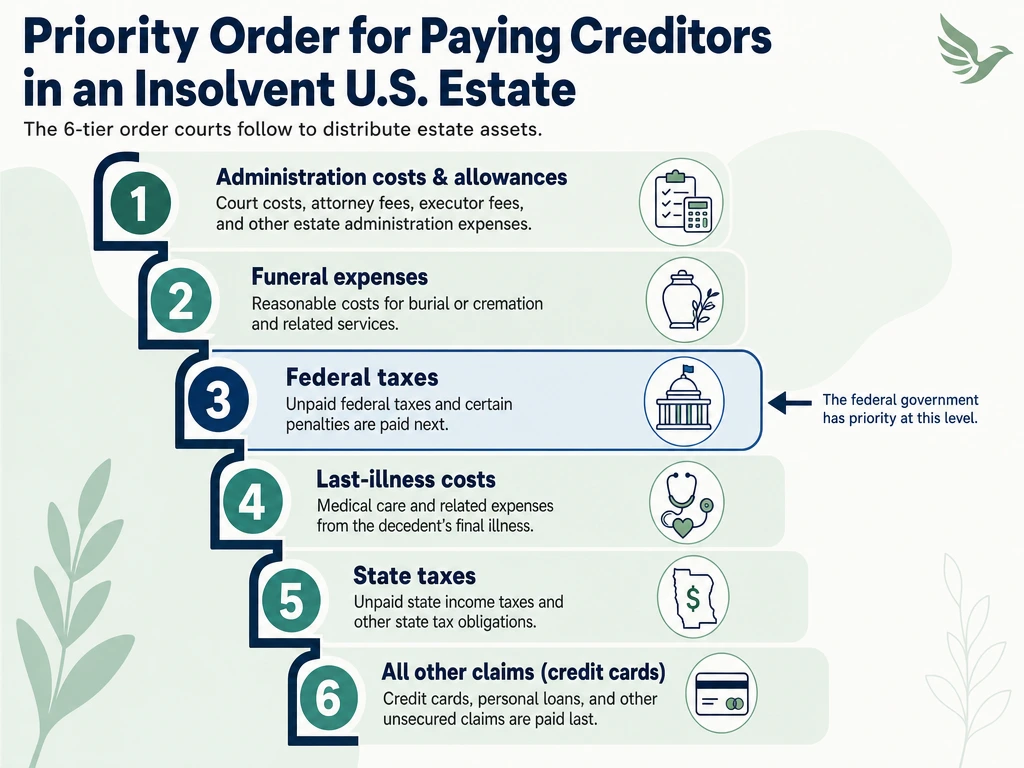
Statutory priority order; where state and federal priorities conflict, federal priority controls (31 USC 3713).
Where state law and federal law interact
State statutes set their own tiers, from Texas Estates Code Ch. 355 to Pennsylvania 20 Pa.C.S. Sec. 3392. When applicable assets fall short, the personal representative pays proper charges in the statutory classification order, and remaining funds may be shared pro rata. The order of payment of debts of a deceased person follows this classification, with the federal government asserting its position under 3713 when the estate cannot cover everything.
Secured vs Unsecured Creditors: How the House and the Credit Cards Are Treated Differently
Secured creditors like a mortgage or car loan hold first claim to the specific collateral backing the debt. Unsecured creditors such as credit cards share whatever remains pro rata, often pennies on the dollar. This split decides who recovers when the estate cannot pay in full, and executor liability and creditor priority hinge on getting the secured tier right.
Mortgage debt and the deceased’s property
A secured lender looks first to its collateral. When the property sells for less than the balance, the lender’s shortfall becomes a deficiency claim, and that unsecured balance drops into the statutory order alongside other unsecured claims. One sharp exception applies to federal tax debt. Under the Romani rule (United States v. Estate of Romani, 523 U.S. 517), the Federal Priority Statute does not apply if, before proceedings begin, another party obtained a property interest that would beat a federal tax lien under IRC 6323. In Romani, a judgment lien recorded before the Notice of Federal Tax Lien prevailed over IRS claims in an insolvent estate.
Pari passu: pro-rata payment among equal-rank unsecured creditors
Equal-rank unsecured creditors share pari passu, meaning proportionally. The math is unforgiving. With $15,000 in available funds against $80,000 in unsecured debt, each creditor recovers 18.75% of what it is owed. Unsecured creditors typically recover only pennies on the dollar once the secured tier and higher priorities are satisfied. Mishandling secured debts can improperly shrink estate value, and the estate need not always pay the full secured balance unless the will expressly directs it.
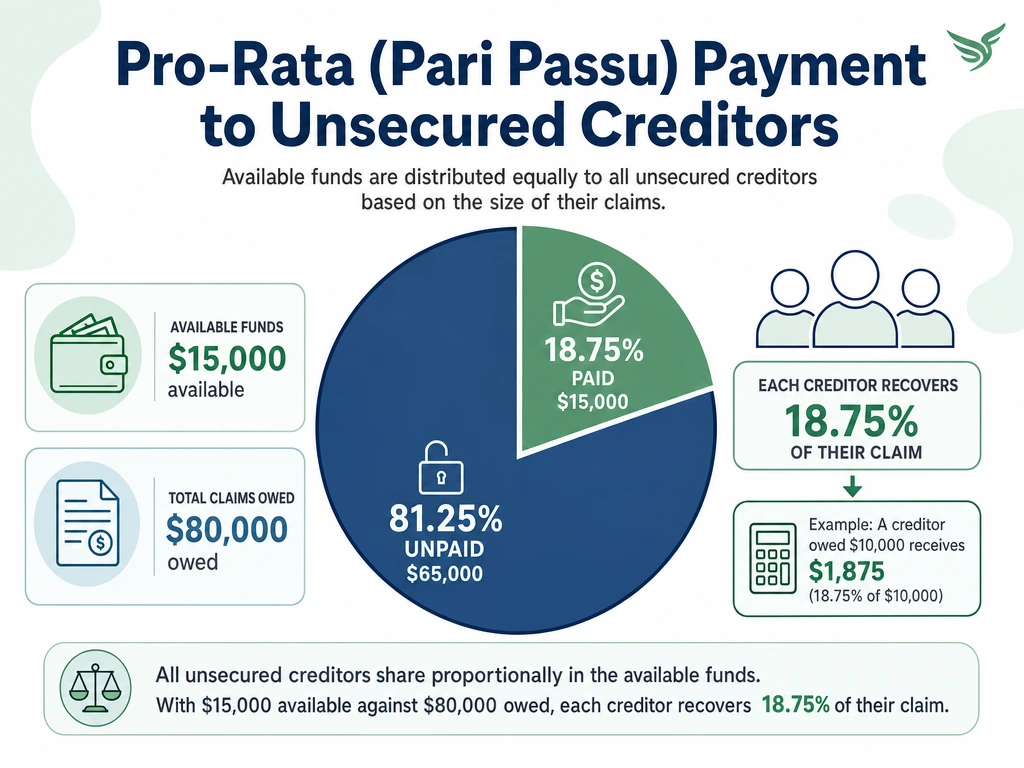
Equal-rank unsecured creditors share pari passu — pennies on the dollar.
Credit card and consumer debt: usually low priority
Credit cards, consumer loans, and similar unsecured obligations rank near the bottom. They collect only after administration costs, funeral expenses, federal claims, and secured collateral shortfalls are addressed. In an insolvent estate, credit card debt usually collects only a pro-rata share of what is left for its class, and any balance the estate cannot cover goes unpaid.
How an Executor Becomes Personally Liable for the Shortfall
You are not automatically liable for the decedent’s debts. But pay a lower-priority creditor first, distribute to heirs too early, or ignore federal taxes, and you become personally responsible for the shortfall from your own funds. Executor liability and creditor priority meet at exactly this point.
The statute that puts your own money on the line
31 USC 3713(b) makes a representative who pays any part of a debt before paying a claim of the government liable to the extent of that payment for unpaid government claims. Liability is capped at the value of assets distributed in violation of federal priority. The Tax Court has held executors personally liable under 3713(b) for unpaid estate taxes and interest, rejecting arguments that shielded a fiduciary who paid other debts ahead of the government.
Knowledge is a required element
The government must show the fiduciary had actual knowledge of facts that would put a reasonably prudent person on notice of the tax debt before the challenged distribution (United States v. Coppola, 85 F.3d 1015, 2d Cir. 1996). Fiduciary defenses include lack of knowledge, estate solvency at the time of distribution, expiration of the statute of limitations, and distributions for claims over which the U.S. had no priority.
Paying the wrong creditor or the wrong person first
An executor is not liable simply by serving. But distribute to beneficiaries while knowing of an outstanding creditor claim, and you owe that creditor up to the amounts distributed. Two common errors create that exposure: distributing assets to heirs before creditors are paid, and paying creditors out of priority order. Premature distributions can trigger transferee liability for executors and beneficiaries under state fraudulent-transfer law, on top of federal exposure. Acting without court permission where the law requires it can also mean removal from office and an order to reimburse the estate from your own funds.
Protecting Yourself: Creditor Notices, Deadlines, and Court Supervision
Before you distribute anything, publish notice to creditors and honor state claim deadlines. When an estate is clearly insolvent, ask the probate court for supervision so you follow the priority order under judicial protection. These steps are the practical core of managing executor liability and creditor priority.
Notice to known and unknown creditors
Publication notice must run in a qualifying county newspaper, commonly once each week for 3 to 4 consecutive weeks. The notice must name the decedent and the personal representative and give instructions for bringing claims. Publication starts the claim-filing clock for unknown creditors.
Claim filing deadlines in probate
Creditor claim windows vary by state, typically 3 to 4 months:
| State | Claim window |
|---|---|
| Florida | 3 months (90 days) from first publication (Fla. Stat. 733.702) |
| California | 4 months after letters issue, or 60 days from mailed notice |
| Michigan | 4 months (MCL 700.3803) |
| North Carolina | at least 3 months from first publication |
Sources:. To share in distribution, a creditor, including the IRS, must file a timely claim, and most probate courts will not pay a debt absent one. State statutes of limitations on claims do not bind the United States (United States v. Summerlin, 310 U.S. 414), so the IRS is never cut off by a state window.
Requesting court supervision
Probate can be court-supervised or informal. Under supervision, the personal representative must obtain court approval for many acts, including asset distribution, which provides judicial protection when you follow the priority order. Creditors file claims, you approve or reject each one, and rejected claimants may litigate in probate court and appeal.
When to consider stepping back before you take control
Once appointed, you cannot simply walk away. In Uniform Probate Code states, you may resign only after giving interested persons at least 15 days of written notice, and the resignation takes effect only when a successor is appointed and receives the estate assets. Get counsel before accepting appointment for an insolvent estate. Bankruptcy is not an exit: a probate estate is not a person under the Bankruptcy Code and cannot be a debtor, so an insolvent estate is settled in probate court under the state priority rules. Specific renunciation procedure is governed by state probate code.
What Happens to Beneficiaries and Family When the Estate Owes More Than It Holds
In a fully insolvent estate, heirs typically receive nothing after creditors are paid in order, and creditors themselves often recover less than the full amount owed. Family members are not personally liable for the decedent’s solo debts, though joint obligations survive for the co-borrower. This is where executor liability and creditor priority reach the people waiting on an inheritance.
Beneficiaries usually receive nothing
Beneficiaries have no claim to the estate until all outstanding debts and expenses are settled. When an insolvent estate cannot cover its creditors, there is no residue left to distribute, and the insolvent estate beneficiary receives nothing outcome is the norm rather than the exception. In a fully insolvent estate, all available funds go to creditors, leaving heirs with nothing.
Family is not liable for the decedent’s individual debt
The obligation ends with the decedent’s assets, not the beneficiaries. After liquidation, claims the estate cannot pay typically go unpaid, and creditors cannot pursue family members for the shortfall. Relatives do not inherit solo debt.
Joint debt and the surviving spouse
Exceptions matter. A spouse or child who co-signed a loan or held joint credit accounts may be individually liable for that debt, and jointly owned property can expose creditors to limited rights against its value. The main carve-outs to the no-personal-liability rule are co-signed loans, joint credit accounts, jointly owned property, and community property states. Community property states add a caveat, since a surviving spouse may bear responsibility for community debts.
The Executor’s Insolvency Checklist: 6 Decisions That Keep You Off the Hook
After watching how personal liability attaches, the pattern is clear: sequence beats speed. Before you touch a dollar, confirm the estate is insolvent using the balance-sheet test at the moment of distribution, publish notice to creditors, and honor the state claim window. Then pay in order: administration costs, funeral, federal taxes, secured collateral, then pro-rata unsecured. Never pay heirs before creditors, and request court supervision when the numbers are contested. The cleaner an estate is set up in advance, with a funded trust and clear directions, the fewer of these decisions land on an executor’s shoulders.
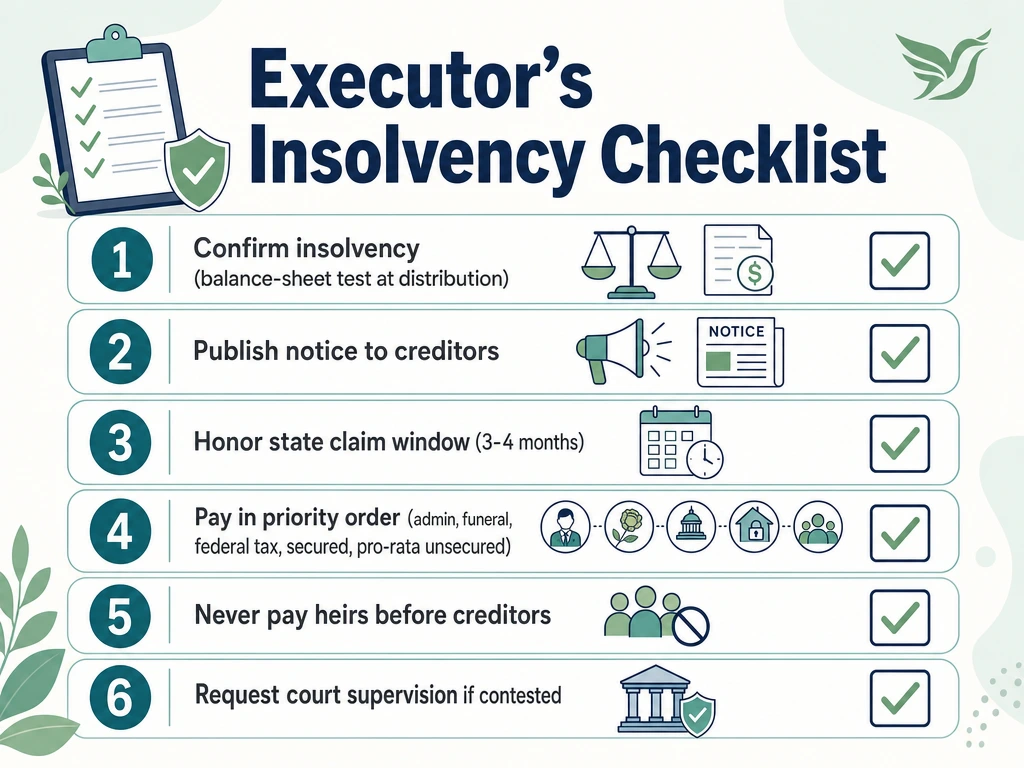
Quick Answers to 6 Questions Executors Ask Most
Can an executor be personally liable for estate debts?
Yes, but not automatically. You become personally liable if you pay a lower-priority creditor first, distribute to beneficiaries before settling debts, or ignore federal taxes under 31 USC 3713(b). Liability is capped at the value of assets you distributed in violation of the priority order, not the full debt.
What is the order of creditor priority in an insolvent estate?
The typical order runs: administration costs and allowances, reasonable funeral expenses, debts and taxes with federal preference, expenses of the last illness, debts and taxes with state preference, then all other claims. When state and federal priorities conflict, federal priority controls.
What happens if the executor does not pay debts in the right order?
Paying out of order exposes you to personal liability for the amount misapplied. If you pay a junior creditor and leave a senior government claim unpaid, you owe that shortfall yourself under 31 USC 3713(b), and a court can remove you and order repayment.
Does an executor have to pay funeral expenses before other debts?
Generally yes, within limits. Reasonable funeral expenses rank high in the statutory order, typically just below administration costs, and courts have allowed them ahead of federal tax debt. Extravagant funeral costs beyond a reasonable amount may not receive the same priority.
How does federal tax debt rank in an insolvent estate?
Near the top. Under the Federal Priority Statute, a claim of the United States is paid first when the estate cannot cover all debts. The main exception is the Romani rule: a competing property interest perfected before proceedings, that would beat a federal tax lien under IRC 6323, can outrank the IRS.
Can an executor be removed for mishandling an insolvent estate?
Yes. Breach of fiduciary duty, including premature distribution or paying creditors out of order, can result in removal from office and a court order to repay funds. Under court supervision, you also need approval for distributions, which reduces the risk of a removable error.
Sources
- irs.gov/irm/part5/irm_05-017-013 – IRS IRM 5.17.13: insolvencies and decedents’ estates, Federal Priority Statute, priority order, Romani and Coppola, court supervision.
- guides.sll.texas.gov/probate/family-protections – Texas State Law Library: Texas homestead exemption and family protections in probate.
- settledestate.com/blog/california-family-allowance-guide – Settled Estate: California family allowance, no statutory maximum, court-set reasonable amount.
- leg.state.nv.us/nrs/nrs-146.html – Nevada Revised Statutes Ch. 146: family allowance scaled by estate size.
- law.cornell.edu/uscode/text/31/3713 – Cornell LII: full text of 31 USC 3713, Federal Priority Statute and 3713(b) liability provision.
- uscode.house.gov/view.xhtml?req=(title:31%20section:3713%20edition:prelim) – U.S. House Office of the Law Revision Counsel: statutory text of 31 USC 3713.
- statutes.capitol.texas.gov/Docs/ES/htm/ES.355.htm – Texas Estates Code Ch. 355: statutory classification and order of paying claims.
- vba.org/?pg=estates – Virginia Bar Association: statutory classification order and pro-rata sharing of remaining funds.
- legis.state.pa.us/WU01/LI/LI/CT/HTM/20/00.033.092.000..HTM – Pennsylvania 20 Pa.C.S. Sec. 3392: order of payment of debts of an estate.
- consumer.ftc.gov/articles/debts-and-deceased-relatives – Federal Trade Commission: what happens to a deceased relative’s debts when the estate cannot cover them.
- courts.ca.gov/sites/default/files/courts/default/2024-11/de147.pdf – Judicial Council of California, form DE-147: duties and liabilities of a personal representative, including removal and reimbursement from personal funds.
- leg.state.fl.us/Statutes/index.cfm?App_mode=Display_Statute&URL=0700-0799/0733/Sections/0733.702.html – Florida Statutes Sec. 733.702: creditor claim filing deadline.
- nyeb.uscourts.gov/sites/nyeb/files/opinions/opinion_ast_24-01-19.pdf – U.S. Bankruptcy Court, E.D.N.Y., In re Estate of Baer (2024): a probate estate is not a person under the Bankruptcy Code and cannot be a Chapter 7 debtor.