A will is a legal document that decides how your assets are divided and who cares for your children after you die. Without one, state law makes those choices for you, often against what you would have wanted. This guide breaks down what a will actually does, the key roles like testator, executor, and beneficiary, what happens when there is no will, how probate brings the document to life, and the common mistakes first-time planners make.
In short:
- A will is a legal document that determines how your assets are distributed and who will care for your children after your death.
- A will serves four main purposes: distributing assets, appointing an executor, naming beneficiaries, and appointing a guardian for children under the age of 18.
- Without a will, the court distributes assets according to intestate succession laws, and an unmarried partner or a stepchild who has not been legally adopted inherits nothing by default.
- In North Carolina, a surviving spouse receives only between one-third and one-half of the estate if the deceased left children or surviving parents.
- A will takes effect through the probate process, which typically takes between 8 and 18 months and is a public proceeding.
- POD and TOD accounts, life insurance policies, and 401(k) plans bypass probate and take precedence over the provisions of a will.
- Fewer than half of Americans, approximately 50%, have a valid will. Without one, all decisions are left to default state laws.
A Will: A Simple Definition of the Document That Determines Your Estate
A will (legal document) is a legal document that expresses a person’s wishes, the testator, about how their estate should be divided after death. It also names an executor who manages the estate until everything is distributed. Put simply: a will lets your voice, not your state’s default law, decide who gets what.
Estate planning starts here. A will only takes effect after you die, so nothing about it binds you while you are alive. That single point separates it from most other planning tools people confuse it with.
Oral vs written wills
Most states expect a written will, signed and witnessed, to be valid. Some jurisdictions recognize spoken or handwritten versions under narrow conditions, but these carry real risk of being challenged. When it matters most, the durable, written document wins.
How a will differs from a living trust
This distinction trips up first-time planners. A will activates only after death and must pass through probate, the court process that confirms the document and oversees distribution. A living trust works differently: it operates during your lifetime and usually skips probate entirely.
There is one clever bridge. A will can create a testamentary trust, a trust that springs into existence only after the testator dies. That feature keeps the will relevant even for people who plan around trusts, since it captures assets a living trust cannot reach on its own.
The Main Purpose of a Will: Controlling What Happens After Your Death
The main purpose of a will is to ensure that your assets go to the people or organizations you choose rather than being distributed according to default state laws. The document also allows you to appoint a guardian for children under the age of 18 and reduce family disputes.
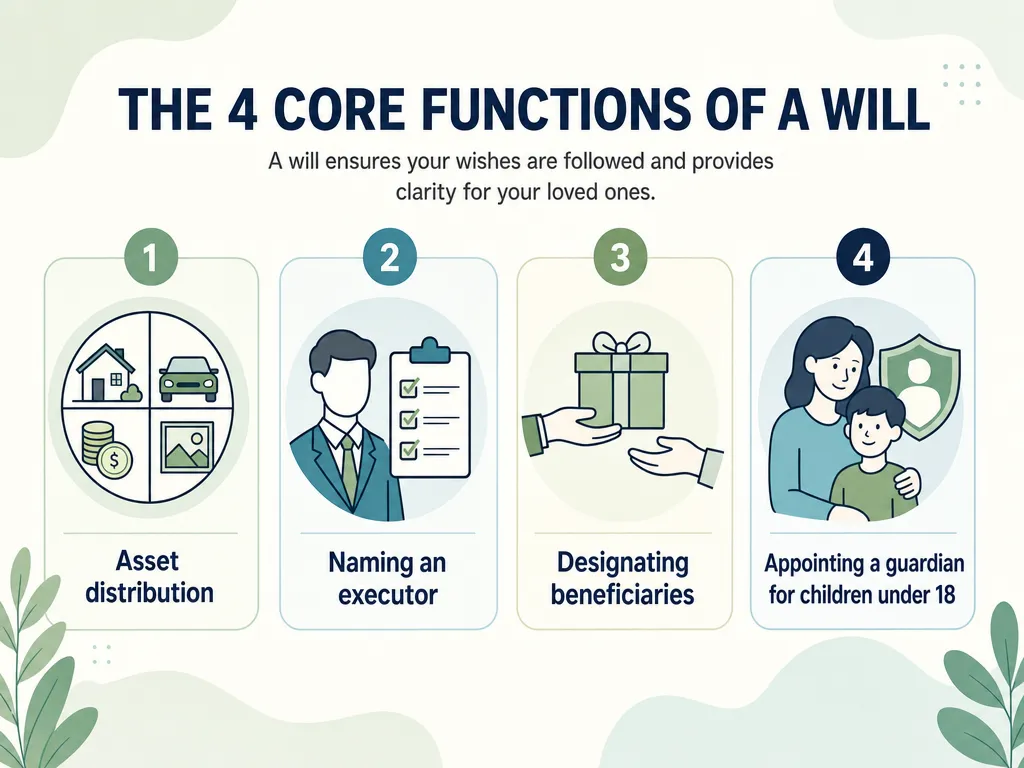
A will serves four main purposes: distributing assets, appointing an executor, naming beneficiaries, and appointing a guardian for dependents. Each of these functions puts control in your hands.
Control Over Asset Distribution
Without a will, state law determines who receives what. A will reverses this approach: you specify the people, amounts, and items you want to leave behind. This helps ensure that your assets go exactly where you want them to go.
This clarity offers another advantage. A will helps ensure that your wishes are carried out and helps prevent conflicts between heirs, making it a key component of estate planning.
Protecting Dependents and Appointing a Guardian
For parents of minor children, this is often the most important function of a will. It allows you to appoint a guardian for minor children, meaning those under the age of 18.
If you do not do this, the court will decide who should care for your children without knowing your preferences. Naming someone you trust in advance helps ensure that your children receive appropriate care. This is a safeguard that no other default legal mechanism provides.
Key Roles in a Will: Testator, Executor, Beneficiaries, and Guardian
Every will (legal document) relies on four core roles: the testator, the executor, the beneficiaries, and the guardian. The testator is the person who writes and signs the will. The executor manages the estate under court supervision, while beneficiaries receive gifts named in the document.
| Role | Who they are | Main responsibility |
|---|---|---|
| Testator | Person making the will | Decides how the estate is divided |
| Executor | Personal representative | Administers the estate under court oversight |
| Beneficiary | Person or organization | Receives an inheritance or gift |
| Guardian | Named caretaker | Cares for minor children |
Who Can Be a Testator and an Executor?
Anyone competent can serve as testator. The executor, sometimes called a personal representative, carries real duties. This person locates and files the will, prepares an inventory of assets, pays debts and taxes, then distributes what remains to beneficiaries.
The job takes months. That is why estate planners recommend naming a backup executor, in case your first choice cannot serve when the time comes.
How Do You Appoint Beneficiaries and a Guardian?
Beneficiaries can be family members, friends, or charities. A trustee differs from a beneficiary: the trustee protects beneficiaries’ rights when assets sit inside a trust.
The guardian role matters most for parents. Through a will you name the person who will raise your children under 18 if you die. Choosing this role in advance keeps a court from deciding for you, and it gives young families genuine peace of mind.
What Happens to Your Estate If You Do Not Have a Will (Intestate Succession)?
If you die without a valid will (legal document), you are legally intestate. A probate court then divides your estate according to your state’s intestate succession laws, following a fixed order of relatives. You lose all say over who inherits and how much they receive.
The Order of Intestate Succession
State law sets a rigid hierarchy. The estate typically passes to the surviving spouse first, then children, then parents, and finally siblings and their descendants. Courts follow this chain mechanically, without weighing your personal relationships or intentions.
Many people assume a spouse simply inherits everything. That is a myth. In North Carolina, a surviving spouse receives only one-third to one-half of the estate when the deceased leaves children or living parents. The exact share varies widely from state to state.
Another common fear is that the state seizes your property. That rarely happens. Assets pass to your relatives under intestate rules, reaching down to children, parents, siblings, even nieces and nephews.
Why Can Not Having a Will Be a Problem for Nontraditional Families?
Intestate laws recognize only legal relationships: marriage and blood or adoption. An unmarried partner, a stepchild you never adopted, or a close friend inherits nothing by default.
A will (legal document) is the only tool that overrides these defaults. Without one, a court decides for people your statute simply does not see. Only if no legal heirs exist at all does the estate escheat to the state where you lived.
A Will and the Probate Process: How the Document Takes Effect
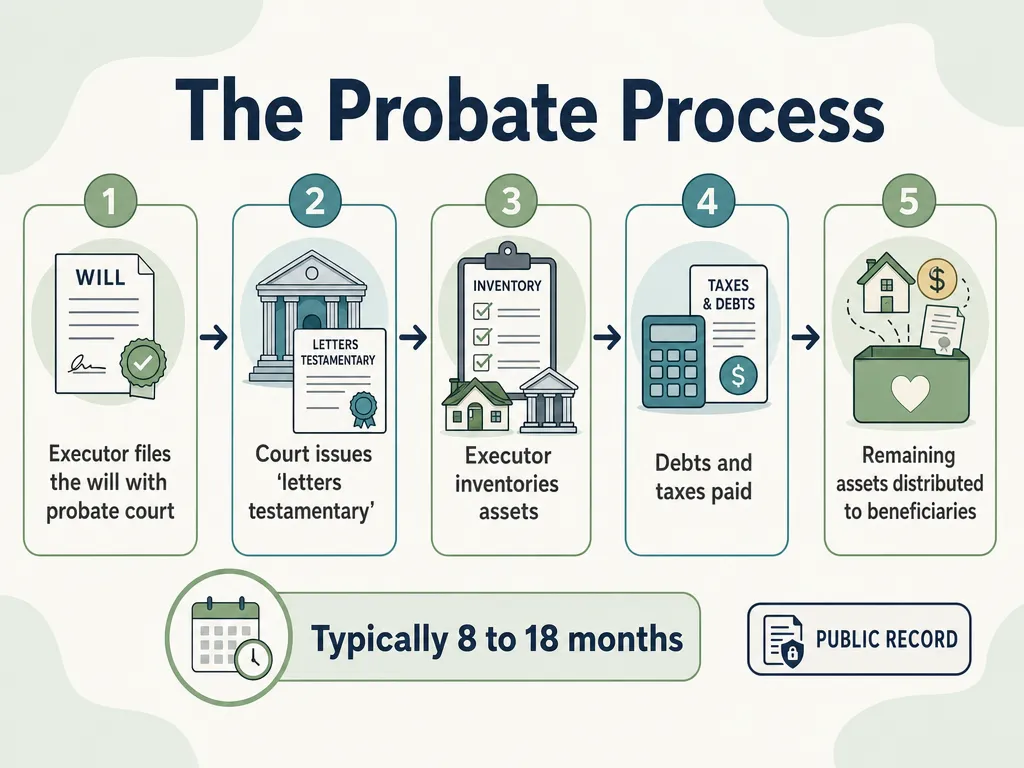
A will (legal document) does not act on its own. After the testator dies, the document must pass through probate, a court process in which a judge confirms the will’s validity, oversees payment of debts, and directs distribution to beneficiaries. Only then do its instructions take legal effect.
Steps in the Probate Process
The named executor files the will with the probate court, which then issues “letters testamentary” authorizing the executor to manage the estate. Next, the executor inventories assets, settles outstanding debts and taxes, and finally transfers what remains to the beneficiaries.
This takes time. Probate typically runs 8 to 18 months from filing, with larger or contested estates landing at the higher end of that range. The process is also public: anything filed with the court becomes a public record, so anyone can see who received what.
When Can Assets Bypass Probate?
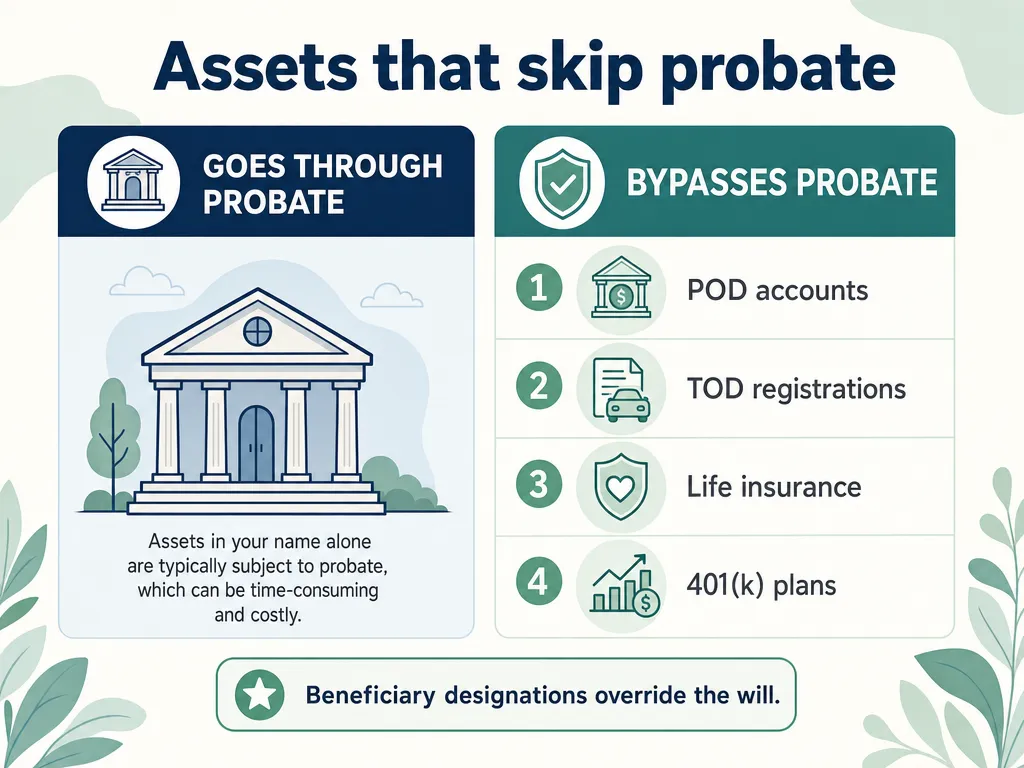
Not every asset waits for the court. Property with a named beneficiary, such as POD accounts, TOD registrations, life insurance, and 401(k) plans, bypasses probate entirely and pays out directly.
These beneficiary designations also take priority over anything your will says. If your policy names one person but your will names another, the designation wins. This is why many people pair a will with a living trust: a trust can sidestep probate’s cost, delay, and lack of privacy for the assets it holds. Unlike a will, which takes effect only after death, a living trust operates during your lifetime and usually avoids probate altogether.
Common Will Mistakes and How to Avoid Them
The biggest mistake with a will (legal document) is not having one at all. Fewer than half of Americans, roughly 50%, actually have a valid will, which leaves the state’s default rules to decide everything. Wealth is not the point here: even modest estates benefit from clear instructions.
The Biggest Mistake: An Outdated or Invalid Will
Many wills fail on technical grounds. A valid will usually requires that the testator be at least 18 and of sound mind, sign a written document, and have it signed by at least two witnesses who are not beneficiaries, often with notarization.
Watch the witness rule carefully. In many jurisdictions, a witness who is also a beneficiary loses the gift or the witness status, so choose disinterested people.
Outdated wills cause just as much trouble. You update a will through a new document for major changes or a codicil for small edits, and failing to revise it after marriage, divorce, or a new child is a very common error.
The Disadvantages of Having Only a Will Without an Estate Plan
A will alone carries real disadvantages. Its main drawback is that it must pass through probate, a costly, public, and time-consuming court process.
Copying someone else’s will is another frequent misstep, because everyone’s circumstances differ and a will does not replace a power of attorney. You also cannot disinherit a spouse without a pre- or post-nuptial agreement, and in Louisiana disinheriting children is illegal. If you intend to leave out a child, say so explicitly.
Quick Answers to the Most Common Questions About Wills
What Is the Main Purpose of a Will?
The main purpose of a will is to ensure that your assets go to the people you choose, rather than being distributed according to default state law. A will also allows you to appoint a guardian for children under the age of 18. It is a document that puts decisions in your hands rather than leaving them to the court.
Who Inherits If There Is No Will?
Without a will, the probate court distributes the estate according to intestate succession, meaning the state’s laws governing inheritance when someone dies without a valid will. The order is fixed: first the spouse and children, then parents, siblings, and more distant relatives. The outcome often does not reflect the deceased person’s actual wishes. People who are not recognized as legal heirs, such as an unmarried partner, receive nothing by default.
What Are the Disadvantages of Having a Will?
The main disadvantage of having only a will is the need to go through probate. This court process can be costly, time-consuming, and public: everything filed with the court becomes part of a public record accessible to anyone. A will does not bypass the court or protect the privacy of your estate, which is why many people combine it with a living trust.
What Is the Biggest Mistake When Making a Will?
The biggest mistake is not having a will at all. Fewer than half of Americans have a valid document, leaving decisions to default state laws. You do not need to be wealthy to benefit from a will: appointing a guardian for your children is valuable for any parent.
How Do You Start Writing a Basic Will?
Start by listing your assets and choosing the people who will fill the key roles: your executor, beneficiaries, and guardian for your children. Then prepare a written document and sign it in the presence of at least two disinterested witnesses. Depending on the applicable law, notarization may also be appropriate. Do not copy someone else’s will, because your circumstances are different.
Sources
- en.wikipedia.org/wiki/Will_and_testament – Wikipedia – Will and testament
- finances.extension.wisc.edu/articles/what-is-a-will-why-is-it-important-to-have-one – University of Wisconsin Extension – What Is a Will
- ubmich.com/resources/understanding-wills – UBMich – Understanding Wills