Who needs estate planning? Every adult from age 18 onward, regardless of how much they own. An estate plan is not a tool reserved for the wealthy or the elderly. It protects your medical and financial decisions while you are alive and directs what happens to your assets and dependents after you die.
This guide breaks down exactly who needs a plan at each life stage, which five core documents actually matter, and the specific risks you take on by having no plan at all.
Key information:
- Estate planning is important for every adult starting at age 18, regardless of the size of their assets.
- About half of Americans do not even have a will, and even fewer have a complete estate plan.
- A complete estate plan is typically built around five documents: a will, financial power of attorney, medical power of attorney, living will, and, optionally, a living trust.
- A will does not avoid probate; instead, it generally initiates the probate process by being submitted to the court.
- Probate in the United States can cost around 6% of the gross estate and typically takes at least six months, sometimes more than a year.
- If someone becomes incapacitated, going to court to have a guardian appointed can cost the family well over $1,000.
- Without a will, an unmarried partner, stepchildren, or friends generally do not inherit anything, and the court decides who will serve as the guardian of minor children.
Who Really Needs Estate Planning?
Estate planning is essential for every adult aged 18 and older, regardless of the size of their estate. An estate plan is not just about distributing assets after death. It also covers medical and financial decisions made during your lifetime if you become unable to make them yourself.
Despite this, the lack of proper planning remains widespread. Approximately half of Americans do not even have a will, and an even smaller percentage have a comprehensive estate plan. This gap affects far more than just wealthy individuals.
Note: The information below is based on US law, including federal estate tax rules, TOD/POD designations, and state intestacy laws. Poland has comparable legal instruments, such as wills, powers of attorney, and notarial deeds, but the underlying legal mechanisms can differ significantly.
Why Is Age 18 the Turning Point?
Once a person turns 18, their parents generally lose the legal authority to make medical and financial decisions on their behalf. Consider a college student who is involved in a serious accident. Without a healthcare proxy or appropriate authorization, their parents may not even be able to obtain information about their diagnosis.
In the United States, the age of majority depends on the state and is generally 18, although certain legal rules may differ or apply until age 21. That is why an 18-year-old heading off to college should consider putting basic powers of attorney in place.
Estate Planning Is Not Just for the Wealthy
The myth that estate planning is exclusively for millionaires remains remarkably persistent. Only around 5% of wealthy individuals inherited their wealth; most built it themselves. Estate planning is therefore about protecting your family and ensuring your wishes are respected, not simply preserving a fortune.
Estate Planning for Every Stage of Life: From Single Adults to Business Owners
Your estate planning needs depend on your stage of life. The right plan looks different for a college student, a young parent, a homeowner, or a business owner. Major life events determine the scope of your plan, including marriage, the birth of a child, career development, buying a home, and retirement.
Every Adult Aged 18 and Older and Young Professionals
Even an 18-year-old heading to college or joining the military should consider a power of attorney and a healthcare proxy. In the United States, these documents address the fact that parents generally lose the automatic authority to make decisions or access medical information once their child reaches adulthood.
In Poland, comparable arrangements include a notarized power of attorney and a declaration of wishes regarding future medical treatment.
Parents of Minor Children
A will is the primary document through which parents can nominate a legal guardian for their minor children. A separate guardian of the estate may also be necessary to manage assets inherited by a child. Without a nomination in a will, the court decides who will serve as the child’s guardian.
Homeowners and Property Owners
Buying your first home is an ideal time to consider establishing a living trust. A trust can help avoid probate, the court-supervised estate administration process that can take more than a year in some parts of the United States.
Business Owners and Succession Planning
Business owners should plan for succession in the event of retirement, incapacity, or death. Various strategies can help transfer a business to family members in a tax-efficient manner.
Newlyweds and Blended Families
A trust can be particularly valuable for blended families, helping ensure that assets are distributed according to the owner’s wishes rather than unintentionally passing to a former spouse or stepchildren.
| Life Situation | Planning Priority | Key Tool |
|---|---|---|
| Young professional (18+) | Decisions during your lifetime | Power of attorney and healthcare proxy |
| Parent of minor children | Children’s care and guardianship | Will naming a guardian |
| Homeowner | Avoiding probate | Living trust |
| Business owner | Business succession | Succession plan and trust |
| Blended family | Protecting and directing assets | Appropriately structured trust |
The 5 Key Documents That Make Up an Estate Plan
A complete estate plan typically rests on five documents: a last will and testament, a durable financial power of attorney, a healthcare proxy, a living will, and, optionally, a living trust. Together, they cover decisions involving both life and death.
Note: These terms describe US legal practice. Poland uses different legal instruments, including wills and powers of attorney, so this framework should be understood in its American legal context.
1. Testament (Last Will and Testament)
A will directs how your property is distributed and, crucially, lets a parent name a legal guardian for minor children. It is the backbone of most plans, yet it does not act until after death.
2. Durable Financial Power of Attorney
A durable financial power of attorney authorizes someone to manage your money, bills, and property if you become incapacitated. It works while you are alive, not after death, and prevents costly court-appointed conservatorship.
3. Healthcare Proxy
A healthcare proxy names the person who makes medical decisions when you cannot. Without it and a HIPAA release, a hospital may refuse to share your information with loved ones.
4. Living Will
A living will takes effect when you are terminally ill and unable to voice your wishes. It documents the treatment you want, such as whether to remain on life support, but it cannot name a decision-maker: that job belongs to the healthcare proxy.
5. Living Trust (Optional)
5. Living Trust (Optional)
A living trust is optional but can be a powerful estate planning tool. Its terms generally remain private, it can help avoid probate, and it takes effect during your lifetime. Most living trusts are revocable, meaning they can be amended or terminated by the grantor, subject to the trust’s terms and applicable law.
| Document | When It Applies | Main Purpose |
|---|---|---|
| Will | After death | Distributes assets and nominates guardians for children |
| Financial power of attorney | During incapacity | Enables someone to manage financial affairs |
| Healthcare proxy | During incapacity | Appoints a medical decision-maker |
| Living will | In specified end-of-life circumstances | Documents treatment preferences |
| Living trust | During life and after death | Supports privacy and helps avoid probate |
A will differs significantly from a trust. A will generally becomes part of the public court record during probate, whereas a living trust generally remains private.
Estate Planning vs. Having Only a Will: Why a Will Is Not Enough
Many people assume that having a will is sufficient. That is a mistake. Estate planning goes far beyond a will because a will alone does not protect you during your lifetime if you become incapacitated, nor does it automatically avoid costly probate proceedings.
What Does a Will Cover, and What Does It Not Cover?
A will distributes assets and nominates a guardian for minor children. However, it does not protect you if you are alive but unable to make decisions. That is where powers of attorney and healthcare directives come in (see Section 3: The Five Key Documents).
More importantly, a will does not avoid probate. In fact, it is typically submitted to the court to initiate the probate process. In other words, a will can be the starting point for court-supervised estate administration.
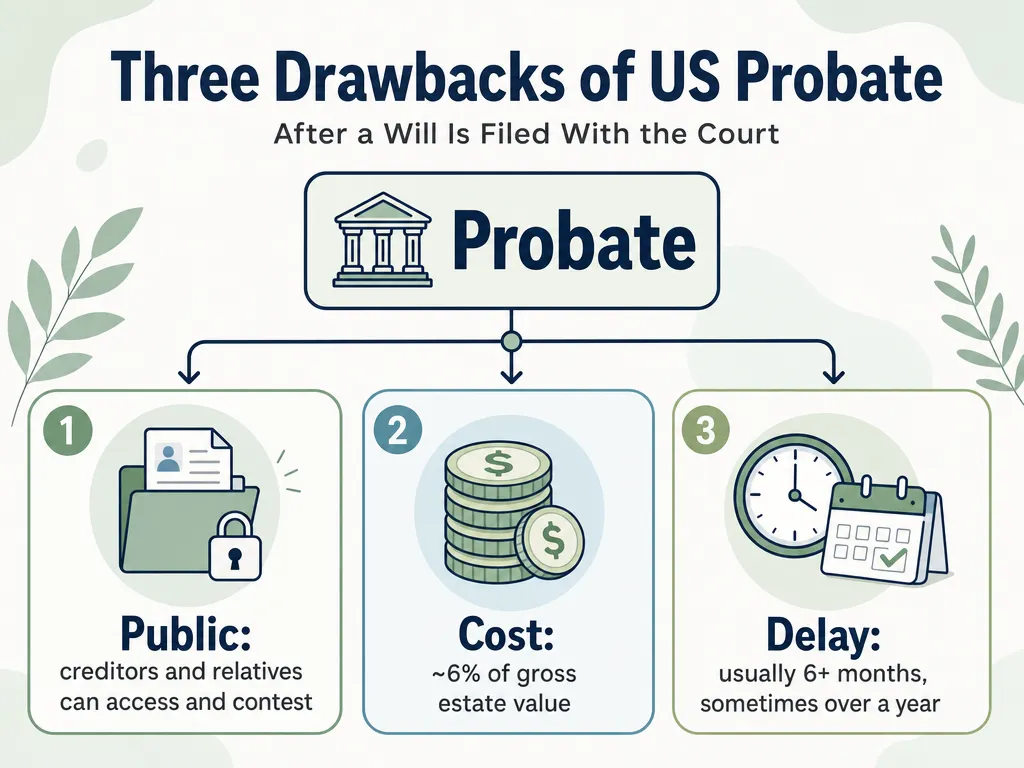
Under the US system, probate has three major disadvantages.
First, public disclosure: creditors and relatives may have access to court records and may challenge the will.
Second, costs: probate expenses are estimated at approximately 6% of the gross value of the estate.
Third, delays: an uncontested probate proceeding typically takes at least six months and may last more than a year. Heirs may have limited access to inherited assets until the process is completed.
When Do You Need a Trust Instead of a Will?
A revocable living trust is commonly used to help avoid probate. It is established during the owner’s lifetime, and its terms generally remain private, unlike a will submitted to probate. Assets properly held in the trust can pass to beneficiaries without going through probate after the grantor’s death.
There is one important condition: a trust avoids probate only if it is properly funded. This means the relevant assets must be transferred into the trust or otherwise titled appropriately.
Owning real estate in multiple states can result in separate probate proceedings in each state, unless the properties have been transferred into a properly structured trust or another applicable exception applies.
What Happens If You Have No Estate Plan? Key Risks
Without an estate plan, the law rather than you determines what happens to your assets and, in certain circumstances, who makes decisions on your behalf. The absence of an estate plan can mean that statutory inheritance rules determine how your property is distributed, a court appoints a guardian for your children, and your family loses time and money navigating legal proceedings.
These risks affect both the period after death and situations that arise during your lifetime.
Intestacy Laws Take Control
If you die without a will or an applicable trust arrangement, state intestacy laws generally determine how your probate estate is distributed. The result may be surprising: your assets might not go to the people you would have chosen.
For example, in Texas, a married person’s estate does not automatically pass entirely to the surviving spouse when there is no will. Depending on whether the property is community or separate property and whether the deceased had children or other relatives, the estate may be divided among different family members according to statutory rules.
Who May Be Excluded From Inheriting From a Parent?
Intestacy laws generally prioritize legally recognized family relationships rather than personal intentions. An unmarried partner, stepchildren, or friends may receive nothing under the default inheritance rules if they have not been adequately provided for through a will, beneficiary designation, or another legally effective arrangement. This can be particularly difficult for blended families.
For minor children, the consequences can be even more serious: without a will nominating a guardian, the court determines who will serve in that role.
Financial and Family Risks
The absence of financial and healthcare powers of attorney can create problems during your lifetime. If you lose the ability to make decisions, your loved ones may need to petition the court for a conservatorship or guardianship.
This process can cost a family well over $1,000, involve ongoing court supervision, and result in the appointment of someone you would not have chosen yourself. It can be an expensive and time-consuming process that appropriate planning documents may help avoid.
The 8 Most Common Estate Planning Mistakes
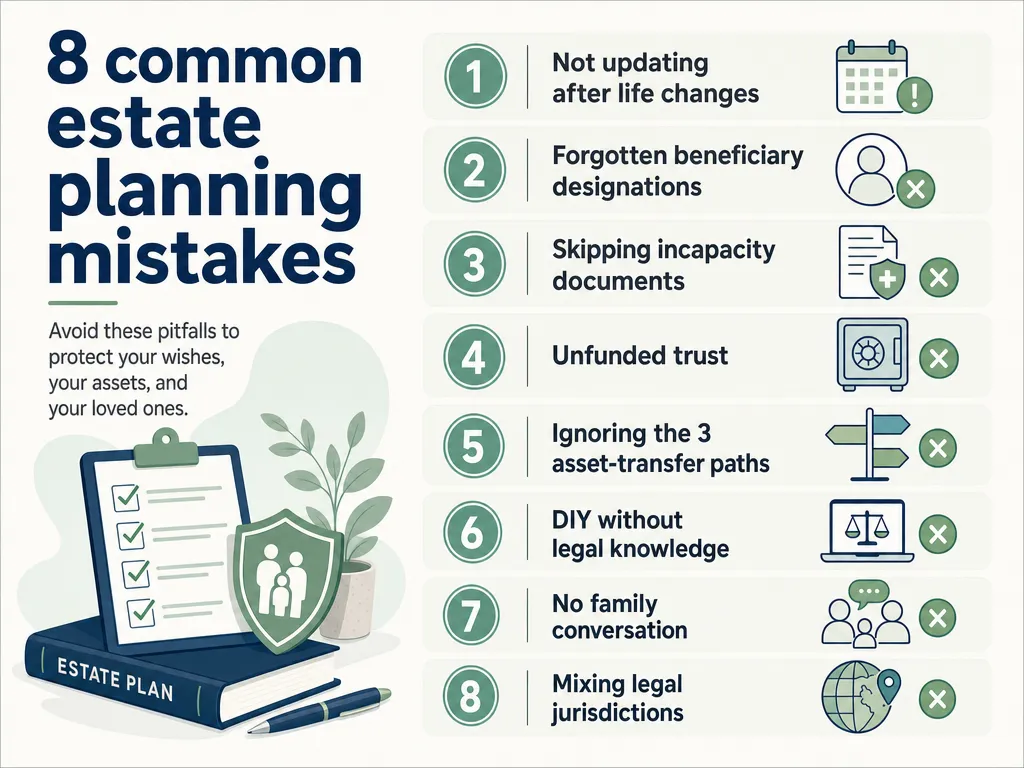
Even a well-intentioned estate plan can fail because of recurring mistakes. The most common include failing to update the plan, overlooking beneficiary designations, and neglecting healthcare directives. Here are eight mistakes that can undermine even carefully prepared documents.
Even a well-intentioned estate plan can fail because of recurring mistakes. The most common include failing to update the plan, overlooking beneficiary designations, and neglecting healthcare directives. Here are eight mistakes that can undermine even carefully prepared documents.
1. Failing to Update Your Plan After Major Life Changes
An estate plan created a decade ago may no longer reflect your current circumstances. Review it after marriage, divorce, the birth of a child, or the purchase of a home. You should also review it every three to five years.
2. Forgetting to Update Beneficiary Designations
This can be one of the costliest mistakes. If your will says one thing but a valid beneficiary designation says something else, the beneficiary designation generally controls the transfer of that particular asset, subject to applicable law and the governing account or policy terms.
Accounts with TOD (transfer on death) or POD (payable on death) designations can pass directly to named beneficiaries without going through probate. Outdated beneficiary designations are a common planning mistake, alongside missing incapacity documents and an unfunded trust.
3. Overlooking Documents for Incapacity
An estate plan focused exclusively on what happens “after death” is incomplete. Without financial and healthcare powers of attorney, your loved ones may lack the legal authority to manage your affairs or make decisions on your behalf during your lifetime.
4. Failing to Fund the Trust
Creating a trust document is not enough. The relevant assets must be transferred into the trust or properly designated for it to achieve its intended purpose.
5. Ignoring the Three Ways Assets Can Pass to Beneficiaries
Assets generally pass through beneficiary designations or contractual arrangements, through ownership and title arrangements, or through probate. Overlooking any of these mechanisms can create gaps in your estate plan.
6. Creating a DIY Estate Plan Without Understanding the Law
A do-it-yourself plan may seem inexpensive, but a drafting or execution error can end up costing more than hiring an attorney. Legal requirements vary by state, and even seemingly minor formalities can affect whether a document is valid.
7. Failing to Discuss the Plan With Your Family
An executor or other person assigned responsibilities may struggle to fulfill their role if they do not know what is expected of them. Clear communication can help prevent confusion and conflict.
8. Mixing Different Legal Systems
The rules discussed above, including TOD/POD designations and probate, describe US law. Your estate plan should be tailored to the inheritance laws that apply to your circumstances.
Frequently Asked Questions About Estate Planning
Does Every Adult Really Need an Estate Plan?
Yes. Estate planning is relevant to every adult aged 18 and older, regardless of the size of their estate. Once a child reaches adulthood, parents generally lose the automatic authority to make medical and financial decisions on their behalf. Estate planning is not just for wealthy people; it protects your loved ones and helps ensure that your own wishes are respected.
What Are the Five Documents You Need for Estate Planning?
A basic estate plan typically includes five documents: a will, a durable financial power of attorney, a healthcare proxy, a living will, and, optionally, a living trust.
A will distributes assets and allows parents to nominate guardians for minor children. A living will documents treatment preferences in specified end-of-life circumstances, but it does not appoint a decision-maker. That is the role of the healthcare proxy. Powers of attorney and healthcare directives address decisions during your lifetime.
How Much Does Estate Planning Cost?
The cost depends on the complexity of the plan and whether you prepare documents yourself or work with an attorney. However, the potential cost of having no plan may be far greater.
Probate expenses can amount to approximately 6% of the gross estate, while a court petition to appoint a guardian or conservator can cost a family well over $1,000. Appropriate planning documents may help reduce these expenses and avoid unnecessary legal proceedings.
Who May Be Excluded From Inheriting From a Parent?
Without a will, statutory intestacy rules determine how an estate is distributed rather than the deceased person’s personal wishes. Under US law, unmarried partners, stepchildren, and friends may be excluded from inheriting under the default rules.
Inheritance under Polish law follows a different set of statutory rules. Estate planning should therefore be tailored to the applicable legal system.
How Is Estate Planning Different From Having a Will?
A will is one component of an estate plan, not the entire plan. A will alone does not protect you during your lifetime if you become incapacitated, and it generally does not avoid probate. In fact, submitting a will to probate typically initiates the court-supervised estate administration process.
Estate planning combines a will with powers of attorney, healthcare directives, and, where appropriate, a trust to address decisions during your lifetime as well as the distribution of assets after death.
When Should I Start Estate Planning?
Ideally, you should begin as soon as you turn 18. At the latest, review your needs when major life events occur, such as marriage, the birth of a child, buying a home, or approaching retirement.
Each of these milestones can change your planning needs and may require you to update your estate plan.
Sources
- ltcfeds.gov/care-navigator/the-importance-of-estate-planning – LTC Feds – The Importance of Estate Planning
- youtube.com/watch?v=oUsqwIS93Bg – YouTube – What estate planning really covers
- fidelity.com/viewpoints/personal-finance/do-you-need-an-estate-plan – Fidelity – Do you need an estate plan?