What is estate planning? At its core, it is the legal and financial process of arranging how your assets are managed and distributed at death or if you become incapacitated. It is far more than writing a will. A complete plan names who controls your property, who makes decisions when you cannot, and who inherits what you leave behind. This guide walks you through the goals, the essential documents, and a practical 7-step process to build a plan that actually protects your family.
Key information:
- Estate planning is the legal and financial process of deciding who will manage your assets and who will inherit them after your death or if you become unable to make decisions yourself.
- According to a Caring.com/YouGov survey, only 24% of adults have a will, while just 13% have a living trust; about half of Americans do not have a will at all.
- In 2026, the federal estate tax exemption is $15 million per person, meaning a married couple can potentially protect up to $30 million combined.
- The four basic estate planning documents are a will, a trust, a power of attorney (POA), and a living will (advance directive).
- A will alone does not avoid probate, which can take more than a year and is a public process because court records are generally available to the public.
- If the beneficiary designation on an account conflicts with the will, the beneficiary designation generally takes precedence.
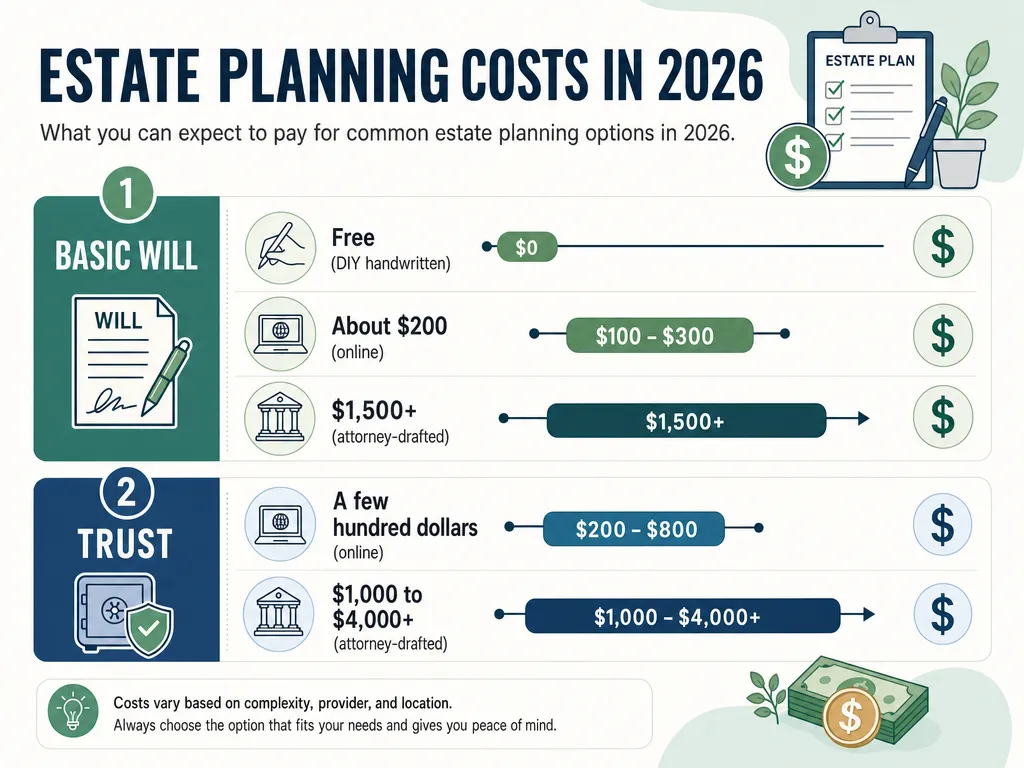
- A basic will can cost anywhere from free (if handwritten) to around $200 online or more than $1,500 when prepared by an attorney. An attorney-prepared trust typically costs $1,000–$4,000 or more.
Estate Planning: Definition and What It Actually Covers
Estate planning is the legal and financial process by which an individual or family arranges the transfer of assets in anticipation of death, and prepares for possible incapacity. It covers far more than a single will. Under U.S. law, it decides who controls your property, when that control changes, and who speaks for you if you cannot speak for yourself.
According to Cornell Legal Information Institute, your estate is the total property you own before distribution: real and personal. That includes cars, homes, land, household items, and bank accounts. A trust or a will then directs where those assets go.
Managing assets after death vs. during incapacity
Good planning addresses two very different scenarios. The first is death: how your estate is distributed and to whom.
The second is incapacity, meaning who makes medical decisions on your behalf and how your estate is protected while you are alive but unable to decide. Skip incapacity planning, and a court may have to appoint a guardian for you: an emotionally difficult and costly outcome.
Common myths about who needs a plan
The biggest myth is that estate planning is only for the wealthy. It is not. Fidelity recommends a minimum plan for virtually every adult, not only the rich.
Yet most Americans still have nothing in place. In a Caring.com/YouGov survey of adults aged 18 to 55+, only 24% had a will and just 13% had a living trust. Fidelity estimates that roughly half of Americans have no will at all. These figures measure slightly different groups, but the message is the same: planning is rare, and the gap is wide.
The Core Goals Every Estate Plan Should Achieve
A solid estate plan does four things. It distributes your assets to chosen heirs, prepares for possible incapacity, protects your dependents, and reduces costs like taxes, court fees, and probate delays. These goals apply to nearly every adult, not only the wealthy.
Distribute assets to chosen heirs
The first goal is control. Estate planning lets you decide who inherits what, rather than leaving that decision to a court applying state law. Without a plan, your wishes carry no legal weight.
Plan for incapacity
Estate planning is not only about death. It also addresses what happens if you can no longer make decisions for yourself. Incapacity planning is the part people most often forget. Without documents in place, a court may have to appoint a conservator or guardian, an emotionally difficult and potentially costly process.
Protect minor children and dependents
A will lets a parent name a guardian for a child. A separate conservator, sometimes called a ‘guardian of the estate,’ may also be needed to manage any assets the child inherits. The age of majority is state-dependent, typically 18 or 21, which is often too young to hand over a large inheritance outright.
Reduce taxes, court fees, and probate delays
The fourth goal is cutting cost and friction. In 2026 the federal estate tax exemption is $15 million per person, and portability lets a married couple shield $30 million combined. So estate tax touches only very large estates. Probate is the broader concern for most families.
An uncontested probate can easily take more than a year, with meaningful fees even in simple cases. Its main downsides are lost privacy, since court records are public, plus cost and delay.
Essential Estate Planning Documents Explained
Four documents form the backbone of most estate plans: a will, a trust, a power of attorney (POA), and a living will (advance directive). Each serves a distinct legal purpose. Together, they cover both death planning and incapacity planning, so your estate stays under your control.
| Document | What it does | When it takes effect |
|---|---|---|
| Will | Divides property and names guardians for children | After death, via probate |
| Trust | Transfers assets, can bypass probate | During life and after death |
| Power of Attorney | Grants financial or medical decision authority | While you are alive |
| Living Will | States end-of-life treatment preferences | During incapacity |
Will: dividing property and naming guardians
A will directs who receives your property and lets a parent name a guardian for a minor child. It is one document within a larger plan, not the whole plan.
Trust: passing assets while bypassing court
A trust helps avoid probate, reduce taxes, protect assets from creditors, and control how and when beneficiaries inherit. The two main categories are the revocable living trust, which you can change during life, and the irrevocable trust, which cannot be altered but shields assets from creditors and estate tax.
One caveat matters. A revocable living trust only avoids probate if it is properly funded: assets must be retitled into the trust’s name. Creating the document alone does nothing.
Power of Attorney: financial and medical authority
A POA has three main types: general (broad, usually short-term), durable (stays in effect even if you lose decision-making capacity), and health care (medical decisions only, not financial). The health care POA and the financial POA are separate authorities.
Living Will: end-of-life care preferences
A living will documents treatment preferences such as resuscitation, life support, pain treatment, and feeding. It does not name a decision-maker. Naming someone to decide requires a health care power of attorney, often called a health care proxy.
Will vs. Estate Plan vs. Trust: How They Differ
These three terms are not interchangeable. A will is just one element of an estate plan, an estate plan is the complete strategy, and a trust is a tool within it that can avoid probate. Confusing them leaves dangerous gaps in how your assets actually transfer.
Why a will alone is not an estate plan
Here is the surprise most people miss: a will does not avoid probate. It is actually the first step of the probate process, since after death the will goes to court, which then initiates the proceeding.
A will only controls part of your estate. Assets pass in just three ways after death: by contract, such as a beneficiary-designated account, by title, such as joint ownership with right of survivorship, and through probate. A will only governs what falls into that probate bucket.
This matters enormously. Accounts with named beneficiaries, like TOD brokerage accounts, POD bank accounts, and in some states real estate, pass directly to the beneficiary, bypassing both probate and the will. If a will says one thing and a beneficiary form says another, the beneficiary form wins every time. Keep those designations current.
When a trust makes sense over a will
Trusts, unlike wills, let you avoid probate, a lengthy and costly legal process supervising the transfer of assets. Probate also means losing privacy, because court records are public, whereas trusts remain private.
A trust makes sense when you want privacy, faster distribution, or control over how and when heirs inherit. A will is simpler and cheaper. An estate plan combines both tools with the right beneficiary designations.
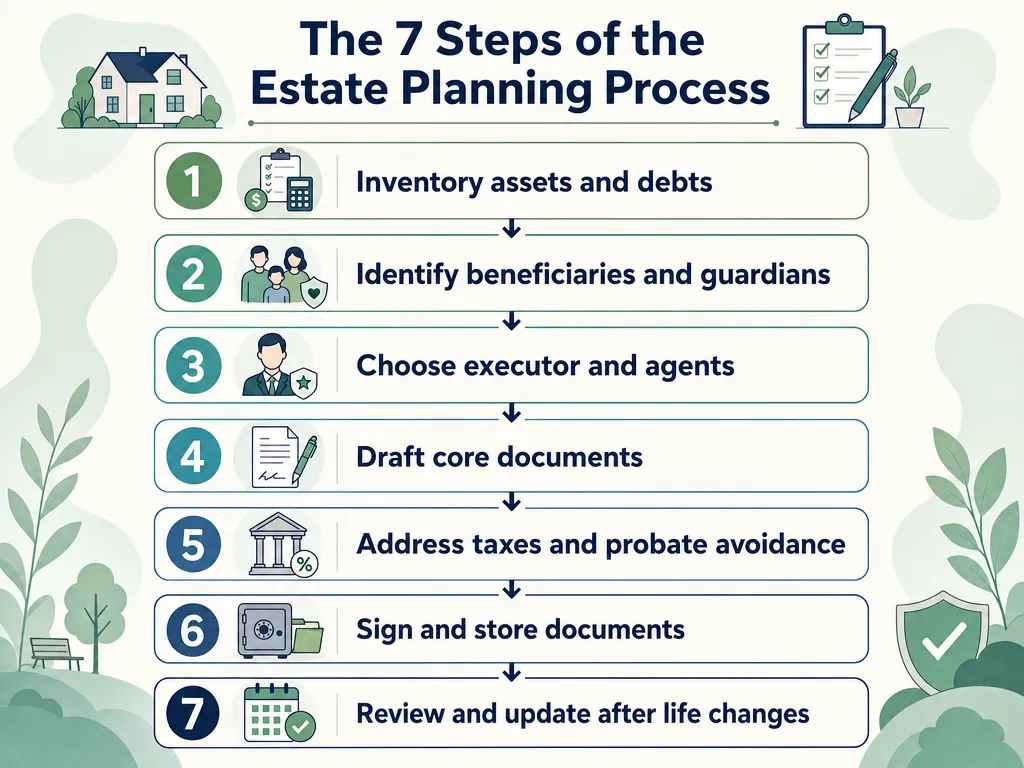
The 7 Steps of the Estate Planning Process
The estate planning process moves through seven clear steps, from taking inventory of what you own to reviewing your plan as life changes. You can start at any adult age, and existing documents should be reviewed periodically to reflect your current wishes.
Step 1: Inventory your assets and debts
List everything you own and owe: homes, cars, bank and brokerage accounts, retirement plans, and any outstanding loans. This inventory becomes the foundation for every decision that follows.
Step 2: Identify your beneficiaries and guardians
Decide who inherits what. If you have minor children, this is where you name a guardian, one of the most important reasons parents build a plan in the first place.
Step 3: Choose an executor and agents
Name the people who will act for you. An executor settles your estate, while agents under your powers of attorney handle financial and medical decisions if you cannot.
Step 4: Draft your core documents
Prepare your will, trust, power of attorney, and living will. Every family is different: attorney Paul Rabalais, with 31 years of experience, jokes he is “still waiting to find the first normal family”. Your documents must fit your circumstances.
Step 5: Address taxes and probate avoidance
Structure assets to reduce tax exposure and skip probate where possible. A revocable living trust only avoids probate if it is actively funded, meaning assets are retitled into the trust; creating the document alone does not transfer control.
Step 6: Sign and store documents properly
Execute each document according to your state’s rules, then store originals safely. Tell your executor and agents where to find them.
Step 7: Review and update after life changes
Revisit your plan after major events. The birth of a child creates a need to name a guardian, while a divorce is an opportunity to revise a revocable living trust. Marriage, a death in the family, and moving states also warrant a fresh look.
Who Needs Estate Planning and Why People Avoid It
Nearly every adult benefits from estate planning, not just the wealthy. Fidelity recommends a minimum plan for virtually every adult: a will, a durable financial power of attorney, and a health care proxy. Yet roughly half of Americans have no will at all, and even fewer have a full plan.
Who benefits most
Parents gain the most from acting early. A will lets you name a guardian for your children, something no court can do the way you would. Homeowners and anyone with named beneficiaries also need a plan, since assets pass in ways a will alone cannot control.
Business owners face added complexity. Leaving everything to a spouse outright is the simplest choice, but it risks a surviving spouse later disinheriting the children, accidentally or under pressure from a new partner. Trust-based planning guards against that.
Why people procrastinate
People delay because estate planning forces uncomfortable questions about death and money. The avoidance is measurable: only a quarter of surveyed adults had a will, and far fewer had a living trust. The fix is to start small. A basic minimum plan covers the essentials and can be expanded later.
Do you need an attorney?
Cost drives the DIY-versus-attorney decision. A basic will ranges from free (handwritten) to about $200 online to $1,500 or more when drafted by an attorney. A trust set up online costs a few hundred dollars, while an attorney-drafted trust runs $1,000 to $4,000 or more, depending on complexity, trust type, and state law. Simple estates suit online tools.
Blended families, business interests, or trusts warrant a lawyer.
Answers to the Questions People Ask Most About Estate Planning
What’s the difference between a will and estate planning?
A will is a single document that directs who inherits your property. Estate planning is the full strategy that surrounds it. Estate planning also covers incapacity, medical decisions, and probate avoidance. A will only controls what passes through probate, so a will alone rarely covers everything an estate plan should.
What are the 7 steps in the estate planning process?
The estate planning process typically moves through seven stages: taking inventory of assets, naming beneficiaries and heirs, choosing decision-makers, selecting documents, drafting them, funding any trust, and reviewing the plan over time. Key life events like a birth or divorce should trigger a fresh review. You can begin at any adult age.
Who benefits most from estate planning?
Nearly every adult benefits, not just the wealthy. Estate planning protects parents of minor children, unmarried partners, business owners, and anyone facing possible incapacity. Wills are not just for the rich. The non-tax benefits, probate avoidance, guardianship, and incapacity protection, apply broadly across income levels.
How much does estate planning cost in 2026?
A basic will runs from free (DIY) to about $200 online, up to $1,500+ with an attorney. A trust set up online costs a few hundred dollars, while an attorney-drafted trust runs $1,000 to $4,000+, depending on complexity, trust type, and state law.
What happens if you die without an estate plan?
Local courts divide your estate under state intestacy law, without knowing your wishes. Your family may face a long, painful, and costly process to recover assets or establish guardianship for minor children. The age of majority for inheriting minors is state-dependent, typically 18 or 21.
Sources
- ltcfeds.gov/care-navigator/the-importance-of-estate-planning – LTCFEDS – The Importance of Estate Planning
- law.cornell.edu/wex/estate_planning – Cornell Legal Information Institute – Estate Planning
- youtube.com/watch?v=ga-neKdtibI – Erin Moriarity – estate planning explainer