
An estate cannot be divided fairly until it is valued honestly, and the assets that are hardest to price (private shares, real estate, and fine art) are the ones heirs fight over. Illiquid asset valuation is the practice of assigning a defensible number to property that no open market prices for you. Having priced illiquid assets across more than forty transactions, I can tell you where the real money and the real disputes hide. This guide walks through fair market value, the three appraisal methods, the discounts that decide the fight, and the IRS rules an executor must survive.
Key takeaways
- The IRS values every non-cash estate asset at fair market value under Rev. Rul. 59-60 from 1959, not a fire-sale figure.
- Illiquid asset valuation uses one of three methods: income (DCF), market (comparables), or net asset value.
- The discount for lack of marketability (DLOM) commonly cuts a private stake’s value by 20% to 40%.
- The discount for lack of control (DLOC) for minority holders typically runs 15% to 35%, applied before DLOM and compounded multiplicatively.
- Any single artwork valued at $50,000 or more is referred to the IRS Art Advisory Panel under Rev. Proc. 96-15.
- Under Connelly v. U.S., a buy-sell redemption agreement must reflect fair market value to bind the estate tax number.
- IRC §6166 lets executors defer estate tax up to roughly 5 years if illiquid closely held business interests make up at least 35% of the estate.
Why Illiquid Assets Break the Fairness of an Estate Division
Illiquid asset valuation starts from a hard fact: an illiquid asset cannot be converted to cash quickly without a large loss, wide bid-ask spreads, or a long exit horizon. A public stock settles in seconds on a T+2 basis, while a private stake sits for years. That gap is where estates get stuck.
The liquidity gap is not abstract. Private equity locks capital for 7 to 10 years, and venture capital runs 10 to 12 years to full return of capital. Real estate sales take months and carry transfer taxes. Art sold at auction can fetch roughly 20% below fair value once auction fees of 10% to 25% come out.
Wide bid-ask spreads and price impact
Spreads widen as an asset gets thinner. Less liquid securities such as small-cap stocks trade at spreads of 1% to 2% of the lowest ask. Modeling illiquidity often assumes a 1% spread on liquid holdings against a 3% spread on illiquid ones. That spread is a real haircut on what an heir actually receives.
Why heirs disagree on the same asset
Illiquid assets carry subjective value on specialized markets, which makes them hard to split and a frequent trigger for family litigation. One heir sees a beloved painting, another sees cash locked in a frame. Without an honest number, the argument never ends. Illiquid asset valuation replaces opinion with a defensible figure.
Fair Market Value: The One Standard the IRS Uses at Death
For estate tax, every non-cash asset is measured at fair market value: the price a willing buyer and willing seller would agree to, with neither compelled to act. That is not what a rushed sale would bring. Rev. Rul. 59-60, issued in 1959, defines FMV through a hypothetical willing buyer and willing seller and lists the factors an appraiser must weigh for closely held stock.
Fair market value assumes an orderly sale with reasonable exposure to the market. Forced liquidation value assumes a distressed, time-pressured sale, and it is almost always lower. The IRS uses fair market value, not liquidation value, so an executor who reports a fire-sale number underpays the estate and invites a challenge.
Fair market value vs forced liquidation value
The distinction matters most for private companies and single-buyer art. A qualified appraiser prices the asset as if it had reasonable time on the market, not as if it must sell by Friday. That framing under Rev. Rul. 59-60 is the backbone of every defensible estate number.
The alternate valuation date election (IRC §2032)
IRC §2032 lets an executor value the estate six months after death instead of at death. Property not distributed, sold, or otherwise disposed of within 6 months is valued as of that later date, while property disposed of earlier is valued at the disposition date. The election has a strict gate. Both the gross estate value and the federal estate tax due must be lower at the alternate date, so an executor cannot use it to shrink a single figure.
The Three Valuation Methods Appraisers Actually Use
Almost every illiquid asset is valued with one of three approaches: income (discounted cash flow), market (comparable transactions), or cost / net asset value. The income approach leans on DCF and EBITDA multiples, the market approach on comparable transactions and comparable companies, and NAV measures the net value of the underlying assets for funds and holding companies. The right method depends on whether the asset produces income, has real comparables, or is a holding entity. Operating companies are typically revalued annually or on a material change.
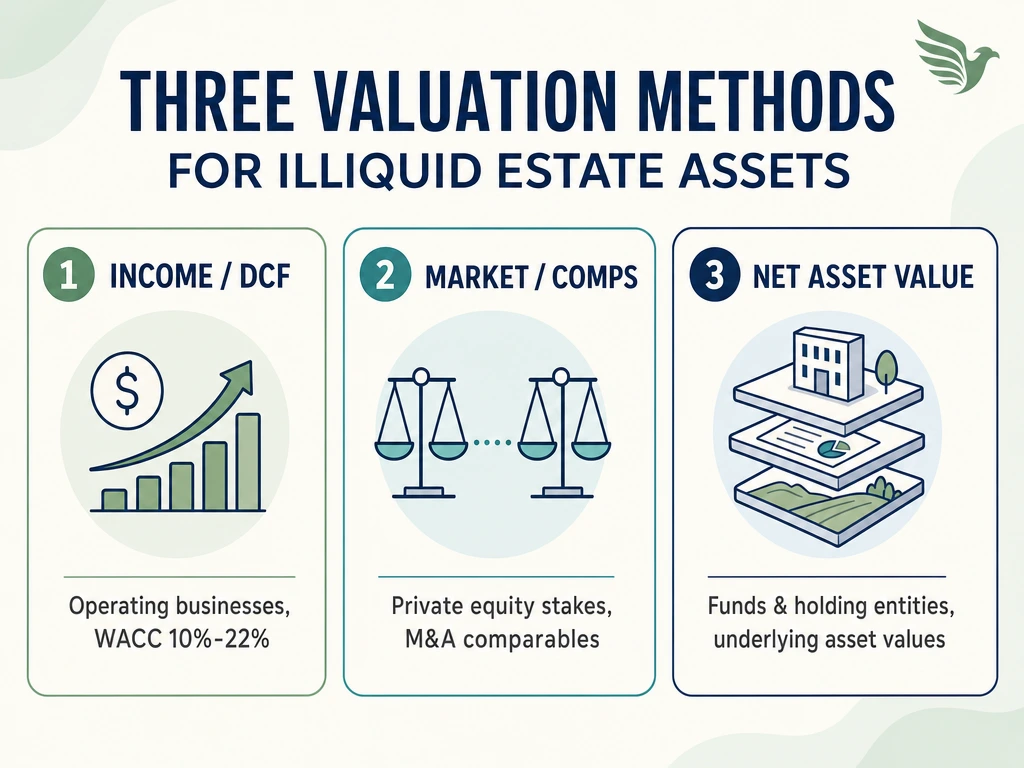
The three approaches appraisers use to value illiquid estate assets
Income approach and DCF for private businesses
The income approach discounts future cash flow to present value. For closely held small and mid-sized businesses, the discount rate (WACC) typically runs 10% to 22%, depending on company size, industry stability, and customer concentration. Appraisers also use EBITDA multiples as a shorthand for the same earning power. A concentrated customer base pushes the rate toward the high end.
Market approach and comparable transactions
The market approach benchmarks the interest against comparable company or transaction data, including the last financing round. For private equity, appraisers anchor to M&A comps and recent secondary trades. The method works only when genuinely similar deals exist, which is the weak point for one-of-a-kind assets.
Net asset value for real estate holding companies
The net asset value (NAV) method is standard for funds and holding entities. Fund managers report NAV quarterly, and holding structures such as LLCs and trusts require a look-through to the underlying assets to avoid double counting. The Tax Court has used NAV to value a decedent’s interest in a family investment company, the typical approach for holding entities.
Cap rates for commercial property
Real estate is valued by professional appraisal or the capitalization rate method applied to net operating income (NOI). For 2026, prime-to-secondary cap rates run roughly: office 4.0% to 7.5%, retail 4.5% to 8.0%, industrial 4.0% to 5.5%+, with multifamily averaging near 5.6% in Q1 2026 per CBRE. A cap rate equals the discount rate minus the expected constant growth rate when income grows steadily.
| Method | Best for | Key input |
|---|---|---|
| Income / DCF | Operating businesses | WACC 10%-22% |
| Market / comps | Private equity, PE stakes | M&A and secondary deals |
| NAV | Funds, holding entities | Underlying asset values |
| Cap rate | Commercial real estate | NOI ÷ cap rate 4%-8% |
Valuation Discounts: DLOM, DLOC, and the Numbers That Decide the Fight
A minority stake in a private company is worth less than a straight percentage of the whole, because of two haircuts. The discount for lack of marketability (DLOM) and the discount for lack of control (DLOC) are the single most contested numbers in illiquid asset valuation. They move the taxable figure more than any other input.
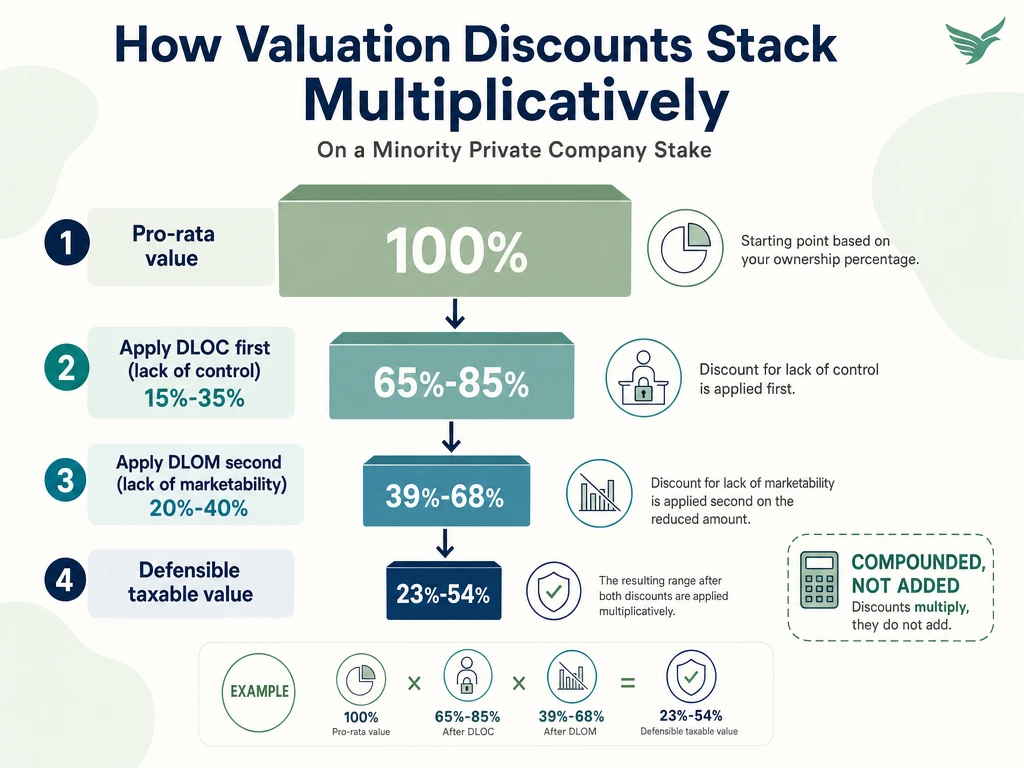
DLOC is applied first, then DLOM, compounded multiplicatively
Discount for lack of marketability (DLOM)
DLOM applies when an interest cannot be readily sold or converted to cash, and it commonly runs 20% to 40% depending on industry, company size, and exit options. The IRS DLOM Job Aid restricted-stock studies show a mean and median near 31.4% and 33%, and many analysts settle around 35%. Some advisory firms cite 30% to 50% for high-risk companies, but that band sits at the outer edge, not the default.
Discount for lack of control (DLOC)
DLOC reflects a minority holder’s inability to direct the company, and it typically runs 15% to 35%. Some studies report a more conservative 5% to 15% for pure lack-of-control adjustments. A control premium does not convert one-for-one into a DLOC, so a 25% control premium is not the same as a 25% DLOC.
DLOM and DLOC are distinct and can stack. Appraisers apply DLOC first to reflect the non-controlling status, then DLOM for illiquidity, and they compound the two multiplicatively rather than adding them.
Restricted and undivided-interest discounts
Co-owned real property carries an undivided (fractional) interest discount of roughly 15% to 35% for lack of control and limited marketability. Courts have upheld larger cuts, near 45% in the Bonner case, and applied fractional discounts to artwork in Elkins. Restricted stock with transfer limits gets its own liquidity haircut for the same reason.
Valuing Fine Art and Collectibles for an Estate
Fine art has no earnings and few identical comps, so appraisers price it on provenance, condition, and recent auction results, and the IRS requires a qualified appraiser for anything meaningful. Art, wine, classic cars, and watches are illiquid because they need specialized buyers and authentication. Auction sales generate fees of 10% to 25%, and specialist valuations are usually refreshed every 2 to 5 years.
Provenance and documentation gaps
Provenance is the ownership chain that proves authenticity. A gap can materially cut the appraised value and spark disputes among heirs, since collectibles carry sentimental value that fuels emotional fights. Solid documentation is the difference between a defended number and a contested one.
The blockage discount for large collections
When a single collection must be sold at once, flooding the market depresses price, and appraisers apply a blockage discount to reflect that. The Elkins case confirmed courts will recognize fractional and blockage-type reductions on art. A large estate collection is worth less as a block than the sum of its pieces sold slowly.
IRS qualified appraiser standards for art
The IRS refers any single item of art valued at $50,000 or more to the Art Advisory Panel for review under Rev. Proc. 96-15. Works the Panel actually reviews generally exceed $150,000 individually, though the Panel keeps discretion. The $50,000 figure is the referral trigger, not the review floor, so executors should treat that threshold as the compliance line.
How Private Company Shares Are Valued for Estate Tax
Private shares have no market price, so a qualified appraisal builds value from company financials, comparables, and discounts, then checks it against any buy-sell agreement. Form 706 instructions require complete financial and other data used to value closely held stock, and the executor uses that form to figure estate tax under chapter 11. Direct minority private-company interests are less liquid than fund interests because they have no secondary market.
When a buy-sell agreement overrides your valuation
A buy-sell agreement price does not automatically set estate tax value, because the IRS applies its own tests. Under Connelly v. U.S., any agreement obligating a closely held company to redeem a deceased owner’s shares must be pegged to fair market value to be respected for estate tax. Heirs who assume the contract number binds the IRS often get a surprise.
409A valuations as a benchmark
A prior 409A independent appraisal can serve as a benchmark for a private company’s FMV, bridging the corporate and estate contexts. It is evidence, not a ceiling, and an estate appraiser weighs it alongside financials, comparables, and discounts.
The qualified appraisal requirement (Form 706)
Key documents shaping the number include shareholder and buy-sell agreements, LLC operating agreements, audited annual statements, and board resolutions. The appraiser assembles these into a Rev. Rul. 59-60 analysis, then applies DLOM and DLOC where a minority or restricted stake justifies them.
When the IRS Challenges Your Number and How Executors Protect Themselves
The IRS contests illiquid valuations, and the executor is personally on the hook for getting appraisals right and on time. A defensible qualified appraisal built to USPAP standards is the best protection, since a qualified appraisal must follow IRS guidelines and USPAP to be respected, with the terms defined under §170(f)(11).
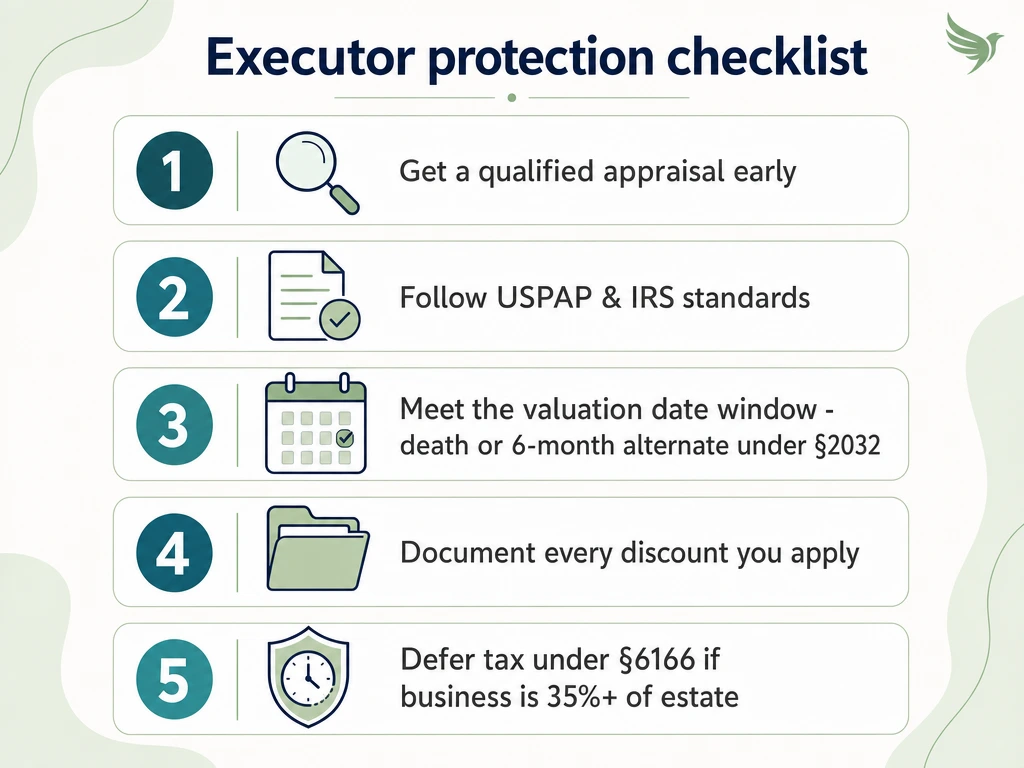
Five defensive steps for executors facing an IRS valuation challenge
Executor duty and the appraisal timeline
The executor must value the estate at death or elect the six-month alternate date under IRC §2032, which sets a hard window for obtaining appraisals. Missing that window forfeits the election and can lock in a higher number.
What happens in a valuation dispute
When a valuer overrides an independent pricing figure, the burden falls on that valuer to prove the new number is more accurate, and repeated overrides create dispute and regulator risk. Independent oversight, such as an annually board-reviewed valuation committee, is the standard defense, and the logic mirrors defending a number before the IRS.
Liquidity relief: installment payment under §6166
If at least 35% of the estate’s value consists of illiquid closely held business interests, the executor may defer estate tax payment for up to roughly 5 years under IRC §6166. That relief matters most for estates heavy in real estate or operating businesses, where cash is scarce. Good liquidity planning forecasts the tax exposure, identifies the gap, and sets aside funding before a forced sale becomes the only option.
What Forty Illiquid Transactions Taught Me About Valuing an Estate Honestly
Get the qualified appraisal early, before heirs anchor on a number they invented. Document provenance, financials, and every discount you apply, because a DLOM or DLOC you cannot defend is a DLOM you will lose. Check for buy-sell agreements before you assume the contract price binds anyone. Then build the estate’s liquidity plan around the honest valuation, not the wish. Once you have a defensible number, put it to work in the estate documents (the will or trust) that actually move the assets, which is where a service like MyEstateAngel turns the math into a plan.
Five Questions Executors Ask Me Most
How do you value illiquid assets in an estate?
You apply fair market value under Rev. Rul. 59-60 using one of three methods: income (DCF), market (comparables), or net asset value. A qualified appraiser then applies discounts such as DLOM (20%-40%) and DLOC (15%-35%) for minority or restricted stakes. The valuation date is death, or six months later if the executor elects under IRC §2032.
What is a discount for lack of marketability, and how large is it?
DLOM lowers the value of an interest that cannot be readily sold for cash. It commonly runs 20% to 40%, and the IRS DLOM Job Aid restricted-stock studies show a mean and median near 31% to 33%, with many analysts using roughly 35%. Higher-risk companies can justify more, but that is an outer band, not the default.
How are private company shares valued for estate tax?
A qualified appraiser builds value from company financials, comparable transactions, and discounts, then reports it on Form 706 with complete supporting data. Any buy-sell agreement is tested rather than accepted outright, and under Connelly v. U.S. a redemption agreement must reflect fair market value to bind the estate tax number.
Who can legally appraise illiquid assets for an estate?
The IRS requires a qualified appraiser whose report follows IRS guidelines and USPAP standards, with qualified appraisal and appraiser defined under §170(f)(11). For art, any single item valued at $50,000 or more is referred to the IRS Art Advisory Panel for review under Rev. Proc. 96-15.
What is the difference between fair market value and liquidation value?
Fair market value assumes a willing buyer and willing seller with reasonable time on the market and neither compelled to act. Forced liquidation value assumes a distressed, time-pressured sale and is almost always lower. The IRS uses fair market value for estate tax, so a fire-sale figure understates the estate and invites a challenge.
Sources
- asora.com/blog/illiquid-assets-examples – Asora: illiquid asset examples, liquidity horizons, valuation methods, NAV and cap rate mechanics.
- pimco.com/us/en/documents – PIMCO: illustrative modeling of liquid vs illiquid security spreads.
- grissomlawfirm.com/illiquid-assets – Grissom Law Firm: estate planning for illiquid assets, subjective value, and heir disputes.
- taxnotes.com/research/federal/irs-guidance/revenue-rulings/rev-rul-59-60/d30t – Tax Notes: Rev. Rul. 59-60 fair market value standard and valuation factors for closely held stock.
- irs.gov/irm/part4/irm_04-025-005 – IRS Internal Revenue Manual: application of Rev. Rul. 59-60 and FMV methodology.
- law.cornell.edu/uscode/text/26/2032 – Cornell Law: IRC §2032 alternate valuation date six-month rule.
- taxnotes.com/research/federal/cfr26/20.2032-1 – Tax Notes: Treasury Regulation 20.2032-1 on alternate valuation.
- irs.gov/pub/irs-lbi/dlom.pdf – IRS DLOM Job Aid: restricted-stock studies with mean/median discount data.
- irs.gov/appeals/art-appraisal-services – IRS: Art Advisory Panel review threshold and Rev. Proc. 96-15 referral rules.
- irs.gov/pub/irs-pdf/i706.pdf – IRS Form 706 instructions: financial data required to value closely held stock.
- irs.gov/charities-non-profits/contributors/information-on-donated-property-for-tax-professionals – IRS: qualified appraisal and appraiser definitions under §170(f)(11).