
Special needs estate planning secures financial support for a loved one with a disability without jeopardizing their eligibility for means-tested benefits such as SSI and Medicaid. At the heart of the plan is a special needs trust (SNT), which protects assets from being counted as the beneficiary’s own resources.
Below is an overview of the available tools, ABLE accounts, guardianship considerations, and the most costly mistakes families make. This is general legal information about U.S. law, not individualized legal advice.
State laws and Medicaid rules vary.
In short:
- A special needs trust (SNT) protects the assets of a person with a disability without jeopardizing eligibility for means-tested benefits such as SSI and Medicaid.
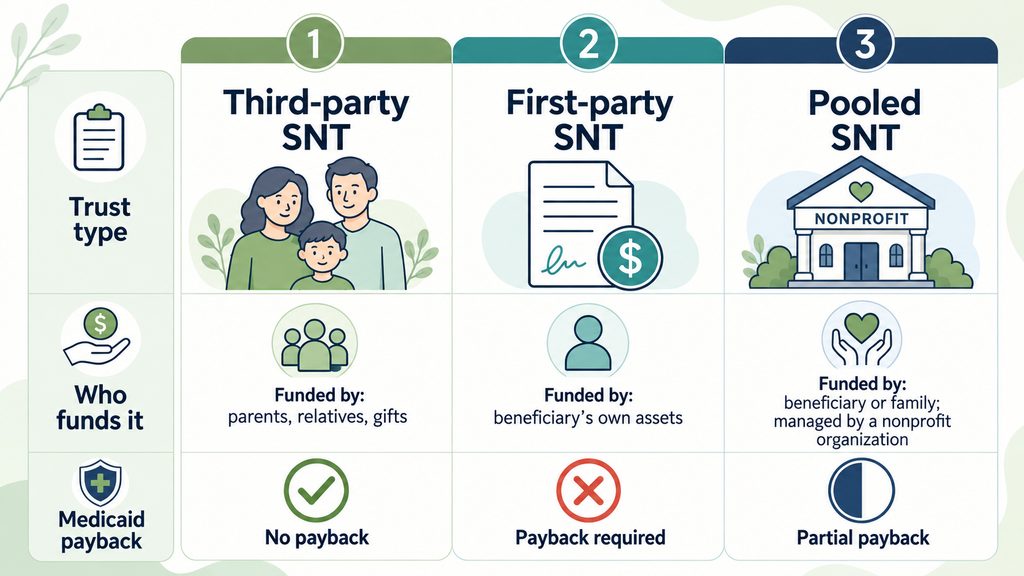
- A third-party trust funded with family assets does not include a Medicaid payback provision, unlike a first-party trust.
- Leaving money directly to a person with a disability can jeopardize their benefits. The trust must be established during the donor’s lifetime or through a will.
- An ABLE account allows individuals to save without jeopardizing their benefits, and starting in 2026, under the SECURE 2.0 Act, the disability onset age threshold increases from before age 26 to before age 46.
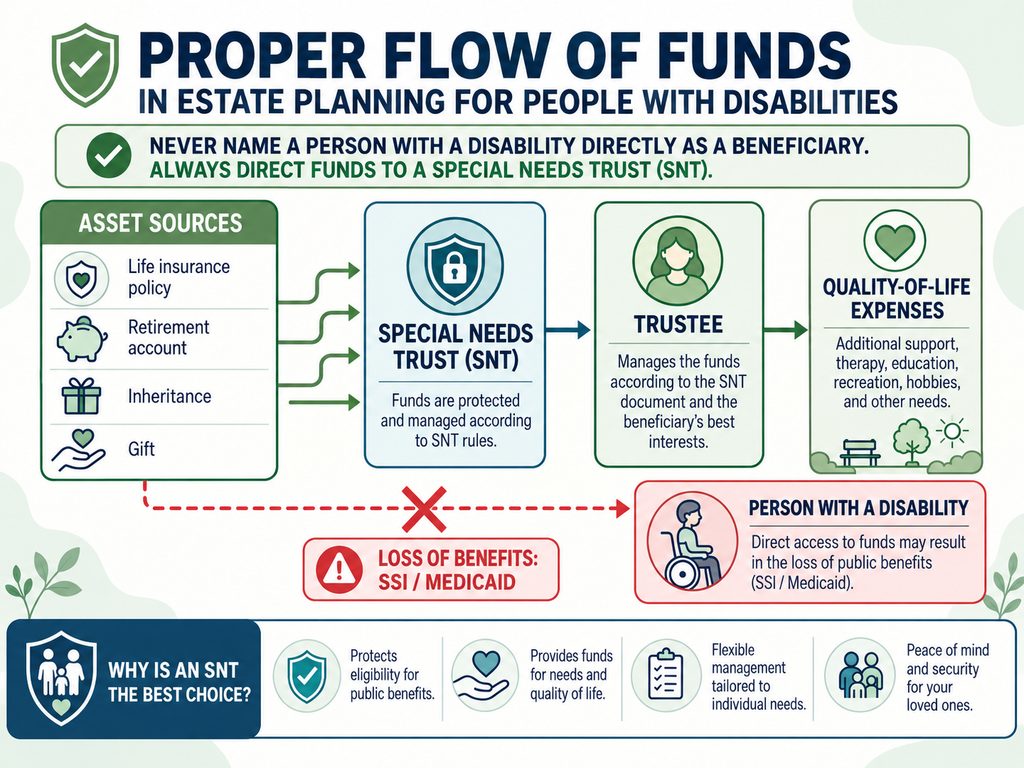
- Never name a person with a disability as the direct beneficiary of a life insurance policy or retirement account. Direct the proceeds to the trust instead.
- When a child turns 18, parents lose their automatic legal authority, and courts increasingly favor supported decision-making over full guardianship.
What Special Needs Estate Planning Actually Protects
Special needs estate planning secures financial support for a loved one with a disability while preserving eligibility for means-tested benefits like SSI and Medicaid. The goal is simple but delicate: provide resources without disqualifying your dependent from public assistance that pays for healthcare, housing, and daily living costs.
The central tool is a special needs trust (SNT). Assets held in a properly drafted SNT are not counted as the beneficiary’s own resources for eligibility purposes, so a person can receive inheritances, gifts, or legal settlements and still qualify for aid.
Why a direct inheritance can backfire
Leaving money outright to a disabled person often does more harm than good. A direct inheritance can destroy means-tested benefit eligibility, cutting off Medicaid coverage the family spent years securing. The protective trust must be established during your life or in your will, not scrambled together by the beneficiary afterward.
How means-tested benefits interact with assets
SSI and Medicaid are need-based, so countable resources above a strict threshold trigger loss of benefits. This is where the planning stakes become real. SSI imposes a modest individual resource limit, and exceeding it suspends payments until spend-down.
Here is the nuance: SSI and core Medicaid eligibility rules are federal, but Medicaid is state-administered, and specifics vary by state. Because thresholds and administration shift, confirm current figures with a qualified attorney before acting.
Special Needs Trusts: The Core of the Plan
A special needs trust (SNT) holds assets for a disabled beneficiary without those assets counting as the beneficiary’s own resources for means-tested programs. The trust pays for extras that improve quality of life, while a trustee follows strict distribution rules. An SNT sits at the heart of special needs estate planning.
Most SNTs are irrevocable and professionally drafted. The trustee controls distributions, which keeps the funds from being treated as the beneficiary’s countable assets. Also called a supplemental needs trust, the vehicle supplements benefits rather than replacing them.
Third-party SNT (no Medicaid payback)
A third-party SNT is funded with someone else’s money, most often a parent’s. Because the disabled person never owned the assets, this trust contains no Medicaid payback clause. A third-party special needs trust, most often set up by parents, does not contain a payback clause. Whatever remains at death passes to other heirs the family names.
First-party SNT (Medicaid payback provision)
A first-party trust holds the beneficiary’s own assets, such as a lawsuit settlement or direct inheritance. These trusts are commonly established under federal law authorizing a payback obligation to the state after the beneficiary dies. Medicaid is repaid first from whatever remains.
Pooled SNT (nonprofit-managed)
A pooled SNT is managed by a nonprofit organization that combines many beneficiaries’ funds into separate accounts for investment purposes. After death, part of the remaining balance reimburses the government and part may stay with the nonprofit.
State law shapes how trustees administer distributions, so what works in one state may differ in another. Confirm the right structure with a qualified special needs attorney before funding anything.
ABLE Accounts and Other Funding Tools
Beyond the special needs trust itself, special needs estate planning relies on a set of funding tools that move money into the plan without triggering benefit losses. ABLE accounts, life insurance, and beneficiary designations each have a role, and each has a trap for the unwary.
ABLE account eligibility and limits
An ABLE account, created under the Achieving a Better Life Experience Act, lets a person with a disability save and invest for qualified disability expenses without those funds counting against SSI and Medicaid limits in the same way ordinary savings do.
Eligibility historically required that the disability began before age 26. Under the SECURE 2.0 Act, that onset threshold expands to before age 46, effective in 2026. Annual contributions are generally tied to the federal gift tax exclusion and adjust over time, so confirm the current limit and maximum balance before funding an account.
ABLE accounts carry a payback catch. After the beneficiary dies, remaining ABLE funds must first reimburse the government for Medicaid benefits paid before any remainder passes through probate to heirs.
Using life insurance to fund an SNT
Life insurance can pay proceeds directly into a special needs trust, bypassing probate and keeping funds outside the taxable estate. The key detail: name the trust, never the disabled child, as the policy beneficiary. Second-to-die policies, which pay after both parents die, are worth considering.
Coordinating retirement and beneficiary designations
Beneficiary designations override your will. Never name the disabled person directly on life insurance or retirement accounts: route everything to the SNT instead. One missed form can undo an otherwise careful plan.
Guardianship, Powers of Attorney, and Decision-Making for Adults
When a dependent turns 18, the law treats them as an adult, which means parents lose automatic authority over medical, financial, and legal decisions. In most states the age of majority is 18, though a few set it differently, so special needs estate planning for adults hinges on the person’s actual functional capacity, not their diagnosis.
Adults: guardianship vs. less-restrictive alternatives
Guardianship is a court process in which a judge gives one person legal authority to make decisions for another. It is powerful but intrusive. Because courts increasingly favor the least-restrictive option, many families first consider supported decision-making, a model where the adult keeps their rights and chooses trusted people to help them understand and act on choices.
Guardianship procedures, terminology, and court costs vary significantly by state. Some states call it conservatorship for financial matters. Confirm the local standard before filing.
Health care proxies and durable powers of attorney
For an adult who can understand and sign documents, a durable power of attorney and a health care proxy often replace the need for guardianship entirely. These let the person name an agent to manage finances and medical decisions if capacity declines, without surrendering rights to a court.
Minors: naming a guardian in your will
For a child under 18, parents should name a guardian in their will. This nomination tells the court whom they trust to raise the child if both parents die, and judges typically honor it absent a compelling reason otherwise.
Caregivers should also plan for their own incapacity, signing a power of attorney early.
The Letter of Intent and Choosing the Right Trustee
A special needs estate plan is only as strong as the people and guidance behind it. Two tools carry that weight: a Letter of Intent, which maps out your loved one’s daily life, and a carefully chosen trustee who follows it.
What to include in a Letter of Intent
The Letter of Intent is not a legally binding document. It is a personal roadmap that tells future trustees and guardians who your loved one really is. Include daily routines, medical history, medications, therapies, favorite activities, behavioral triggers, and your long-term care goals. A trust lets you guide trustees this way, through a letter of wishes that an inflexible power of attorney cannot replicate.
Update it as circumstances change.
Individual vs. professional vs. corporate trustee
Trustees hold significant responsibility and power, so choose carefully. A family member knows the beneficiary intimately but may lack financial or legal expertise. If you are uncomfortable entrusting the role to family or friends, a professional trustee can be appointed. Many families name a corporate co-trustee alongside a relative, pairing institutional discipline with personal insight.
Why trustee selection prevents benefit-disqualifying errors
Trustees control distributions under SNT rules. A single direct cash payment to the beneficiary can count as income and jeopardize SSI or Medicaid eligibility. A knowledgeable trustee pays vendors directly and documents everything. Because trustee duties and standards vary by state, confirm your choice with a qualified special needs attorney.
Costly Mistakes Families Make (and How to Avoid Them)
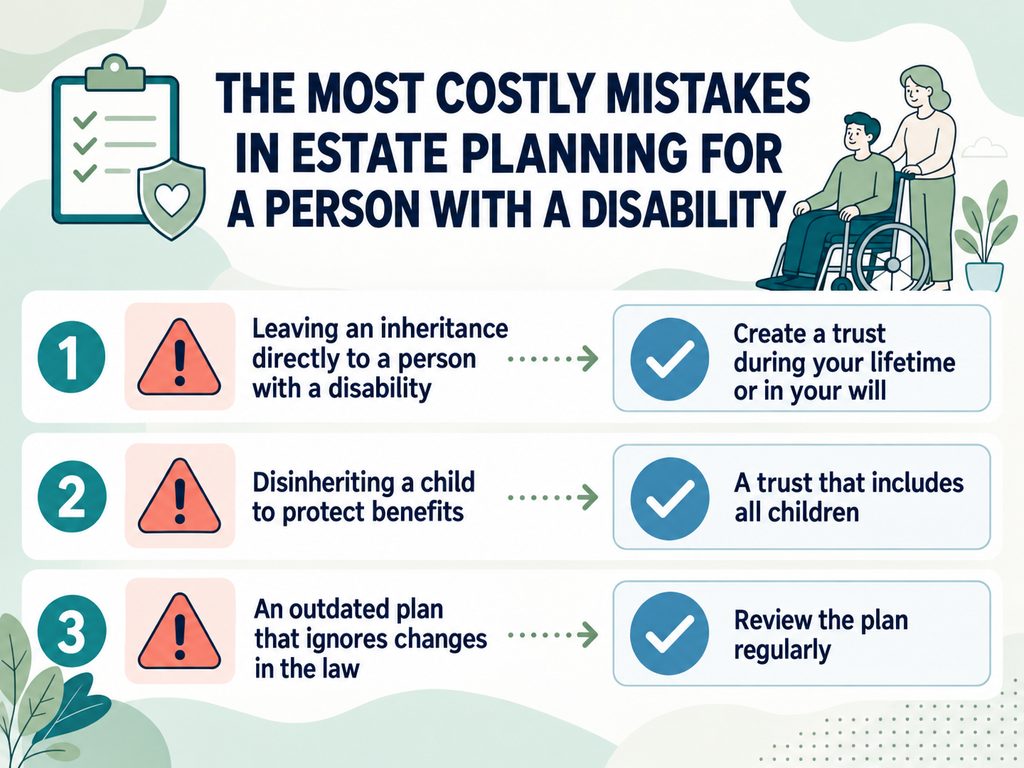
Most special needs estate planning failures trace to a handful of avoidable errors. The most damaging are leaving money directly to a disabled person, disinheriting the child to shield benefits, and naming the wrong trustee. Each can disqualify your loved one from means-tested programs or hand a court grounds to undo your wishes.
Direct gifts that trigger benefit loss
A direct inheritance to a disabled person can destroy eligibility for means-tested benefits like SSI and Medicaid. The fix is timing: the special needs trust must be established during your lifetime or inside your will.
Do not assume your loved one can simply build a trust later. If the person tries to create one themselves after a parent’s death, benefits may not be protected. The vehicle has to exist before the money arrives.
Disinheriting and family-provision risks
Some families cut a disabled child out entirely, hoping to preserve benefits. That gamble invites challenge. Disinheriting a disabled child to protect benefits can expose the will to legal challenge, and courts may redistribute the estate to ensure that person’s care.
A better route is a trust covering all your children, with assets divided by need and circumstance. This flexibility also spares non-disabled siblings from an involuntary caregiver role.
Outdated plans that ignore changing law
Benefit thresholds, tax rules, and state statutes shift over time. Estate plans and wills should be reviewed regularly so they stay consistent with your wishes and effective after any law, tax, or benefit-threshold change. Because outcomes vary by state, confirm current rules with a qualified special needs attorney.
Questions Families Ask Us Most Often
What is the best way to protect a disabled child after the parents die?
The strongest tool is a third-party special needs trust, typically created by parents and funded at death. It holds assets for your child without counting as their own resources for means-tested programs, and unlike first-party trusts, it carries no Medicaid payback clause. Fund it through your will, life insurance, or beneficiary designations: never leave money to the child directly.
Can a person with a disability legally inherit money or property?
Yes. A person with a disability has the same legal right to inherit as anyone else. The problem is not the inheritance itself but its effect on benefits. A direct inheritance counts as the person’s own resource and can disqualify them from SSI and Medicaid.
Routing that same money into a special needs trust preserves eligibility while still improving their quality of life.
Does receiving an inheritance affect SSI or Medicaid benefits?
It can, and often does. These are means-tested programs, so assets held in the person’s own name can push them over resource limits and suspend benefits. An inheritance paid into a properly drafted special needs trust is not counted, because the trustee, not the beneficiary, controls the funds. Exact thresholds are federal but administered by states, so confirm current figures with a qualified attorney.
Should I set up a trust, focus on funding, or arrange guardianship first?
These are not either-or choices. A trust gives the plan a safe destination, funding fills it, and guardianship or a less-restrictive alternative addresses decision-making once your child turns 18. Most families establish the trust framework first, then coordinate funding and decision-making tools around it so no piece works in isolation.
When do I need a special needs attorney instead of DIY documents?
Whenever state law, benefit eligibility, or tax outcomes could materially change the result. Trust drafting, Medicaid rules, and guardianship procedures vary by state, and a single mistaken beneficiary form can undo an otherwise careful plan. If meaningful assets, benefits, or your child’s long-term care are at stake, consult a qualified special needs or estate attorney.
Sources / References
- law.cornell.edu/uscode/text/42/1396p – 42 U.S.C. 1396p(d)(4)(A) – Medicaid special needs trust provision
- plantogetherlaw.com/Tips-on-Creating-an-Estate-Plan-that-Benefits-a-Child-with-Special-Needs – Plan Together Law – Estate Plan for a Child with Special Needs
- palawhelp.org/resource/special-needs-trust – PA Law Help – special needs trust overview