
Senior estate planning is the process of organizing your assets, healthcare, and financial decisions in preparation for potential incapacity or death. Put simply, it protects your assets and designates the people who will make decisions on your behalf when you are no longer able to do so yourself.
In this guide, you will learn about four essential documents every senior should have and a seven-step process for preparing them. Keep in mind that U.S. laws vary by state and change over time, so treat this information as general legal knowledge rather than legal advice.
Key Takeaways:
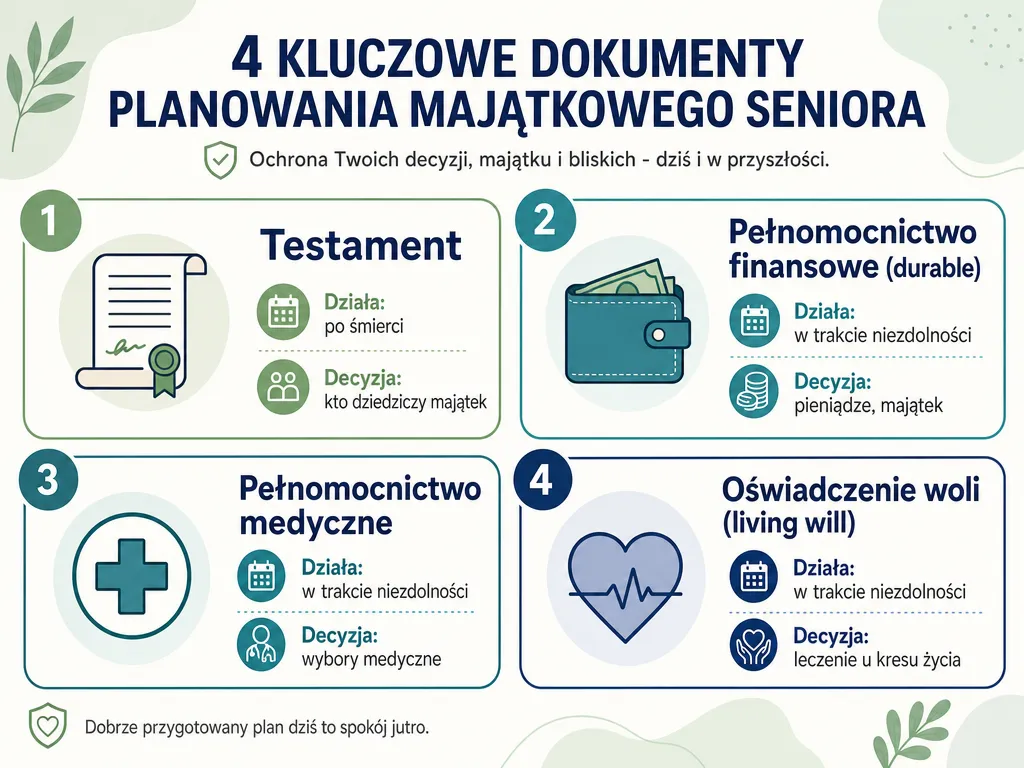
- The four essential documents every senior should have are a will, a durable financial power of attorney, a healthcare power of attorney, and a living will.
- A power of attorney operates during your lifetime when you are unable to make decisions, while a will takes effect only after your death.
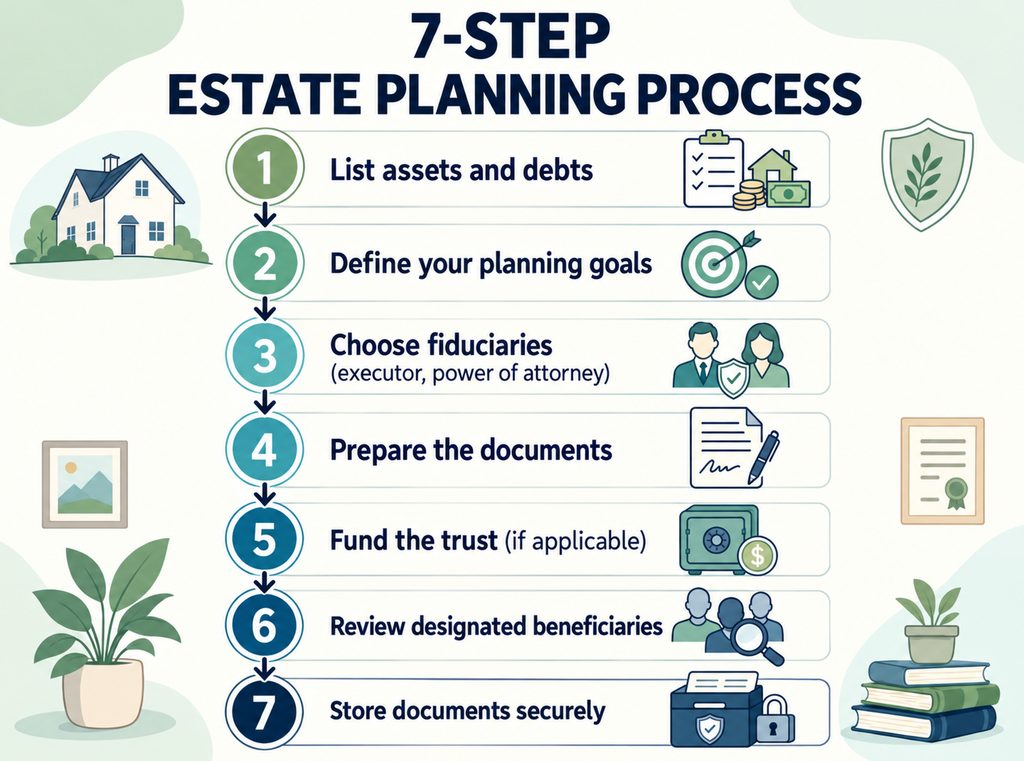
- The estate planning process involves seven steps, from listing assets and debts to reviewing beneficiary designations.
- Named beneficiaries of retirement accounts and life insurance policies generally take precedence over a will, so an outdated form could transfer money to an ex-spouse.
- Medicaid reviews recent asset transfers during the so-called look-back period, and gifts made during this period may delay benefit eligibility.
- Documents must be signed while the senior still has legal capacity, because their wishes may no longer be carried out after they lose capacity or die.
- According to the article, 50–70% of Canadians do not have a valid will or a complete estate plan.
What Senior Estate Planning Covers and Why It Matters
Senior estate planning is the process of arranging your assets, healthcare, and financial decisions for the time when you lose capacity or pass away. At its core, estate planning means ensuring that everything you own (minus debts) is distributed according to your wishes after death. It protects those wishes and spares your family avoidable conflict.
A common myth is that this only matters for the wealthy. In truth, estate planning is useful regardless of age, family situation, or asset value, not a tool reserved for large estates. Planning while you are alive and clear-headed also relieves loved ones of needless stress during a period of grief.
Estate planning vs. elder law: the key difference
These two practice areas overlap but serve different goals. Elder law focuses on preserving your assets during your lifetime, including long-term care and Medicaid, while estate planning focuses on what happens to your assets after you die. Elder law is a specialized field covering the legal, financial, healthcare, and long-term planning needs of older adults.
For this reason, it is worth consulting an attorney who specializes in elder law, bearing in mind that rules vary by state.
When does estate planning become urgent for seniors
Urgency rises as legal capacity becomes uncertain. Act while the senior can still make valid decisions. It is essential to put the core documents in place while the senior still retains legal capacity, because after loss of capacity or death their wishes may no longer be realizable. Rules vary by U.S. state and change over time, so treat any specific figure as something to verify with a qualified attorney.
This guide offers general legal information, not individualized advice.
The Core Documents Every Senior Needs in Place
Four documents form the foundation of senior estate planning: a last will and testament, a durable financial power of attorney, a healthcare power of attorney, and a living will. Each covers a different decision point, and each must be signed while the senior still holds legal capacity. It is essential to put the will and durable power of attorney in place as the key pieces of any plan.
The most important distinction cuts across all four. A power of attorney operates while you are alive but unable to act, while a will takes effect only after death. One fills the gap during incapacity. The other distributes what remains afterward.
Last Will and Testament: directing asset distribution
A will directs who receives your assets and names an executor to manage the estate through probate. It speaks only after you die. Without one, state intestacy law decides for you, and the outcome rarely matches what families expect.
Durable financial power of attorney
A financial and property power of attorney designates a trusted person to make money and property decisions on your behalf. The word durable matters: it keeps the authority valid even after you lose capacity, which is precisely when families need it most.
Healthcare POA and living will (advance directives)
A healthcare power of attorney names someone to make medical decisions when you cannot speak for yourself. A living will records your own wishes about life-sustaining treatment. Together these are often called advance directives.
Execution and witnessing requirements vary by state, and a signer must have legal capacity when signing. Confirm the current rules with a qualified attorney.
The 7 Steps in the Estate Planning Process
A practical estate plan follows seven steps, from inventorying your assets to reviewing beneficiary designations. Senior estate planning works best when you move through them in order, because each step builds on the last. Here is the sequence.
Step 1-2: Inventory assets and define goals
Start by listing everything you own and everything you owe. Estate planning is the process of arranging that everything you own, minus debts, is distributed according to your wishes after death. Account for real estate, bank and retirement accounts, insurance, and personal property.
Next, define your goals. A sound plan lets you designate who receives assets, whether family members or charities, and define care for any dependents who rely on you.
Step 3-5: Choose fiduciaries, draft documents, fund any trust
Step three is choosing the people who will act for you. Appointing an executor to properly manage the estate is a crucial step, and so is naming an agent under your durable power of attorney. Pick trustworthy, capable individuals and name backups.
Step four is drafting the documents themselves: your will, powers of attorney, and any trust. Execution and witnessing requirements vary by state, so confirm the current rules with a qualified attorney.
Step five applies only if you create a trust. A trust controls nothing until you fund it, meaning you must retitle assets into the trust’s name. An unfunded trust is one of the most common and costly oversights.
Step 6-7: Review beneficiary designations and store documents safely
Step six is reviewing beneficiary designations on retirement accounts and life insurance. These designations generally override your will, so a stale beneficiary form can send money to an ex-spouse regardless of what your will says.
Step seven: store originals somewhere safe and tell your executor where to find them. A well-structured plan also strengthens protection against challenges to your beneficiary choices.
Wills vs. Trusts vs. Lifetime Gifts: Choosing the Right Tool
A will directs who receives your assets but routes them through probate. A revocable trust can help assets bypass probate and transfer privately. Lifetime gifts move property now, while you are alive. The right tool for senior estate planning depends on your assets, your state, and your goals.
The three main tools to weigh are a testament, trust, and lifetime gifts.
A professionally prepared plan can reduce the costs and taxes that burden an estate, speed up the transfer of assets to the next generation, and protect your beneficiaries according to your wishes.
| Tool | When it transfers | Avoids probate? | Key caution |
|---|---|---|---|
| Will | After death | No, assets pass through probate | Becomes public record |
| Revocable trust | During life or at death | Yes, if funded properly | You keep control; limited creditor protection |
| Irrevocable trust | Per trust terms | Yes | You give up control permanently |
| Lifetime gift | Immediately | Yes, no longer in estate | Possible gift tax; Medicaid consequences |
How probate works and when a trust avoids it
Probate is the court-supervised process of validating a will, paying debts, and distributing what remains. It can be slow and public. A revocable living trust lets you move assets into the trust during life, so they pass outside probate. Rules and timelines vary significantly by state, so confirm how your state handles probate with a qualified attorney.
Lifetime gifting: benefits and tax/Medicaid cautions
Giving assets away now can simplify your estate, but it carries traps. If you have an estate, recognize your potential tax liability early. Gift tax rules and the annual exclusion change over time and vary by situation, so verify current IRS guidance rather than rely on a fixed figure. Never transfer assets to evade Medicaid eligibility or creditors; such moves can trigger penalties and be unwound.
Speak with an elder law attorney before gifting.
Protecting an Aging Parent’s Assets Without Breaking the Rules
The safest way to protect an aging parent’s assets is early, lawful planning: proper documents, correct titling, and legitimate long-term care strategies. Senior estate planning works best when the parent still holds legal capacity, because once capacity is lost or death occurs, their wishes may no longer be realizable, and families risk costly, drawn-out procedures.
Legitimate protection looks nothing like a last-minute scramble. It means putting a will and durable power of attorney in place, choosing beneficiaries deliberately, and, where appropriate, using trusts. What it does not mean is shuffling assets to dodge creditors or qualify for benefits.
Medicaid and long-term care planning basics
Medicaid can help cover long-term care, but it reviews recent asset transfers through a so-called look-back period. Gifts or below-value transfers made during that window can trigger a penalty delaying eligibility.
Here is the catch: the length of the look-back and the penalty math vary by state and change over time. Treat any specific figure as something to verify. An elder law attorney can structure planning years ahead so that protection stays lawful rather than punitive.
Guarding against fraud, scams, and financial exploitation
Older adults are frequent targets of financial exploitation. Watch for red flags: sudden changes to a will, new “friends” controlling finances, unexplained withdrawals, or pressure to sign documents quickly.
A caregiver’s role should stay narrow. A caregiver’s help should be limited to encouraging and arranging legal advice, but never exert undue influence, because pressure can invalidate the very document you meant to secure. When facts or state law could change the outcome, consult a qualified attorney.
The Biggest Estate Planning Mistakes Seniors and Families Make
The costliest errors in senior estate planning are predictable: procrastination, outdated beneficiary designations, do-it-yourself documents that fail your state’s execution rules, and avoiding the family conversation altogether. Each one quietly undermines even the best intentions, and each is preventable with a modest amount of foresight.
Procrastination tops the list. Delay is widespread: between 50 and 70 percent of Canadians lack a valid will or complete estate plan, a striking illustration of how easily people put this off. Waiting until a health crisis is dangerous because capacity can vanish overnight, and once it does, your wishes may no longer be realizable.
Other mistakes are quieter but just as damaging. Many seniors never revisit their plan after a marriage, divorce, or second marriage, leaving stale beneficiary designations that override the will itself. Others ignore their digital estate entirely: passwords, online accounts, and cloud-stored records that heirs cannot reach. A further trap is assuming one rule applies everywhere.
Estate planning rules vary by state and change over time, so a form that works in one jurisdiction may be invalid in another.
How to start the conversation between adult children and parents
Avoiding the talk leaves adult children struggling to manage their parents’ financial and healthcare affairs; having it gives families clarity, confidence, and control over the future. Start simply. Ask whether your parent has thought about managing their affairs during life and after death. Older relatives without immediate family, such as aunts and uncles, are easily overlooked, so include them before their wishes are lost.
Quick Answers to the Questions Families Ask Most
These plain-English answers cover the questions families raise most often. They offer general U.S. principles. Because rules vary by state and change over time, treat them as legal information, not individualized advice, and consult a qualified attorney for your situation.
When should a senior make or update a will?
Make a will as soon as you have assets, dependents, or clear wishes, and ideally while you still have full legal capacity. Update it after major life events, not on a fixed calendar. Marriage, divorce, a second marriage, a death in the family, or a large change in assets should trigger a review. There is no universal “every five years” rule.
Who inherits from a senior who dies without a will?
When someone dies intestate (without a valid will), state law decides who inherits, not the family. Typically a spouse and children come first, then parents and more distant relatives. The exact shares vary significantly by state, and unmarried partners or stepchildren often receive nothing. This is why a signed, valid will matters.
What is the difference between elder law and estate planning?
Elder law focuses on preserving your assets during your lifetime, covering long-term care and Medicaid. Estate planning focuses on what happens to your assets after you die. Many seniors need both, and some attorneys practice in both areas.
How does estate planning differ for couples with a large age gap?
A significant age gap means one spouse will likely outlive the other by many years. Plan for the survivor’s long income horizon, long-term care, and updated beneficiaries. Trusts and careful titling often help balance the needs of both spouses.
Can I protect assets from nursing home costs, and is it legal?
Yes, through lawful, early planning: proper titling, certain trusts, and legitimate long-term care strategies. Transferring assets to hide them or rush Medicaid eligibility is not legal and can trigger penalties. Speak with an elder law attorney first.
Sources / References
- sagicor.com/en-gd/client-care/buying-guides/guide-to-estate-planning – Sagicor – Guide to Estate Planning
- elderneedslaw.com/blog/estate-planning-for-seniors-5-things-you-need-to-know – Elder Needs Law – Estate Planning for Seniors
- copenbarger.com/elder-law-vs-estate-planning – Copenbarger – Elder Law vs Estate Planning