
Estate planning for complex asset portfolios requires multi-layered legal structures, cross-border coordination, and active reduction of tax burdens long before probate begins. A simple will rarely suffices when business interests, foreign real estate, and alternative investments are involved.
This text is general legal information in the context of U.S. law, not advice tailored to an individual situation. Keep in mind that state laws and tax thresholds differ between jurisdictions and can significantly change the outcome.
In short
A simple will covers only probate assets, and in diversified portfolios most of the value often passes outside probate.
Beneficiary designations (TOD, POD) and ownership titling (JTWROS) override the will and let assets bypass court-supervised probate.
An irrevocable trust removes assets from the estate subject to estate tax, but means permanently giving up control over them.
Family LLCs and partnerships provide valuation discounts for tax purposes, but require strict corporate formality.
A buy-sell agreement funded with life insurance provides cash to buy out ownership interests after a business owner’s death.
Without the private keys or seed phrase, cryptocurrency is permanently unrecoverable for heirs.
An estate plan should be reviewed every 3 to 5 years and after a marriage, divorce, birth, or change in law.
What Estate Planning for Complex Asset Portfolios Actually Requires
Estate planning (planowanie spadkowe) for a complex portfolio means coordinating legal structures, cross-border holdings, and tax exposure long before probate begins. A simple will rarely suffices once you hold business interests, international assets, or alternative investments. The goal is a custom strategy, not a template.
Complex estates introduce planning factors that are absent from ordinary ones: multiple income sources, closely held business interests, foreign property, intricate family dynamics, and philanthropic goals. Each factor pulls in its own tax rules, titling considerations, and potential disputes. Coordinating them is the work.
When a will alone is not enough
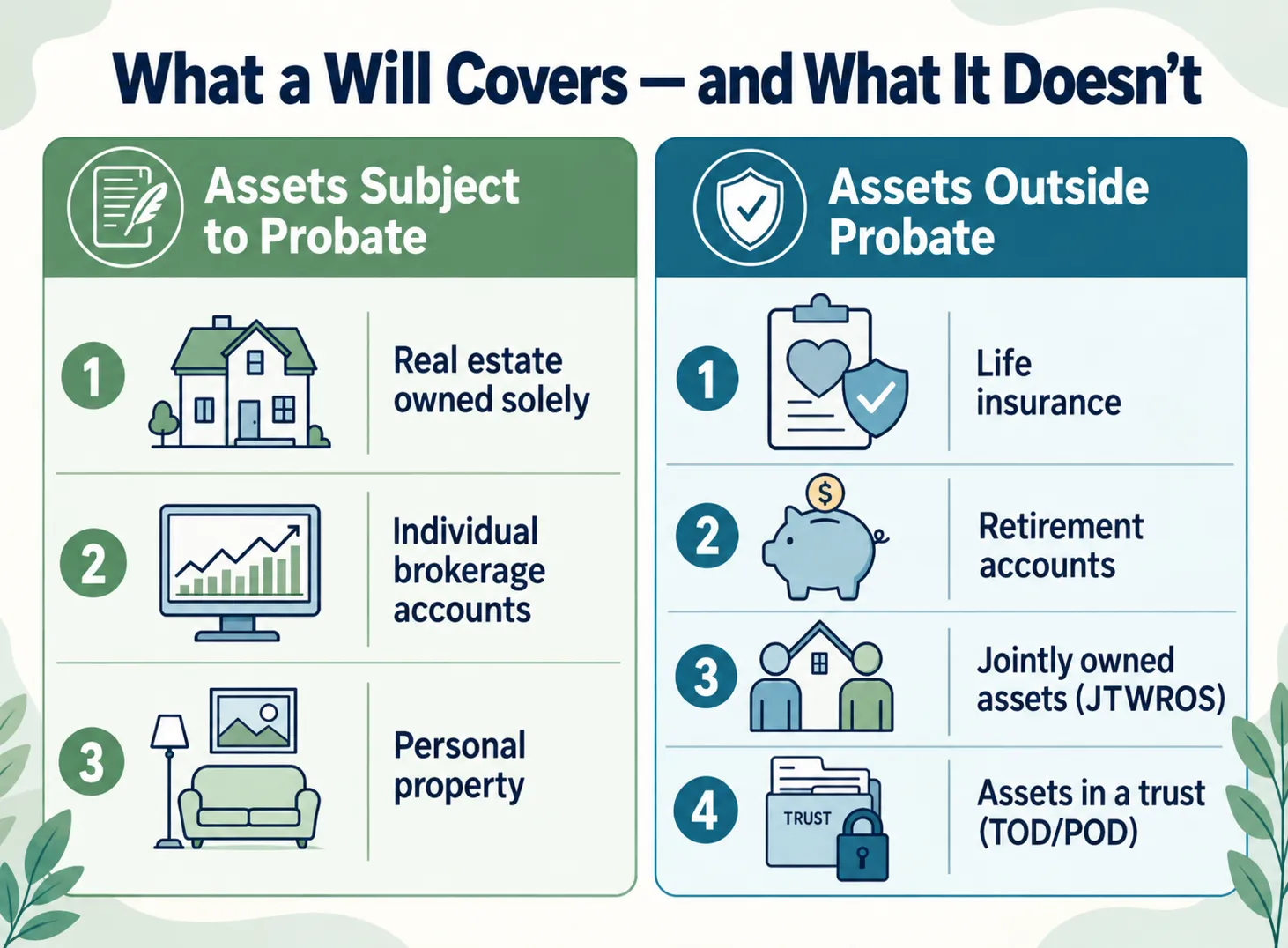
A will only directs probate assets: property that passes through the public, court-supervised process after death. Non-probate assets (life insurance, retirement accounts, jointly titled property, and trust-held property) transfer outside that process through beneficiary designations or titling. For a diversified portfolio, the non-probate side often carries most of the value, so a will controls only a fraction of the estate.
General U.S. principles vs state-specific rules
Federal estate tax applies above a large exemption, but the exact 2026 threshold and the number of states levying their own estate or inheritance tax change with legislation and should be confirmed against current IRS and state sources before you rely on a figure. State law also governs probate, trust execution, and spousal rights, so a rule that holds in one state may not apply in another. This is legal information, not individualized advice: consult a qualified attorney licensed where your assets sit.
Building Your Asset Inventory: What Belongs on the List
Estate planning (planowanie spadkowe) begins with one deceptively simple task: a detailed inventory of every property, account, and valuable you own. This list is the foundation of the entire plan. For a complex portfolio, it must capture real estate, private business equity, retirement accounts, insurance, digital assets, and foreign holdings across every jurisdiction where you hold value.
Domestic vs international holdings
Sort each asset first by probate status. Probate assets pass through court under your will: solely owned real estate, individual brokerage accounts, personal property. Non-probate assets transfer automatically, outside court supervision.
Flag alternative and illiquid holdings separately. Private company shares, partnership interests, art, collectibles, and real estate in another state or country each carry their own transfer rules and often trigger a second, ancillary probate abroad.
Documenting digital assets and private keys
Crypto, domains, and online accounts need explicit handling. A private key that dies with you can lock heirs out permanently, so record access instructions securely without exposing credentials in the will itself.
Titling and how it affects transfer
How you title an account can quietly override your will. JTWROS, TOD, and POD designations, plus trusts, let assets bypass probate entirely: a public, court-supervised process that is often slow and costly. For large estates, consolidate holdings into fewer accounts and keep the inventory and asset map current. This is legal information, not individualized advice; titling rules vary by state.
The Core Legal Structures: Trusts, LLCs, and Insurance Vehicles
Once the inventory is complete, estate planning (planowanie spadkowe) for a complex portfolio turns to the vehicles that actually move assets out of your taxable estate and centralize control. Three dominate the conversation: trusts, family LLCs or partnerships, and specialized insurance structures. Each trades a measure of direct ownership for protection or tax efficiency.
Revocable vs irrevocable trusts
A revocable living trust keeps you in control: you can amend or dissolve it anytime, and it helps assets bypass probate. The tradeoff is that the assets remain in your taxable estate.
An irrevocable trust reverses that bargain. By giving up the power to change or revoke it, you generally remove the assets (and their future growth) from your estate, which can cut estate tax exposure. A trust also gives greater control over when and how beneficiaries receive an inheritance, plus protection from creditors, taxes, and mismanagement. The cost is permanence: you cannot simply take the assets back.
Family LLCs and limited partnerships
Family limited partnerships and LLCs (FLP/LLC) enable centralized management of family wealth, especially large real estate and business interests, shield assets from creditors, and can yield valuation discounts for gift and estate tax purposes. They demand real corporate formality, though: separate bank accounts, documented meetings, and arm’s-length transactions. Sloppy administration invites the IRS to disregard the discount entirely.
Private placement life insurance (PPLI) for liquidity
PPLI wraps investments inside a life insurance policy, deferring tax on growth and delivering a tax-free death benefit. It is built for UHNWI clients, typically requiring multimillion-dollar commitments and accredited-investor status, and it carries a meaningful compliance and reporting burden.
|
Structure |
Primary benefit |
Key tradeoff |
|---|---|---|
|
Revocable trust |
Flexibility, probate bypass |
Stays in taxable estate |
|
Irrevocable trust |
Estate tax reduction, creditor protection |
Loss of direct control |
|
Family LLC/FLP |
Centralized control, valuation discounts |
Strict corporate formalities |
|
PPLI |
Tax-deferred growth, liquidity |
High entry threshold, reporting load |
This is legal information, not individualized advice; trust and tax treatment vary by state.
The 7-Step Estate Planning Process for High-Net-Worth Individuals
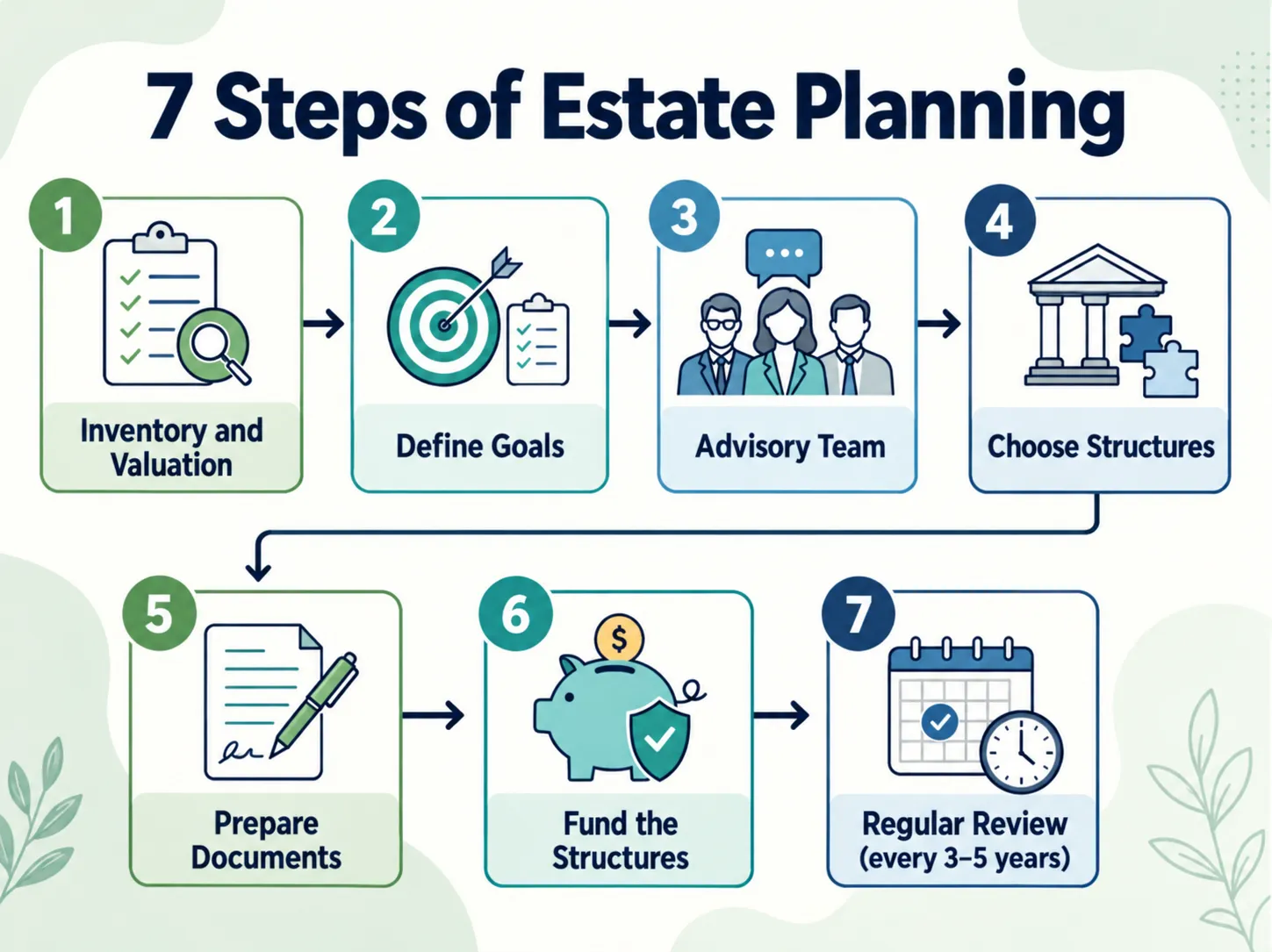
The seven steps are: inventory and valuation, goal-setting, assembling the advisory team, selecting structures, drafting core documents, funding those structures, and scheduled review. Each step builds on the last. Skipping funding or review is where complex estates most often unravel, even when the drafting was flawless.
Step 1-2: Discovery, valuation, and goal-setting
Estate planning (planowanie spadkowe) opens with a detailed inventory of property, accounts, business interests, and alternative assets, then a defensible valuation of each. Valuation matters most for illiquid holdings, where a number drives both tax exposure and fairness among heirs.
Goal-setting follows. You decide who controls what, when beneficiaries receive distributions, and whether philanthropy belongs in the plan. These choices shape every structure that comes next.
Step 3-4: Assembling the advisory team and choosing structures
No single advisor covers a complex estate. A wealthy family’s team typically includes an estate attorney, a CPA, a financial advisor, an insurance advisor, a trust officer, and sometimes a family business consultant, each collaborating on one cohesive plan. In practice the wealth manager often acts as quarterback, keeping the private wealth attorney and cross-border tax accountant aligned.
With goals clear, you match structures to them: trusts, family LLCs, and insurance vehicles chosen for the specific portfolio rather than copied from a template.
Step 5-7: Drafting, funding, and scheduled review
Drafting produces the core documents. A minimum complete plan includes a will, a durable financial power of attorney, a healthcare power of attorney, and an advance directive or living will specifying end-of-life care preferences. Requirements for valid execution vary by state.
Funding is the step most people forget: an unfunded trust controls nothing. Title the assets into it.
Finally, review. An estate plan should be revisited every 3 to 5 years, and after any major event: marriage, divorce, a birth, a large change in wealth, the death of a beneficiary, or a change in law. This is legal information, not individualized advice.
Succession for Business Owners and Illiquid Holdings
When most of your wealth is locked inside a closely held company or a private equity stake, estate planning (planowanie spadkowe) has one overriding job: move control to the next generation without forcing a fire sale to pay tax. Three tools do most of the work: a buy-sell agreement, a disciplined valuation, and a dedicated pool of liquidity. Skip any one and heirs inherit a dispute instead of a business.
Buy-sell agreements and valuation
A buy-sell agreement sets in advance who may buy an owner’s interest, at what price, and on what trigger: death, disability, or exit. Funding usually comes from a life insurance policy, so cash is available the moment a shareholder dies. Succession plans can also use gifts of ownership interests or an ESOP sale, which helps prevent family conflict. The agreement’s valuation clause matters as much as the funding.
Use a stale or arbitrary number and co-owners litigate; a current, formula-based or appraised value keeps the transfer clean.
Avoiding family disputes over control
Family conflict is the single most common reason succession fails. Spreading equal shares across heirs who do not all work in the business invites deadlock. Practical fixes include gifting interests during life, separating economic ownership from voting control, or a sale to an employee stock ownership plan (ESOP).
Liquidity planning to cover tax liabilities
An irrevocable life insurance trust (ILIT) holds a policy outside your taxable estate and delivers tax-free proceeds to cover estate tax and other post-death costs. That liquidity means illiquid assets, a company, real estate, a fund interest, need not be sold under unfavorable conditions. This is legal information, not individualized advice; tax and trust rules vary by state.
Cross-Border Assets, Taxes, and the Mistakes That Cost the Most
Foreign property, dual-jurisdiction probate, and cryptocurrency create overlapping tax and compliance risks that a single will cannot resolve. The costliest errors are rarely exotic. They are stale beneficiary designations, trusts that were drafted but never funded, and plans that ignore state-level estate tax while watching only the federal threshold.
International property and multi-jurisdiction probate
A villa in France and a brokerage account in New York may each trigger a separate probate proceeding under separate law. Estate planning (planowanie spadkowe) for cross-border holdings coordinates these forums early, because forced heirship and community-property rules in a foreign jurisdiction can override what your U.S. will says. U.S. persons with foreign accounts also face information-reporting obligations: FBAR and FATCA-type filings apply during life and must be mapped so your executor can continue them. These are general principles; a qualified attorney in each jurisdiction should confirm them.
Digital assets and crypto access planning
Cryptocurrency introduces a problem no beneficiary designation solves: without the private keys or seed phrase, the asset is permanently unrecoverable. A plan should document access securely and separately from the public estate record, naming a competent fiduciary to execute the transfer.
Common and costly mistakes to avoid
Beneficiary designations override your will, so a forgotten ex-spouse on a retirement account defeats the whole plan. A trust that holds no assets protects nothing. And future legislative change: shifts in exemption thresholds or rates, can quietly make an efficient plan suboptimal, which is why review every three to five years matters. This is legal information, not individualized advice; consult counsel licensed where your assets sit.
Questions Clients Ask Us Most About Complex Estates
What is the best estate planning option for a large or complex portfolio?
There is no single best option. The strongest approach combines a revocable living trust, careful account titling, and entity structures layered to match your asset mix. A basic will alone rarely suffices once you hold business interests, real estate, and foreign or alternative assets. Estate planning for a complex portfolio pairs these tools with a coordinated advisory team rather than one document.
When does a trust make more sense than a will for high-net-worth individuals?
A trust usually wins when probate cost, privacy, or control matter. Account titling such as JTWROS, TOD, and POD and funded trusts let assets bypass probate, a public, court-supervised process that can be slow and costly. A trust also gives greater control over when and how beneficiaries receive an inheritance, plus protection from creditors, taxes, and mismanagement.
A will still has its place: it names guardians and catches assets no one retitled.
How often should I review a complex estate plan?
Review your plan every 3 to 5 years, and sooner after any major life event: marriage, divorce, a birth or adoption, a large change in wealth, or the death of a beneficiary or executor. A change in tax law is also a trigger. Legislative shifts in exemption thresholds or rates can quietly make a once-efficient plan suboptimal.
How are foreign property and cryptocurrency handled in U.S. estate planning?
Foreign real estate often requires a separate will or probate in that country, and U.S. reporting duties may apply to foreign accounts. Cryptocurrency raises a distinct risk: without a documented plan for private keys, heirs may never recover the assets. Treat both as high-risk items needing specialist review.
Do I need separate advisors for tax, legal, and investment matters?
Yes, and the value lies in coordination. A typical team includes an estate attorney, a CPA, a financial advisor, an insurance advisor, a trust officer, and sometimes a family business consultant, each collaborating on one cohesive plan. When facts or state law could change the outcome, consult a qualified attorney licensed where your assets sit.
Sources / Bibliography
creativeplanning.com/insights/estate-planning/effectively-manage-large-estate – Creative Planning – managing a large estate
financestrategists.com/estate-planning-lawyer/estate-planning-for-wealthy-families – Finance Strategists – Estate Planning for Wealthy Families
icanprotect.com/protecting-your-future-5-simple-steps-to-make-estate-planning-just-a-little-easier – iCanProtect – simple steps to estate planning