
Medicaid estate planning is the lawful structuring of income and assets to qualify for coverage of long-term care costs without losing a lifetime of savings. It is a specific branch of elder law, not a way to hide money. Below, you will find general legal information about the United States, not advice tailored to your situation. Keep in mind that key limits and thresholds vary by state and year.
Let’s look at what this planning actually means and how it works in practice.
In short:
- Medicaid estate planning is the lawful structuring of income and assets to qualify for long-term care without losing a lifetime of savings.
- Medicare does not cover long-term custodial care; in New York State, a private room in a nursing home costs more than $200,000 per year.
- The look-back rule covers 5 years (60 months) in New York and Pennsylvania, and gifts made below fair market value trigger a penalty period.
- Assets are divided into countable assets (cash, accounts, stocks) and exempt assets (a home, one vehicle, personal belongings, and a burial plot).
- The main tools include an irrevocable MAPT trust, a compliant spend-down, Medicaid-compliant annuities, and a written agreement with a family caregiver.
- Spousal impoverishment rules (CSRA and MMMNA) allow a healthy spouse to retain part of the couple’s shared assets and income.
- After a beneficiary’s death, the state may recover costs from their estate, usually by placing a lien on real property. For this reason, it is best to begin planning at age 50–60.
What Medicaid Estate Planning Actually Means
Medicaid estate planning is the legal process of structuring your income and assets so you can qualify for Medicaid long-term care benefits while preserving as much accumulated wealth as possible. It serves people who may one day need a nursing home, in-home care, or other custodial support. Done properly, it uses lawful tools, not concealment.
Think of it as a specialized branch of elder law. It is distinct from ordinary estate planning, and the difference matters when real money is at stake.
Medicaid planning vs. traditional estate planning
Traditional estate planning is broad. It governs how your assets are distributed after death and who makes financial and health decisions if you cannot. Medicaid planning is narrower: it focuses on structuring finances to qualify for Medicaid, especially long-term care, without exhausting the estate. That makes it a focused subset, not a replacement.
Where Medicaid fits in elder law
People routinely confuse Medicaid with Medicare. Medicare is a federal health insurance program mainly for people 65 and older; it covers only limited long-term care and emphasizes medical rather than custodial care. Medicaid is different.
Medicaid is a joint federal-state program that can cover long-term custodial care for eligible individuals, including nursing homes and some home care. Because each state administers its own rules, specifics vary widely. Always confirm your state’s current standards with a qualified elder law attorney.
Why Long-Term Care Costs Make This Planning Essential
A single year of nursing home care can erase decades of savings. Standard health coverage and Medicare do not pay for extended custodial care, which is the daily help with bathing, dressing, and eating that most residents actually need. That coverage gap is precisely why families turn to Medicaid estate planning.
The numbers explain the urgency. In New York State, a private nursing home room can exceed $200,000 per year, making prolonged out-of-pocket care nearly impossible for most households. Treat that figure as a state-specific, point-in-time example: costs vary widely by state and rise over time, so always confirm current local rates.
What Medicare does and does not cover
Medicare is a federal program mainly for people 65 and older. It focuses on medical care, not custodial care, and covers only limited, short-term skilled nursing after a qualifying hospital stay.
Once the need shifts to long-term custodial support, Medicare steps back. Medicaid, a joint federal-state program, is the main public payer that can cover nursing home and some in-home custodial care for eligible individuals.
Who qualifies for Medicaid long-term care
Eligibility turns on two tests: functional need and financial limits. Applicants generally must show they require a nursing-home level of care, then meet strict income and asset thresholds.
Those dollar limits are set by each state and change annually, so a rule that applies in one state may not apply in another. Verifying your state’s current standards with a qualified elder law attorney protects both your eligibility and your estate.
Countable vs. Exempt Assets and Medicaid Income Limits
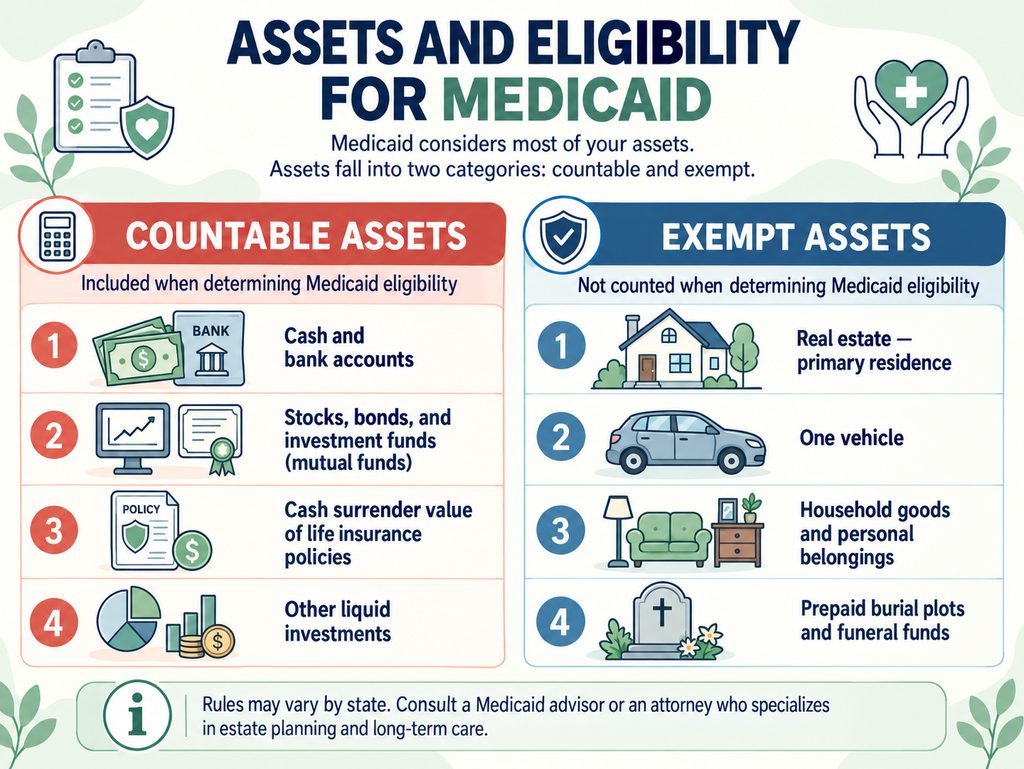
Medicaid estate planning starts with a simple distinction: every dollar you own falls into one of two buckets. Countable (available) assets count against the program’s resource limit, while exempt (noncountable) assets do not. Getting this split right is the foundation of any qualification strategy.
What counts as an exempt asset
Countable assets typically include cash, bank accounts, stocks and bonds, other liquid holdings, and the cash surrender value of a life insurance policy.
Exempt assets are the things Medicaid lets you keep. These generally include the primary residence owned and occupied by the applicant or spouse, one vehicle, household items, personal belongings, prepaid burial plots or funeral funds, and low-value life insurance.
In New York, for example, a life insurance policy with a face value up to $1,500 is treated as noncountable. Retirement accounts such as a 401(k) or IRA in payout status may also be exempt there, though this is state-specific.
How income limits differ from asset limits
Asset limits cap what you own; income limits cap what you receive monthly. Both must be satisfied, and they are evaluated separately.
Why limits vary by state
Specific dollar figures for asset thresholds and home equity limits vary by state and year, so always verify current numbers with a qualified elder law attorney.
The 5-Year Look-Back Rule and Transfer Penalties
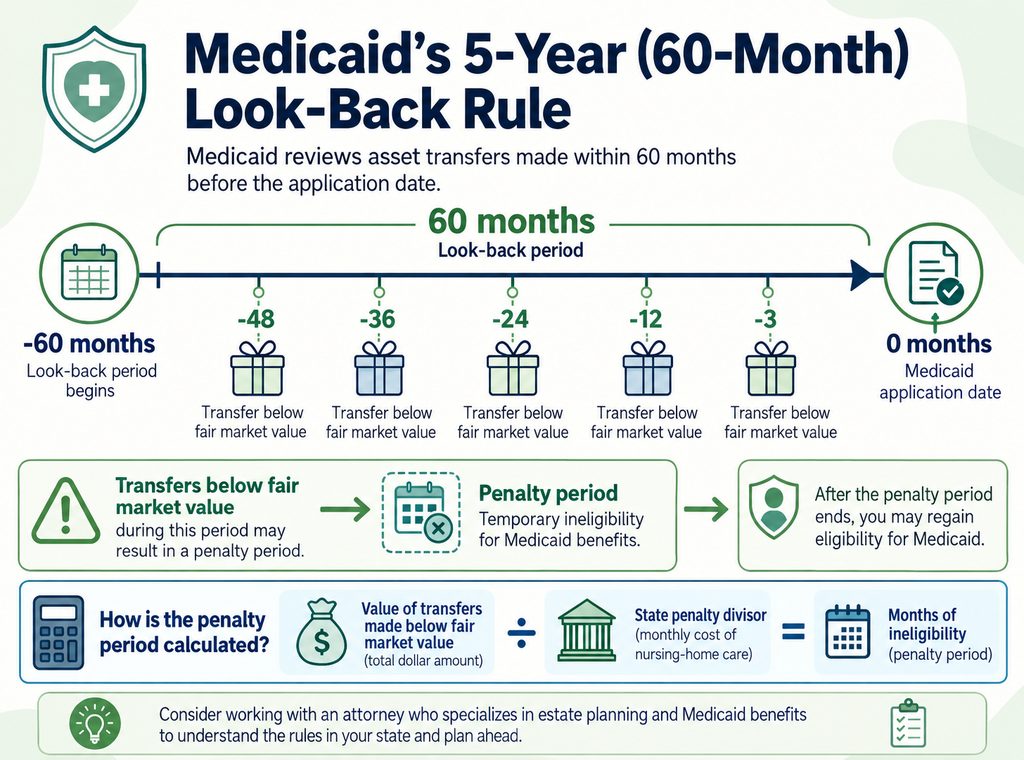
When you apply for long-term care Medicaid, the program reviews every asset transfer and gift you made during a set window before filing. In New York, nursing home Medicaid uses a five-year (60-month) look-back, and Pennsylvania applies the same 60-month period. Transferring assets below fair market value during this time can trigger a penalty period of ineligibility unless an exception applies.
This rule explains why Medicaid estate planning must happen early, not at the moment of crisis.
How the penalty period is calculated
Medicaid does not simply deny you outright. Instead, it divides the value of the disqualifying transfers by a state-specific penalty divisor (roughly the average monthly cost of nursing home care in your state) to produce a number of months you must wait for benefits. Larger gifts mean longer penalties.
Because that divisor and the exact formula are set at the state level and change over time, confirm current figures with a qualified elder law attorney.
Legal transfers vs. transfers that trigger penalties
Some transfers are exempt, such as certain gifts to a spouse or a disabled child. Others, like handing stocks, retirement accounts, or property to your children to meet asset limits, do not work: Medicaid can review all financial transactions from the prior five years, and discovered gifts can trigger a penalty of ineligibility. Simply giving away assets does not work, precisely because of this five-year look-back.
Why fraud and asset concealment are never the answer
Hiding assets or backdating transfers is not planning. It is fraud, carrying civil penalties, denial of benefits, and potential criminal exposure. Lawful strategies exist. Use them.
Core Strategies to Protect Assets and Qualify
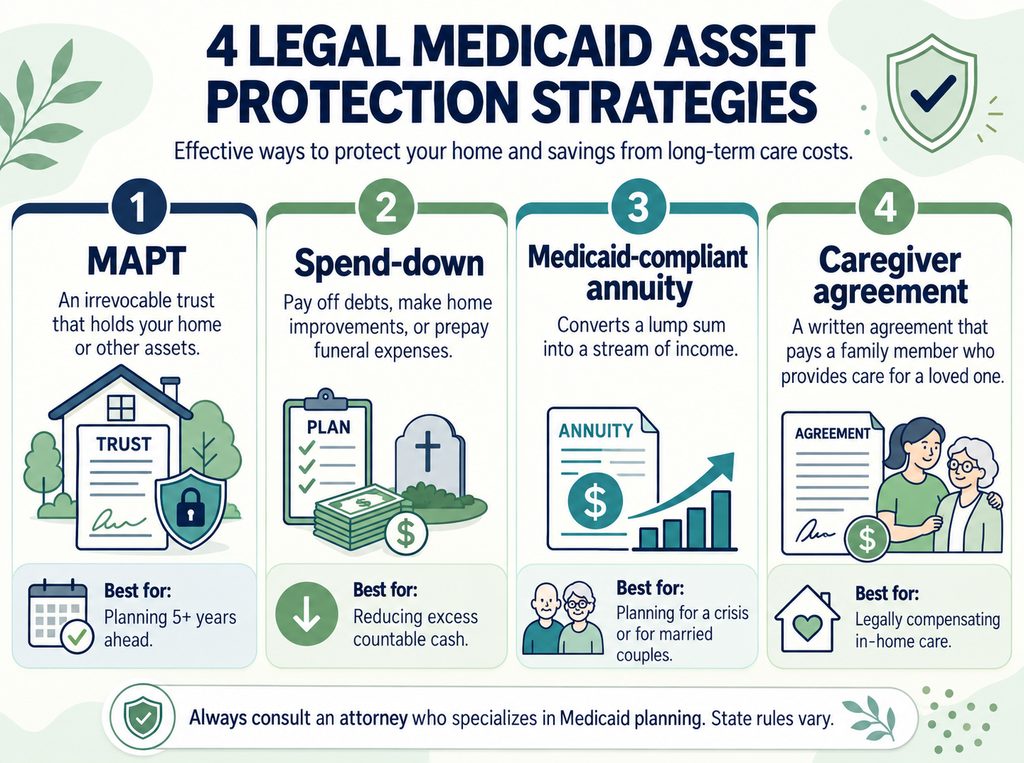
Several lawful tools help reduce countable assets while preserving wealth. Medicaid estate planning relies on irrevocable trusts, compliant spend-down, Medicaid-compliant annuities, and family caregiver agreements. Each fits a different situation and timeline. None involves hiding or giving away assets, which fails under the five-year look-back.
Medicaid Asset Protection Trust (MAPT)
A MAPT is an irrevocable trust: you cannot freely take back what you place inside it. The grantor often keeps the right to live in the home and receive trust income, while the principal passes to chosen beneficiaries at death. Transferring the home into such a trust avoids spending the whole estate, lets assets pass to beneficiaries without recovery concerns, and shields the property from later estate recovery.
These trusts must be carefully drafted by an experienced elder law attorney to comply with state rules, because the laws are complex and change often.
Spend-down, annuities, and caregiver agreements
Compliant spend-down converts countable cash into permitted purchases. A life estate is an alternative to a MAPT that automatically passes property at death and avoids recovery.
A Medicaid-compliant annuity turns a countable lump sum into a steady income payment, which Medicaid may treat differently than cash. A family caregiver agreement is a written contract paying a relative fair-market value for care, so the transfer is compensation, not a disqualifying gift.
Because rules and dollar thresholds vary by state and year, confirm every strategy with a qualified elder law attorney before acting.
Protecting a Healthy Spouse From Impoverishment
When one spouse enters a nursing home and the other stays home, Medicaid estate planning does not require draining every shared dollar. Federal spousal impoverishment rules let the healthy at-home spouse, called the community spouse, keep a protected share of the couple’s combined assets and income.
Community Spouse Resource Allowance
The Community Spouse Resource Allowance (CSRA) sets the amount of countable assets the at-home spouse may retain while the institutionalized spouse qualifies for Medicaid. The figure falls within federal minimum and maximum ranges that are updated annually and applied differently from state to state.
States may calculate the allowance as a percentage of combined resources or apply a flat standard. Because the numbers change each year and vary by jurisdiction, confirm your state’s current CSRA with a qualified elder law attorney before acting.
Income protections for the at-home spouse
A second safeguard protects income. The Minimum Monthly Maintenance Needs Allowance (MMMNA) guarantees the community spouse a baseline level of monthly income, drawn in part from the institutionalized spouse’s income when the healthy spouse earns too little.
Like the CSRA, these income floors sit within federally set ranges revised each year. State implementation differs, so a couple in one state may protect more income than an otherwise identical couple elsewhere.
Estate Recovery: When the State Seeks Repayment
After a Medicaid recipient dies, the government has the legal right to recover long-term care costs it paid on that person’s behalf. It does so from the deceased’s estate: typically by placing a lien on real property and filing a claim for reimbursement. Without planning, this can lead to loss of many assets, including the family home.
How aggressively a state pursues recovery, and what even counts as the “recoverable estate,” depends heavily on state law. Medicaid estate planning exists largely to blunt this risk before care begins.
How estate recovery works (general U.S. rule)
Federal law requires every state to seek recovery from the estates of certain Medicaid recipients who received long-term care. In practice, the state files a claim during probate or enforces a lien against the home. Proactive planning, done well before care is needed, can keep the home outside the reach of recovery.
State variation: the New York example
States differ sharply in what they treat as recoverable. Some limit recovery to assets passing through probate; others reach more broadly. A rule that applies in New York may not apply in Connecticut or Pennsylvania. Any specific New York figure or procedure should be confirmed against current state guidance, because these rules change.
Inheritance and payback questions (Connecticut example)
Many families ask whether inheriting money triggers payback. Recovery targets the deceased recipient’s own estate, not a separate inheritance you receive. Still, Connecticut and other states define the recoverable estate differently, so confirm your state’s rules with a qualified elder law attorney before acting.
Timing, Crisis Planning, and When to Call an Elder Law Attorney
The best time to start Medicaid estate planning is before long-term care becomes necessary, ideally in your 50s, 60s, or early retirement, especially with a family history of chronic illness. Early action gives you more flexibility, more asset-protection options, and extra time to let strategies clear the look-back window.
Advance planning vs. crisis planning
Advance planning assumes time is on your side. It lets you place assets in an irrevocable trust, spend down in compliant ways, and wait out the five-year look-back before applying.
Crisis planning is different. A sudden stroke, heart attack, serious accident, or the unexpected loss of a primary caregiver can force an earlier application once medical bills mount. Fewer options remain, but lawful strategies still exist even when care is needed right now.
Why state law and an attorney matter
Medicaid estate planning intersects with your broader estate plan. Asset transfers and certain trusts can significantly reshape how property passes at death, so coordinating the two matters keeps qualification efforts from quietly undermining your inheritance goals. Trusts in particular must be carefully drafted to comply with state rules, which is why an experienced elder law attorney is essential rather than optional. Because the laws are complex and change often, professional guidance is not a luxury but a safeguard.
Quick answers to common questions
What is the maximum amount of assets you can have to qualify for Medicaid?
There is no single national number. Countable assets, such as cash, bank accounts, stocks, and the cash surrender value of life insurance, must fall below your state’s resource limit. Exempt assets, including your primary residence, one vehicle, and prepaid burial funds, do not count. Because thresholds and home-equity caps vary by state and year, verify current figures with a qualified elder law attorney.
How does the Medicaid 5-year look-back period actually work?
When you apply for long-term care Medicaid, the program reviews every asset transfer and gift from the prior five years (60 months). Any transfer below fair market value can trigger a penalty period of ineligibility, unless an exception applies. Simply giving away assets to meet the limit does not work, because discovered gifts restart this problem.
Can you transfer your home before applying for Medicaid?
Yes, but timing and method matter. Transferring your home into an irrevocable trust can avoid spending the whole estate and let the property pass without estate-recovery concerns, and a life estate is a common alternative. Done inside the look-back without an exception, however, a transfer triggers a penalty. Have an attorney structure it.
Do you have to pay back Medicaid if you inherit money?
An inheritance is generally new income or a countable asset that can push you over the limit and interrupt eligibility until it is properly managed. Separately, after a recipient dies, the state can recover long-term care costs from the estate, often through a lien on real property. Report changes promptly and consult an attorney.
When should you start Medicaid estate planning?
Start now, before a health crisis forces your hand. Planning in your 50s or 60s gives transfers time to clear the five-year look-back and preserves the widest range of lawful options. If care is already needed, crisis planning still helps, but call a qualified elder law attorney immediately to protect what you can.
Sources / References
- nyelderlawgroup.com/medicaid-planning – NY Elder Law Group – Medicaid Planning
- curraneelaw.com/what-are-the-differences-between-medicaid-planning-and-estate-planning – Curran Eel Law – Medicaid Planning vs. Estate Planning
- mamannalaw.com/articles/guarding-against-medicaid-recovery-with-a-sound-estate-plan – Mamanna Law – Guarding Against Medicaid Recovery