
High net worth estate planning is a coordinated strategy rather than a single will, designed to protect wealth, reduce transfer taxes, safeguard assets, and ensure the smooth succession of businesses and investments.
This guide explains the tools and decisions involved under general U.S. law, highlighting where state regulations may differ and when an experienced attorney becomes essential. We begin by defining the scope of this type of planning, then explore trusts, tax strategies, and business succession.
Key Takeaways
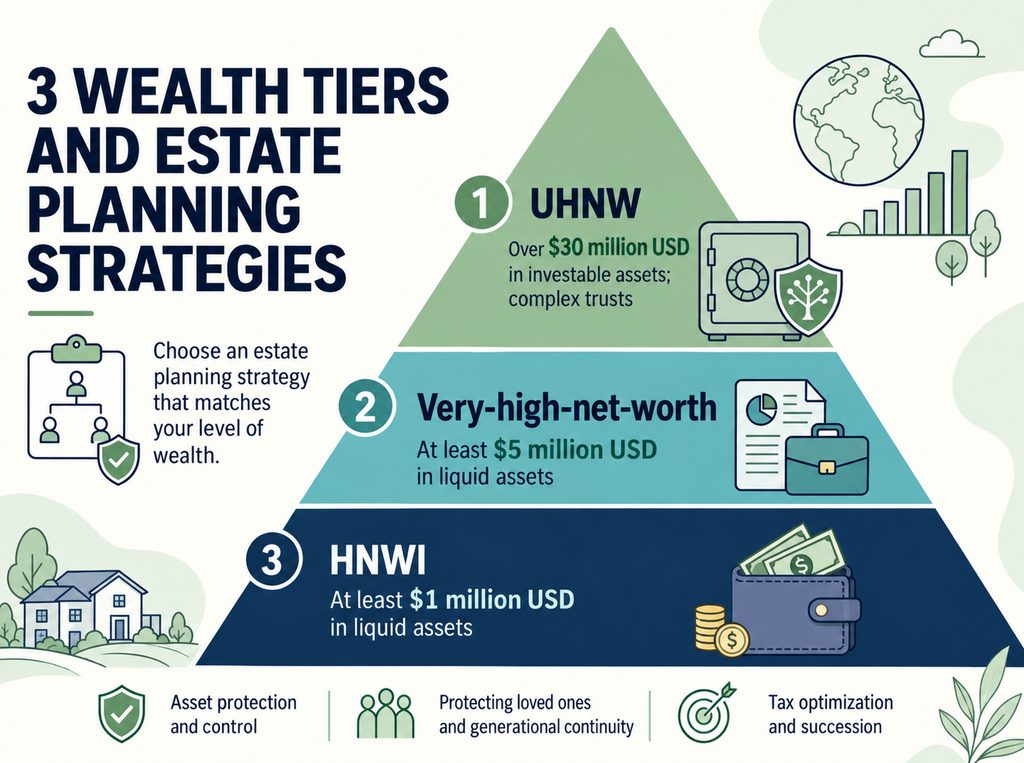
- A high-net-worth individual (HNWI) is generally defined as someone with at least $1 million in liquid assets, often excluding the value of a primary residence.
- Ultra-high-net-worth (UHNW) families hold more than $30 million in investable assets, opening the door to dynasty trust planning.
- The federal estate tax exemption in 2025 is $13.99 million per person and $27.98 million per couple, with amounts above the exemption taxed at rates of up to 40%.
- The increased tax exemptions introduced by the 2017 law are scheduled to expire after 2025, making early planning essential.
- In 2025, you can gift up to $19,000 per recipient annually without using any of your lifetime exemption.
- An irrevocable trust removes assets from the taxable estate and protects them from creditors, but at the cost of losing control over those assets.
- Beneficiary designations on life insurance policies and retirement accounts transfer assets directly to beneficiaries, bypassing the will, so they should be updated after a divorce, death, or birth.
What High Net Worth Estate Planning Actually Involves
High net worth estate planning goes far beyond a simple will. It is a coordinated strategy to preserve capital, minimize transfer taxes, and ensure a smooth succession of businesses and investments. This guide explains the tools and decisions under general U.S. principles, flagging where state law may differ and when a qualified attorney is essential.
Who counts as high-net-worth and why the threshold matters
There is no single official definition. A high-net-worth individual (HNWI) is typically someone holding at least $1 million in liquid financial assets, often excluding the value of a primary residence: a threshold widely used by financial institutions. The tiers matter because they drive strategy.
Ultra-high-net-worth (UHNW) families generally hold more than $30 million in investable assets, which opens the door to generation-skipping and dynasty trust planning. Between these lies the very-high-net-worth band, broadly falling under the same advanced toolkit.
Core goals: tax minimization, asset protection, succession, legacy
Estate planning builds a set of coordinated legal documents. These include wills, living trusts, irrevocable trusts, powers of attorney, advance health care directives, and special needs provisions, each giving clear instructions on how assets pass at death.
The aims are practical. You want to minimize transfer taxes, shield assets from creditors, transition a business cleanly, and define a lasting legacy. Because rules on taxes, probate, and trust validity vary by state, treat these as general principles, not universal law.
Why Wealthy Families Plan Their Succession Early
The driving force is risk. Without a plan, a large estate faces probate exposure, creditor and lawsuit claims, family conflict, and a potentially heavy transfer tax bill. Advisers group these pressures into five recurring concerns: estate tax, asset protection, family dynamics, legacy planning, and investment performance amid volatility.
Protecting assets from creditors, lawsuits, and divorce
Irrevocable structures shield wealth that sits exposed in a personal name. The 2017 Tax Cuts and Jobs Act raised estate and gift limits, but those higher thresholds are scheduled to sunset after 2025, so attorneys stress monitoring legislative change. Starting early locks in strategies while today’s rules still apply.
Avoiding probate and keeping the estate private
Probate is the court process of settling a deceased person’s estate: paying debts and distributing what remains. It is a public, costly, and time-consuming judicial process, though timelines and procedures vary by state. A properly funded revocable trust avoids probate and keeps the estate private.
Managing family dynamics and second marriages
Blended families need a plan that honors both a spouse and children from a prior marriage. A QTIP (qualified terminable interest property) trust pays income to the surviving spouse, then passes the remaining assets to the first-marriage children. It qualifies for the unlimited marital deduction and defers tax until the second spouse dies. Without this foresight, even well-intentioned plans invite unnecessary taxes, delays, or conflict.
Trusts: The Backbone of HNW Estate Plans
Trusts sit at the center of nearly every high net worth estate plan. A revocable living trust preserves lifetime control and avoids probate, while irrevocable trusts move assets, and their future growth, outside the taxable estate. The right choice depends on your goals, your family, and state law.
Revocable living trusts: control plus probate avoidance
A revocable living trust lets you retain full control over assets during your lifetime and avoids the public, costly probate process. You can amend or revoke it at will. The tradeoff: because you keep control, the assets remain part of your taxable estate. Trust taxation and validity still vary by state, so a structure that works in one jurisdiction may be treated differently in another.
Irrevocable trusts: moving assets out of the taxable estate
An irrevocable trust removes assets from your taxable estate, delivering tax benefits and creditor protection, but at the cost of giving up control. An IDGT (intentionally defective grantor trust) moves assets out of the estate while the grantor keeps paying income tax on the trust’s gains, which is especially useful for high-appreciation holdings.
Specialized trusts (ILIT, QTIP, special-needs) and when they apply
Life insurance is one of the most effective HNW tools: it provides liquidity to cover estate taxes without forcing a fire-sale of assets, and is often held in an ILIT to keep proceeds out of the taxable estate. Specialized trusts each serve a distinct purpose.
Which structure fits is fact-specific. Consult a qualified attorney.

Tax-Efficient Strategies for Transferring Wealth
Beyond trusts, high net worth estate planning relies on lifetime gifting, generation-skipping transfers, and specialized irrevocable trusts to legally reduce the taxable estate.
For 2025, the federal estate tax exemption sits at $13.99 million per individual and $27.98 million per married couple, with amounts above the threshold taxed at up to 40%. One caution matters above all others: these elevated limits are scheduled to sunset after 2025, so treat them as a moving target and plan with that uncertainty in mind.
Lifetime gifting within annual and lifetime exclusions
The simplest lever is the annual gift. In 2025 you can give up to $19,000 per recipient each year without touching your lifetime exemption. Regular gifts within this annual limit steadily reduce the taxable estate without depleting the lifetime exemption.
The GSTT (generation-skipping transfer tax) exemption for 2025 is also $13.99 million. It lets wealth pass to grandchildren or further descendants while shielding transfers from an additional layer of tax.
Advanced trust structures for appreciating assets
Two tools stand out for high-growth holdings. A SLAT (spousal lifetime access trust) is an irrevocable trust funded by one spouse, excluding gifted assets and future appreciation from both estates while preserving indirect access through the beneficiary spouse.
A GRAT (grantor retained annuity trust) suits fast-growing assets like startup equity, transferring appreciation above the IRS assumed rate without using the lifetime exemption. The risk is real: if the grantor dies before the term ends, assets may return to the estate.
State law shapes outcomes, so confirm strategy with a qualified attorney.
Business Succession and Cross-Border Assets
If your estate includes an operating company or assets in more than one country, succession needs its own plan. Done early, it keeps the business running and shields foreign holdings from double taxation or conflicting legal systems. A generic will rarely does this work.
Passing down a family business without disrupting operations
High net worth estate planning treats a closely held business as a distinct problem. Who takes the reins? Who gets cash instead? Spell out management succession, voting control, and distributions in advance.
Without clarity, heirs fight and operations stall while probate drags on. Keep ownership and day-to-day leadership decisions explicit so the company does not freeze at the worst possible moment.
Buy-sell agreements and liquidity planning
A buy-sell agreement controls how a departing or deceased owner’s interest transfers to remaining owners. The hard part is funding the buyout. Life insurance commonly funds buy-sell agreements, providing liquidity for the orderly transfer of a business interest without forcing a fire-sale of assets.
That cash lets surviving owners buy out the estate while heirs receive fair value. The structure also helps cover estate taxes that might otherwise squeeze the business.
International and multi-state assets: conflicting laws and treaties
Foreign-situs assets, real estate, accounts, or shares abroad, may trigger a separate jurisdiction’s succession and tax rules. Cross-border outcomes depend on applicable tax treaties and local law, which can conflict with U.S. planning. Multi-state property raises similar issues at home. Coordinate counsel in each jurisdiction.
Consult a qualified attorney experienced in cross-border estate planning before you rely on any assumption.
Common Mistakes and When to Call an Attorney
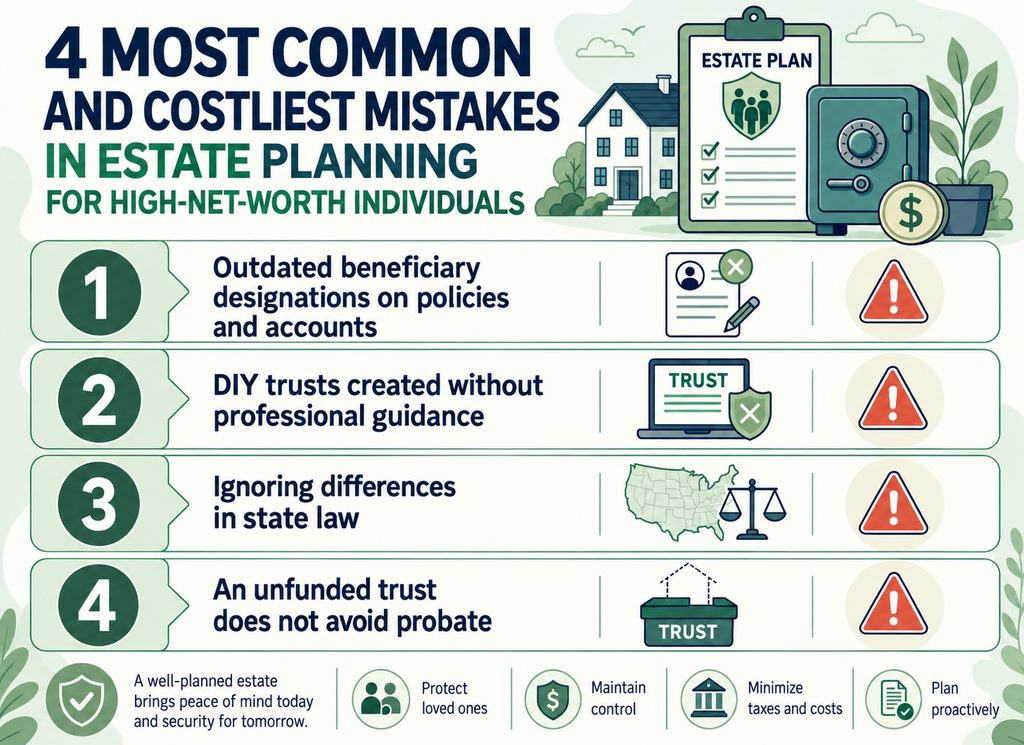
The costliest errors in high net worth estate planning are outdated beneficiary designations, do-it-yourself irrevocable trusts, ignoring state-law differences, and failing to fund a trust. Each quietly defeats the plan you paid for. This is where general information ends and individualized legal advice begins.
Beneficiary designations that override your will
Beneficiary designations on life insurance policies, retirement accounts, and certain bank accounts pass assets directly to the named person, bypassing probate and overriding whatever your will says. An ex-spouse named decades ago still collects. Review and update these forms after every divorce, death, or birth.
Unfunded trusts and stale documents
A trust only works if you retitle assets into it. An unfunded trust, one that was drafted but never actually funded, fails to avoid probate entirely. Stale documents with old trustees or repealed tax assumptions quietly undermine the whole structure.
Why state law can change the whole outcome
State law can flip the result. Estate tax, probate procedure, and even trust validity differ by jurisdiction, so a rule that holds in one state may not apply in yours. For example, Texas levies no state estate tax, though the federal estate tax can still apply. Treat the principles here as general U.S. information, not advice.
When the facts, the tax sunset, or your state’s rules could materially change the outcome, consult a qualified estate planning attorney before you act.
Questions High Net Worth Clients Ask Most
What is considered high-net-worth for a financial advisor?
There is no single official definition. Most financial institutions treat a high-net-worth individual (HNWI) as someone holding at least $1 million in liquid financial assets, often excluding the value of a primary residence. A separate tier, the ultra-high-net-worth family, holds more than $30 million in investable assets. These thresholds drive which strategies an advisor recommends.
How many Americans have a net worth of $1,000,000 or more?
The exact count shifts year to year with markets and reporting methods, so a precise figure here would mislead. What matters for planning is the threshold, not the headcount: once liquid assets approach the $1 million mark, estate and transfer-tax exposure becomes a real concern, and the HNWI toolkit, trusts, strategic gifting, and life insurance, starts to apply.
Is a $3 million net worth considered wealthy?
Yes, by most advisor benchmarks a $3 million net worth sits comfortably in high-net-worth territory, well above the common $1 million liquid-asset line. It is far below the federal estate-tax exemption, though. State law changes the picture: Texas levies no state estate tax, yet the federal estate tax can still apply.
How many families have a net worth over $10 million?
Reliable, current counts vary by source and year, so I will not cite a hard number. Households near or above $10 million typically face active transfer-tax planning, since this range can approach or exceed federal exemption limits depending on marital status and prior gifting.
Do I still need a will if I have a living trust?
Yes. A living trust only controls assets actually retitled into it. A pour-over will catches anything left outside the trust and names guardians for minor children. Because trust validity and probate rules vary by state, confirm your documents with a qualified estate planning attorney.
Sources
- thlg.law/blog/guide-to-high-net-worth-estate-planning – THLG Law – Guide to High Net Worth Estate Planning
- trustandwill.com/learn/estate-planning-for-high-networth-individuals – Trust & Will – Estate Planning for High Net Worth Individuals
- mercer.com/pcs/insights/may-2023/high-stakes-high-net-worth-estate-planning – Mercer – High Stakes High Net Worth Estate Planning