
Estate planning for young adults aged 20–35 primarily focuses on decisions to be made in the event of incapacity, rather than asset distribution. Turning 18 means your parents no longer have automatic access to your medical records or bank accounts, nor do they automatically have the right to make decisions on your behalf.
In this guide, you will find the key documents, ways to protect your digital life, and seven practical steps to get started. This is general legal information relating to the United States, not advice tailored to your individual circumstances.
In Brief
- Once you turn 18, your parents lose automatic access to your medical records and bank accounts, as well as the automatic right to make decisions on your behalf.
- For people aged 20–35, planning for incapacity is more important than asset distribution.
- The four essential documents are a healthcare proxy, a durable financial power of attorney, a simple will, and up-to-date beneficiary designations.
- Beneficiary designations for retirement accounts, insurance policies, and investments take precedence over a will and allow assets to bypass probate.
- In the United States, an estate worth more than approximately $50,000 may often need to go through probate, but the threshold varies by state.
- In states such as Missouri and Arkansas, an unmarried partner may inherit nothing if there is no will.
- Experts recommend reviewing your estate plan every three to five years and after major life events, such as marriage, moving to another state, or the birth of a child.
Why Turning 18 Changes Everything for Your Legal Rights
Estate planning for young adults rarely starts with dividing wealth. It starts with a quiet legal shift at age 18, when your child becomes a legal adult in the United States and parents lose the automatic right to access medical records, bank accounts, or to make decisions on their behalf.
This matters most for students living away from home. The moment a teenager turns 18, the parent who once signed every form becomes, legally, a stranger to doctors and banks.
The HIPAA and privacy gap parents don’t expect
In an emergency, a hospital cannot simply brief a parent on a conscious or unconscious adult child’s condition. Federal privacy rules block that disclosure unless the young adult has authorized it in advance.
A properly drafted Advance Directive includes a HIPAA authorization, which lets a medical facility release health information to the agent the young adult has named. Without it, stepping in during a crisis can be legally impossible, even for a devoted parent. This is general U.S. legal information, not individualized advice, and the exact forms vary by state.
Why accidents, not wealth, drive the need
Young adults are at least as exposed to serious accidents as older people, and often more, given riskier activities. That reality points toward incapacity planning rather than inheritance as the real reason to act early.
The question is less “who gets my assets” and more “who speaks and signs for me if I cannot.” For a 20-something, that single shift reframes the entire conversation.
What Estate Planning Actually Means (and What It Doesn’t)
Estate planning is the process of creating legal documents that determine two things: who can speak and act on your behalf if you become incapacitated, and what happens to your assets after you die. It is not reserved for older adults or the wealthy, and it is not simply a will sitting in a drawer. Broadly speaking, it involves creating legal documents that protect your assets and ensure your wishes are respected. Its scope extends beyond distributing your estate after death to include planning for incapacity.
Most people picture estate planning as dividing an inheritance. That is only half of it.
Incapacity planning vs asset distribution
The other half, incapacity planning, can be done entirely on its own, which is exactly why so many young adults stall. They assume they have too little to distribute, so they do nothing, thereby skipping the part that matters most in their twenties. This is a common misconception: incapacity planning can be handled separately from estate distribution, and confusing the two prevents young adults from taking action.
Incapacity planning answers a living question: who manages your money and your medical care if an accident leaves you unable to? Asset distribution answers a question that, for most 25-year-olds, is still distant.
General U.S. principles vs state-specific rules
Here is the critical caveat. The principles described here are based on US law, and the specific rules vary significantly from state to state. What is considered valid in one state may not be valid in another. This guide focuses on the United States and provides general legal information, not legal advice. US state laws should not be applied to Polish law.
Treat this as legal information, not legal advice. When your situation or your state’s law could change the outcome, consult a qualified attorney before you sign anything.
The Core Documents Every Young Adult Should Consider
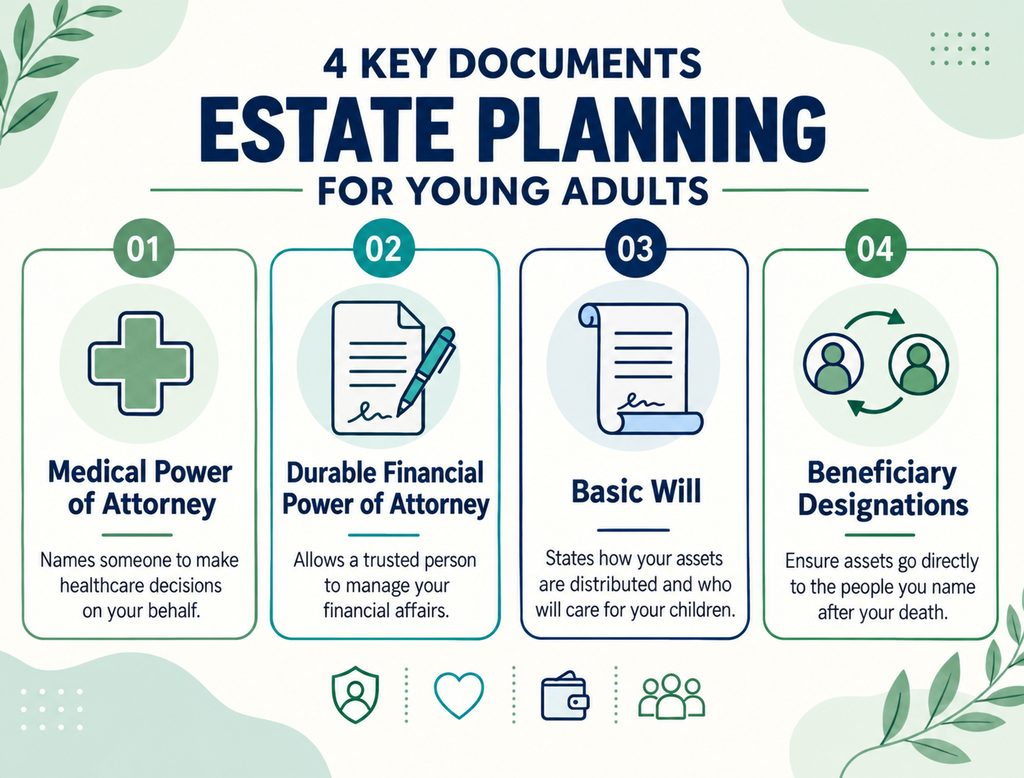
Four documents cover most young adults: a healthcare proxy, a durable financial power of attorney, a basic will, and updated beneficiary designations. Each solves a different problem. Estate planning for someone in their twenties usually leans on the first two, because they decide who speaks and signs for you if you cannot. These are general U.S. principles, and specifics vary by state, so treat this as legal information rather than advice.
Healthcare proxy and living will
A healthcare proxy names the person who makes medical decisions for you when you cannot. A properly drafted advance directive also includes a HIPAA authorization, which lets a hospital release your health information to your chosen agent. Without it, even a parent may be blocked in an emergency.
Durable financial power of attorney
A financial power of attorney gives your agent, known as the attorney-in-fact, authority over bank accounts, investments, real estate, retirement accounts, and insurance policies, as well as the ability to pay bills and handle taxes. A durable power of attorney remains valid after you lose the capacity to make decisions.
A springing power of attorney becomes effective only after a specified event occurs, such as a medical diagnosis. You can also appoint a successor agent as a backup.
Basic will and why intestacy may not match your wishes
A will directs who receives your assets. Without one, state intestacy laws decide, and the result may not match what you intended. Rules differ sharply by state, so a partner you are not married to could inherit nothing under some statutes.
Beneficiary designations that bypass probate
Here is the detail many people miss. Beneficiary designations on retirement accounts, life insurance policies, and investments allow these assets to pass outside probate. If an ex-partner is still listed as a beneficiary, that person may inherit the assets regardless of what your will says.
Review these designations periodically, especially after major life changes.
Protecting Your Digital Life and Online Accounts
A digital estate plan catalogs everything you hold online: social media profiles, cloud storage, cryptocurrency wallets, and subscriptions, together with instructions on who may access or close each one. Without it, loved ones can be locked out permanently. For a generation that lives online, this gap is easy to overlook and costly to leave open.
Estate planning increasingly treats digital assets as real property. Start with an inventory: list each account, its purpose, and where recovery information lives, but never write passwords in your will, which becomes a public document in probate.
Cataloging accounts and crypto access
Cryptocurrency deserves special care. If no one knows your wallet exists or holds the private keys, the funds are effectively gone. Record where access lives, not the keys themselves, and store that pointer securely.
Using a password manager safely
A password manager is the practical backbone of a digital plan. Many offer an emergency or legacy access feature that releases your vault to a trusted contact after a waiting period. Designate that contact now.
Major platforms also provide their own tools: legacy contacts and account memorialization that govern what happens to a profile. One caveat: U.S. access laws vary by state, and these rules differ sharply from Polish law, so treat this as legal information, not advice, and confirm the specifics for your jurisdiction.
Life Without a Plan vs With One: What Changes
The practical difference shows up in three places: who makes medical decisions, who can reach your accounts, and how your savings are distributed. Estate planning moves each of these from a court or a statute to a person you chose.
Without a plan, the gaps appear fast. If you cannot speak for yourself, a physician or a court decides your medical care. Your bank accounts may be frozen until someone gets legal authority. And if you die without a will, your state’s intestacy laws decide who inherits, which can clash with your actual wishes and create stress and delays for the people you leave behind.
| Situation | Without a plan | With a plan |
|---|---|---|
| Medical decisions | A physician or court decides | Your named healthcare agent decides |
| Account access | Accounts can be frozen; family needs court authority | Your agent acts under a durable power of attorney |
| Distribution | State intestacy statute controls | Your will directs who receives what |
The asset side also carries a trigger. In the United States, an estate above roughly $50,000 often must pass through probate, a public court process that adds time and cost. That threshold is a US example, and it varies by state. Polish succession law works differently, so treat this as general legal information, not advice for your jurisdiction.
How to Start Estate Planning in Seven Practical Steps
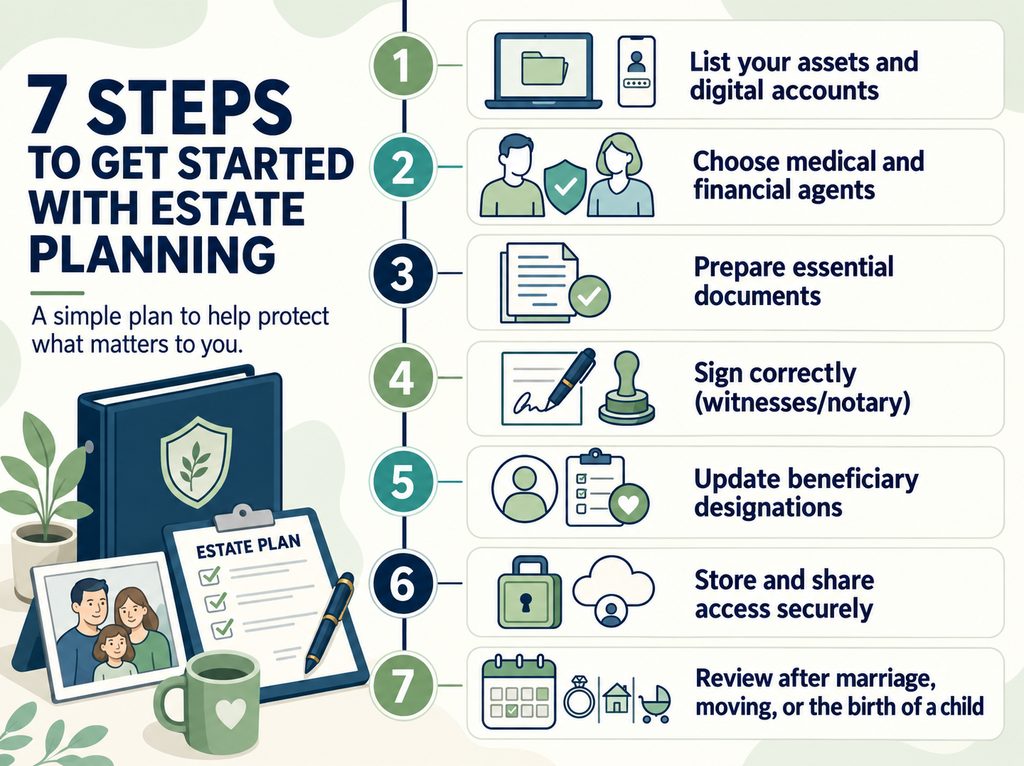
Starting is simpler than most people in their 20s expect. Follow a clear sequence: inventory what you own, choose your agents, draft the core documents, execute them correctly, and update everything after major life events. Estate planning becomes manageable once you break it into steps.
Step 1: Inventory assets and digital accounts
List everything first. Bank and investment accounts, retirement savings, real estate, insurance policies, and your digital life: social profiles, cloud storage, and crypto wallets. A clear catalog tells you which tools you actually need.
Step 2: Choose your healthcare and financial agents
Decide who speaks and signs for you if you cannot. You name one person as your healthcare proxy and another (or the same) as your financial agent, or Attorney-In-Fact. Name a successor agent as backup.
Step 3: Draft or obtain the core documents
Prepare a healthcare proxy, a durable financial power of attorney, a basic will, and updated beneficiary forms. DIY templates cost little but miss state-specific detail. An attorney costs more and catches the gaps.
Step 4: Execute them correctly (notarization/witnesses)
This is where plans fail. Signing, witnessing, and notarization requirements vary by state in the US, and a document executed improperly may be void. During the pandemic, some states allowed remote execution: Maryland did so under Governor Hogan’s executive order of April 10, 2020. That is a US example, not Polish law.
Step 5: Update beneficiary designations
Beneficiary forms override your will. Check them on retirement accounts, insurance, and investments so an ex-partner is not still listed.
Step 6: Store and share access securely
Keep originals safe and tell your agents where to find them. Access means nothing if no one can reach it.
Step 7: Review after marriage, move, or new assets
Review your plan every three to five years, and sooner after marriage, a move, or a new child. When facts get complex, consult a qualified attorney.
Common Mistakes and Situations That Need a Lawyer
The biggest mistakes are not forgetting to plan at all, but planning badly. Estate planning breaks down when beneficiary forms go stale, when a template is forced onto a complicated life, and when people assume the law will fill the gaps the way they expect. It rarely does.
The most common error is the outdated beneficiary designation. A retirement account or life insurance policy pays whoever is named on the form, not whoever is named in your will, so an ex-partner left on an old form still inherits. A second frequent mistake is relying on a cheap template for a situation that is anything but simple.
Unmarried and same-sex couples
Unmarried partners are the clearest case where silence hurts. In US states such as Missouri and Arkansas, common law marriage is not recognized, so without a will a surviving partner may inherit nothing under intestacy. State intestacy statutes pass property to blood relatives and spouses, never to a partner you never married. A will or beneficiary designation is the only fix.
Divorce, remarriage, and stale beneficiaries
Divorce and remarriage demand a full review. A new marriage rarely rewrites old forms automatically. Update every designation, name a successor agent, and confirm who inherits.
Special-needs and international assets
Some facts should send you to a lawyer, not a form. Special-needs planning must protect benefits without any unlawful transfer of assets. International assets add foreign law and tax layers. When state law could change the outcome, consult a qualified attorney.
Quick Answers to the Questions Young Adults Ask Most
Short answers below cover what young adults ask most often about estate planning. These apply to general U.S. principles. State law varies, and Polish succession law works differently, so treat this as legal information, not advice.
Does a young adult really need a will?
Usually not right away. If you have few assets, your property typically passes to your parents under default rules anyway. A will matters most when you hold significant assets, or when you do not want everything going to your parents: say, to a partner or a sibling. After 18, you are legally an adult and may write one, and the share of young adults with a will has risen from 16%.
Without a will, state intestacy laws determine how your estate is distributed, which may conflict with your wishes.
How much does it cost to create a will or estate plan?
Cost depends on complexity and your state, and verified, current figures are hard to pin down. A simple incapacity package costs far less than a trust-based plan. Get a written fee quote before signing. Many lawyers charge flat fees for core documents.
What is the most accurate definition of estate planning?
It is the process of creating legal documents that control two things: who speaks and signs for you if you cannot, and what happens to your assets when you die. It is not only for the old or wealthy.
Where and how do I execute these documents correctly?
Sign according to your state’s rules, usually before witnesses and sometimes a notary. Some states allow remote or electronic signing.
Which document should I set up first in my 20s?
Start with incapacity tools: a healthcare proxy with HIPAA authorization and a durable financial power of attorney. They protect you while you are alive.
Sources
- sessadorsey.com/2020/07/16/estate-planning-documents-for-your-college-student – Sessa & Dorsey – Estate Planning Documents for Your College Student
- farrlawfirm.com/why-should-millennials-and-gen-zers-care-about-estate-planning – Farr Law Firm – Why Millennials and Gen Z Should Care About Estate Planning
- randisilaw.com/blog/2024/06/understanding-the-basics-of-estate-planning-for-young-adults – Randisi Law – Understanding the Basics of Estate Planning for Young Adults