
In the estate planning vs trust comparison, you are not choosing one over the other. Estate planning is a comprehensive strategy for managing your assets during life and distributing them after death, and a trust is just one of the tools that may be part of that strategy. So the real question is: does a trust fit your plan? This is general information about U.S. law, which varies by state, and it is not a substitute for individual advice.
Below you will find a concrete comparison and a cross-border section for people with assets in Poland.
In short
-
Estate planning is the entire strategy for managing assets during life and after death, and a trust is just one of its tools.
-
A complete U.S. plan combines a will, powers of attorney (POA), beneficiary designations, and guardianship nominations for minor children.
-
A trust lets you avoid probate and keep your affairs private, while a will is cheaper but becomes public after probate.
-
A trust does not work on its own without so-called funding: you have to actually retitle ownership, as the Schaddelee Jr. v. Deleon case shows.
-
Some assets are usually not placed in a trust: retirement accounts (IRA, 401(k)), HSAs, vehicles, and life insurance policies with a named beneficiary.
-
Polish law does not recognize trusts; the closest equivalents are the family foundation (since 2023) and the fiduciary agreement.
-
Poland imposes forced heirship (zachowek) and inheritance tax, which clashes with the broad testamentary freedom in most U.S. states.
Estate Planning vs Trust: The Core Difference in One Answer
Estate planning is the entire strategy for managing your assets during life and distributing them after death. A trust is just one legal tool inside that plan. You rarely choose between the two. Instead, you decide whether a trust belongs in your estate plan at all.
Think of it this way. The estate planner sets the overall strategy, while a trust attorney drafts the legal instrument that carries out part of it. A standalone trust, or an LLC, is never a complete plan by itself.
What estate planning actually covers
Estate planning is a process, not a single document. It coordinates several instruments that work together. A will directs who inherits what and names guardians for minor children. Durable powers of attorney authorize someone to handle finances and healthcare if you cannot.
Beneficiary designations on accounts pass assets outside the will. Guardianship nominations protect dependents.
Where a trust fits inside the plan
A trust is a legal arrangement in which the grantor (also called the settlor) transfers assets to a separate entity, managed by a trustee for the benefit of named beneficiaries. It is powerful, but it is still one component among many.
|
Aspect |
Estate planning |
Trust |
|---|---|---|
|
What it is |
Full strategy for life and death |
Single legal instrument |
|
Scope |
Will, POAs, beneficiary designations, guardianship |
Holds and manages specific assets |
|
Decision role |
Sets the overall plan |
Executes part of that plan |
|
Key players |
You and your attorney |
Grantor, trustee, beneficiaries |
Rules vary by state, so confirm specifics with a licensed attorney.
What Belongs in an Estate Plan Beyond a Trust
Estate planning rarely rests on a single document. A complete U.S. plan typically combines a will, financial and healthcare powers of attorney, beneficiary designations, and guardianship nominations for minor children. A trust handles only the assets you actually move into it, so these other tools cover everything else.
Last will and testament
Your will directs assets that have no beneficiary designation and names an executor to carry out your wishes. It also catches property you never titled into a trust. Without a will, state intestate succession laws decide who inherits, typically favoring spouses and children. Aretha Franklin left several conflicting handwritten documents, and the resulting family litigation shows what happens when papers are not properly drafted.
Powers of attorney (financial and healthcare)
A durable power of attorney stays effective if you become incapacitated. A springing power of attorney, by contrast, takes effect only once a defined triggering event, usually incapacity, actually occurs. A healthcare power of attorney authorizes someone to make medical decisions for you. Both documents fill gaps a trust cannot address during your lifetime.
Beneficiary designations and transfer-on-death accounts
Retirement accounts, life insurance, and payable-on-death (POD) or transfer-on-death (TOD) accounts pass directly to the named beneficiary. These assets bypass probate entirely and override what your will says, so keeping designations current is essential.
Guardianship for minor children
If you have minor children, your will is where you nominate a guardian. Courts give that nomination significant weight.
Specific rules for TOD/POD accounts and powers of attorney vary by state, so confirm the details with a licensed attorney.
How a Trust Works and the Main Types
A trust is a legal arrangement in which a grantor (also called a settlor) transfers assets to a trustee, who holds and manages them for named beneficiaries. Within estate planning (planowanie majątkowe), a trust is one tool among several, and it comes in a handful of core varieties that behave very differently.
Who is the trustee and who are the beneficiaries
Every trust turns on three roles. The grantor creates the trust and funds it with assets. The trustee manages those assets under a legal fiduciary duty: a strict obligation to act in the beneficiaries’ best interest. The beneficiary receives the benefits.
A fourth role matters too: the successor trustee, who steps in when the original trustee dies or becomes incapacitated.
Revocable living trust
A revocable living trust can be changed, amended, or revoked at any time while you are alive. The trade-off is simple. Because you keep control, the assets usually remain part of your taxable estate. It becomes irrevocable automatically at your death, when the terms lock in.
Irrevocable trust
An irrevocable trust cannot be easily altered once created. You give up control, and in exchange you may gain tax advantages and protection from creditors. These features also make irrevocable trusts relevant to Medicaid and long-term-care planning, though the rules are technical and vary by state.
Testamentary trust
A testamentary trust is created by your will and only springs into existence after you die. Its assets still pass through probate first. Families often use it to hold and manage property for minor children.
|
Trust type |
Changeable? |
Avoids probate? |
Key use |
|---|---|---|---|
|
Revocable living |
Yes, anytime |
Yes, if funded |
Control plus incapacity planning |
|
Irrevocable |
No, not easily |
Yes |
Tax and creditor protection |
|
Testamentary |
Via will edits |
No |
Minor children’s inheritance |
The best structure depends on your goals, and state law can change the outcome, so confirm the specifics with a licensed attorney.
Will vs Trust: Probate, Privacy, and Cost Compared
The practical question most people face is whether a will alone suffices or whether adding a trust earns its cost. The short answer: a trust avoids probate and keeps distribution private, while a will is simpler and cheaper but becomes public and moves through court.
How probate works and why trusts avoid it
Probate is a court-supervised process that validates a will: it confirms the document’s authenticity, inventories and appraises assets, pays debts and taxes, then distributes what remains. It can take months or years, and court and attorney fees are paid from the estate itself. Timelines and procedures vary significantly by state.
A trust sidesteps this. Assets properly transferred into a trust do not form part of the probate estate, which is the central reason a trust can bypass court administration entirely. Within estate planning (planowanie majątkowe), that single feature often drives the decision to add a revocable living trust.
Privacy differences
Once a will clears probate, it generally becomes a public record anyone can read. A trust stays private. Bing Crosby reportedly added a living trust after his first wife’s will became public, a cautionary example of how exposed a probated estate can be.
Cost and complexity of setup
A will is typically cheaper and quicker to draft. A trust carries a higher upfront cost and requires funding to work. Still, the trust cost is often lower, sometimes substantially, than typical probate expenses, and it also spares heirs the time and emotional burden of administration.
Avoid fixed dollar figures: costs and probate procedures differ by state and complexity. Confirm specifics with a licensed attorney.
When a Trust Is Worth It and When a Will Is Enough
Within estate planning (planowanie majątkowe), a trust earns its cost when you own real estate, have minor or special-needs beneficiaries, want to control the timing of inheritances, or hold property in more than one state. A straightforward estate with modest assets and clear beneficiaries is often served well by a will plus up-to-date beneficiary designations.
Situations that favor a trust
Owning real estate, even a modest home, frequently justifies a trust, because property held in trust avoids probate. The benefit grows if you own property in multiple states. A living trust can eliminate several separate probate proceedings that out-of-state real estate would otherwise trigger.
A revocable living trust also plans for incapacity: a successor trustee can step in to manage your affairs without a court-ordered conservatorship.
Trusts also help families with layered needs. Blended families, second marriages, unmarried couples, and children from prior relationships often require precise distribution terms that a simple will cannot easily deliver. A trust can set conditions, stagger payments, and build in contingency plans, which matters for minor children and special-needs planning.
Reasons a will may be enough
If your estate is small, your beneficiaries are clear, and most assets already pass by designation, a will may cover you adequately. Trusts are not only for the wealthy, but they are not free, and funding one takes ongoing effort.
Assets that usually stay out of a trust
Some assets generally should not be retitled into a trust: retirement accounts such as IRAs and 401(k)s, HSAs, vehicles, certain bank accounts, and life insurance payable to a named beneficiary. Retitling a retirement account can trigger unwanted tax consequences, so coordinate beneficiary designations instead. Rules vary by state, so confirm the details with a licensed attorney.
The Mistake That Makes a Trust Worthless: Funding
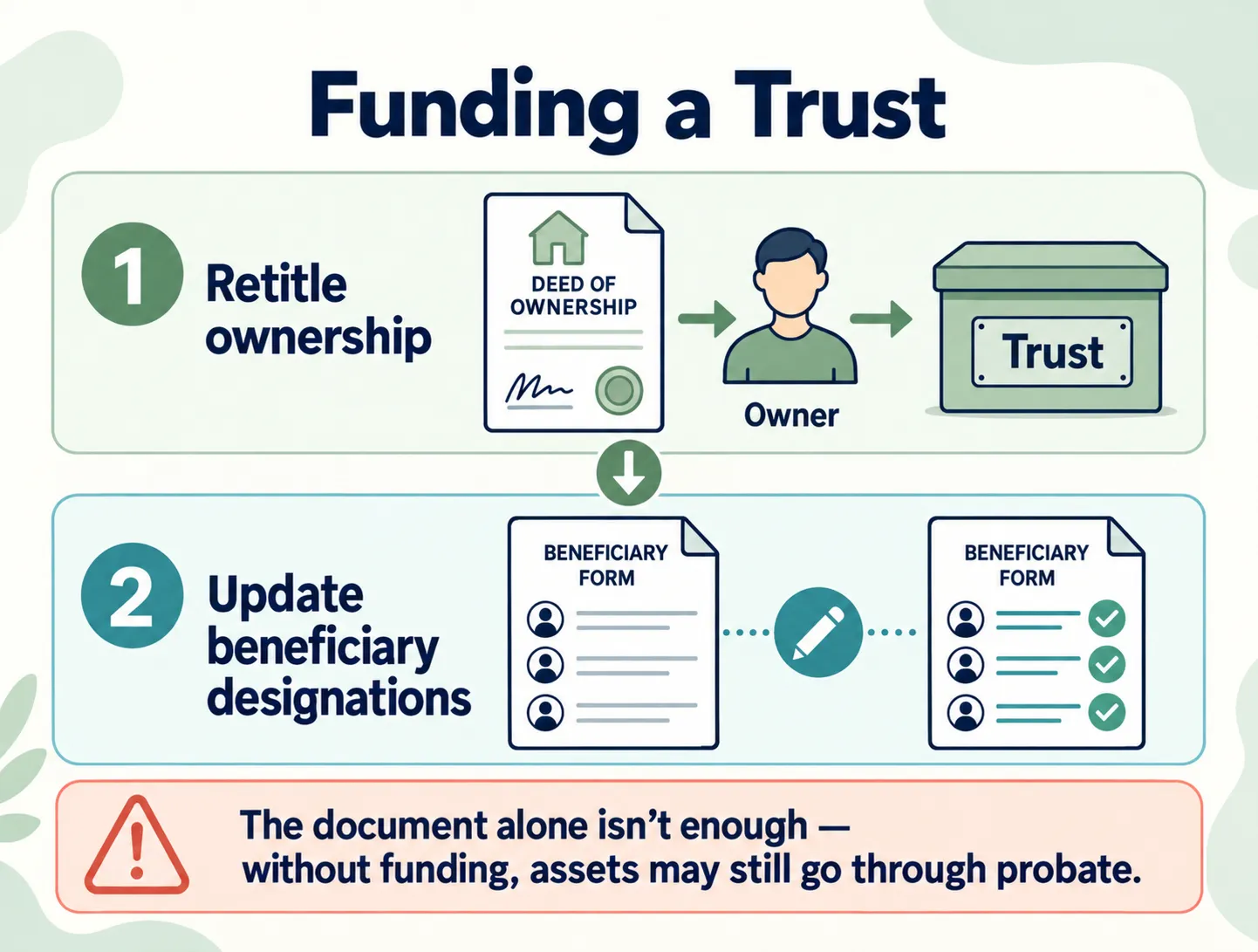
Creating a trust is only half the work. Within estate planning (planowanie majątkowe), a trust controls only the assets you actually transfer into it during your lifetime or through a pour-over clause. Sign the document, file it away, and forget it, and your estate may still land in probate despite the trust existing.
What funding a trust means
Funding is the act of retitling your assets so the trust, not you personally, owns them. That means changing the name on deeds, bank and brokerage accounts, and business interests to the name of your trust. Intent alone does not do the job.
A Michigan case drives this home. In Schaddelee, Jr. v. Deleon, the Court of Appeals held that a Declaration of Trust Ownership does not actually transfer assets: it merely shows intent. An account with its own beneficiary designation never entered the trust, because the designation took priority.
How to confirm your trust is actually funded
Proper funding usually takes two coordinated steps. First, retitle ownership so the trust holds legal title to each asset you intend it to control. Second, review your beneficiary designations and update them so they name the trust where that aligns with your plan.
Walk through every account and deed one by one. Confirm the title now reads in the trust’s name, and check that no stray beneficiary designation quietly overrides it. Retitling rules and tax effects vary by state, so confirm the details with a licensed attorney.
International and Cross-Border Assets: Polish Family Foundation vs U.S. Trust
Trusts do not exist under Polish law. A Pole with assets on both sides of the Atlantic cannot simply create a trust in Poland. Within estate planning (planowanie majątkowe), the closest functional substitutes are the fundacja rodzinna (Polish family foundation) and the fiduciary agreement (umowa powiernicza).
Why Polish law has no direct trust equivalent
Poland follows a civil-law tradition built on the Civil Code, which does not recognize the common-law split between legal and equitable ownership. That split is what makes a trust work. Because Polish courts cannot enforce a U.S.-style trust against Polish assets, holding Polish property directly inside an American trust often creates confusion at death.
Fundacja rodzinna as a functional substitute
The fundacja rodzinna, available in Poland since 2023, lets a founder transfer assets to a separate legal entity that manages them for named beneficiaries. The structure echoes a trust: asset separation, managed succession, defined beneficiaries. It is not identical, and its tax treatment differs sharply from a U.S. trust.
Coordinating U.S. and Polish succession rules
Two features clash most with American practice. Polish law imposes forced heirship (zachowek), guaranteeing close relatives a minimum share regardless of your will. U.S. law, by contrast, grants broad testamentary freedom in most states. Poland also levies an inheritance tax, scaled by relationship to the deceased.
Cross-border plans therefore demand coordinated counsel. Retain a qualified attorney in each jurisdiction, because a document valid in one country may be unenforceable or trigger unexpected tax in the other. Confirm the specifics with licensed advisors before transferring any asset.
Quick Answers to the Questions Clients Ask Most
What is the difference between a trust and estate planning?
Estate planning (planowanie majątkowe) is the full strategy for managing your assets during life and distributing them after death. A trust is just one legal tool inside that plan, an arrangement where a grantor transfers assets to a trustee for named beneficiaries. The estate planner sets the strategy; a trust attorney handles the legal mechanics.
What are reasons not to have a trust?
For some people, a trust adds cost and complexity without proportionate benefit. A small estate, few assets, or straightforward wishes may be handled well by a will plus beneficiary designations. Trusts also require funding: retitling assets into the trust, which many people neglect. If your situation is simple, the extra paperwork may not be worth it.
What are five things that should not be placed in a trust?
Several assets generally stay outside a trust: retirement accounts (IRA, 401(k)), health savings accounts, vehicles, certain everyday bank accounts, and life insurance with a named beneficiary. Retitling a retirement account into a trust can trigger unwanted tax consequences. For these, coordinate beneficiary designations instead of transferring ownership.
What type of trust is best for estate planning?
There is no universal answer. The best type depends on your goals: a revocable living trust offers flexibility and incapacity planning, while an irrevocable trust trades control for tax and creditor protection. Costs vary by state and complexity. Consult a licensed attorney before choosing.
Can I create a U.S.-style trust if I live in Poland?
Polish law does not recognize common-law trusts. The closest substitutes are the family foundation and fiduciary arrangements, which operate differently. Polish forced heirship (zachowek) and inheritance tax contrast sharply with U.S. testamentary freedom. Cross-border planning needs licensed advisors in both jurisdictions.
Sources / Bibliography
-
clfusa.com/estate-planning/trust-attorney-vs-estate-planner-whats-the-difference – CLF USA – Trust Attorney vs Estate Planner
-
seddiqlawfirm.com/blog/estate-planning-vs-succession-planning-vs-asset-protection-why-your-trust-or-llc-is-not-a-complete-plan-virginia-guide – Seddiq Law Firm – Why Your Trust or LLC Is Not a Complete Plan
-
shanezismanlaw.com/do-i-need-a-trust-iowa-estate-planning-attorney – Shane Zisman Law – Do I Need a Trust